

Realistic testosterone booster timelines for week 1, week 4, and week 8, plus when to reassess, get labs, or stop.
- Do not expect a testosterone booster to feel like testosterone therapy, a stimulant, or an overnight libido switch.
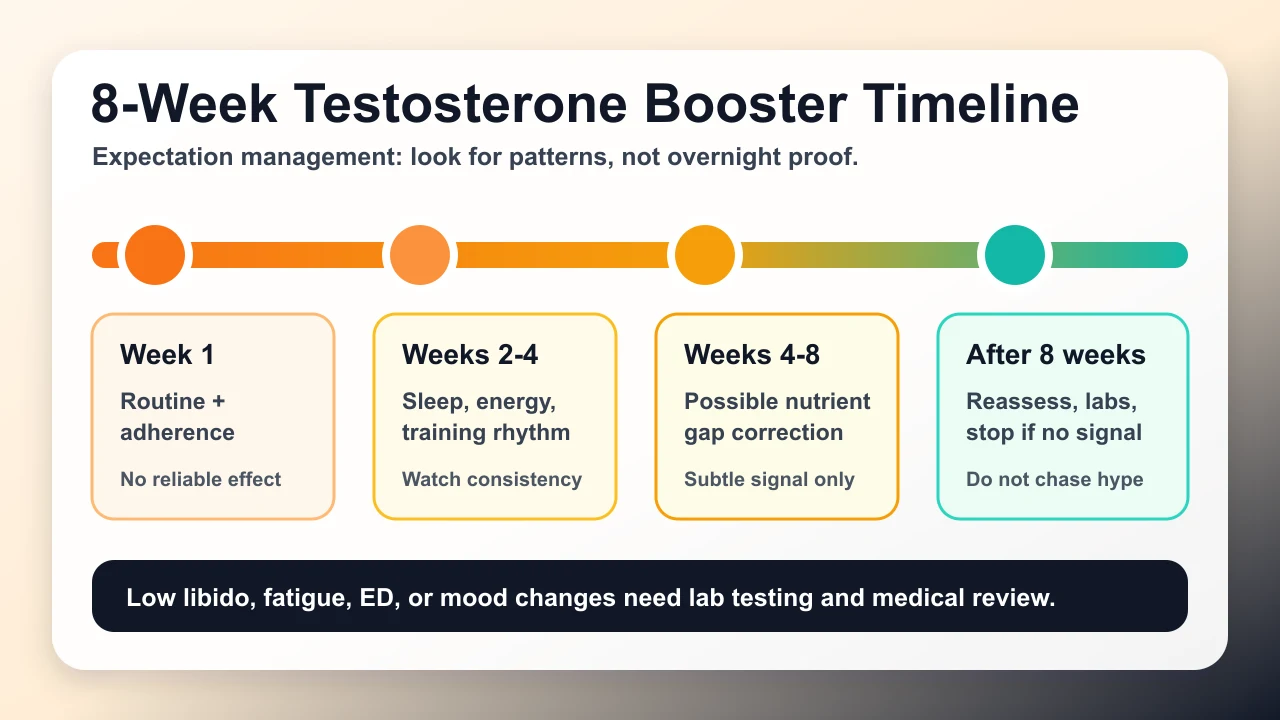
- Week 1 is for checking side effects, routine fit, and whether you can take it consistently.
- Weeks 2 to 4 may show indirect support: sleep quality, training consistency, or energy stability.
Bottom line So, how long do testosterone boosters take to work?

Testosterone boosters usually take 4 to 8 weeks before you can judge whether they are helping at all. The first week is mostly about adherence and tolerance, not results. Weeks 2 to 4 may reveal better sleep, steadier energy, or more consistent training if the formula is correcting a real nutrition or recovery gap. Weeks 4 to 8 are the earliest realistic window for a subtle signal. If nothing measurable or repeatable has changed after 8 weeks, stop expecting the bottle to suddenly transform your testosterone, libido, strength, or mood.
Quick Summary: How long do testosterone boosters take to work?
- Do not expect a testosterone booster to feel like testosterone therapy, a stimulant, or an overnight libido switch.
- Week 1 is for checking side effects, routine fit, and whether you can take it consistently.
- Weeks 2 to 4 may show indirect support: sleep quality, training consistency, or energy stability.
- Weeks 4 to 8 are the fair trial window for nutrient-gap formulas, especially vitamin D, zinc, magnesium, or ashwagandha-based blends.
- If symptoms are persistent, severe, or paired with erectile dysfunction, low mood, or fatigue, get lab testing instead of extending the supplement run.
The Prime Perspective
The honest answer is not “testosterone boosters work in X days.” It is: they can only support the conditions your body uses to make hormones. That means sleep, energy balance, micronutrient status, stress load, alcohol intake, body fat, training recovery, and medical status matter more than the marketing copy on the bottle.
If you are new to this category, start with our broader guide to testosterone boosters before you treat a timeline as proof. A supplement can be useful when it fills a real gap. It is a poor substitute for bloodwork, medical care, or fixing the habits suppressing your baseline.
Best signal: consistency
Red flag: symptom chasing
What Should You Feel After 1 Week?
In week 1, most men should expect almost nothing dramatic. You are testing whether the product sits well with digestion, sleep, training, caffeine use, and your daily schedule. A week is too short to conclude that testosterone rose in a meaningful way.
What you can judge is friction. If the formula makes you wired at night, nauseated, irritable, or inconsistent with meals, that matters. The FDA’s dietary supplement guidance is blunt about a key point many ads skip: supplements can have risks, interactions, and strong biological effects, and they are not pre-approved by FDA for safety and effectiveness before sale.
Weeks 2 to 4: Look for Indirect Support, Not a Hormone Surge
If a testosterone support supplement is going to help early, the signal often shows up indirectly. You may sleep a little better, hit workouts with fewer low-energy days, feel less run down, or recover more predictably. Those changes do not prove testosterone increased. They only suggest the supplement may be supporting the inputs that affect performance.
This is where context matters. A man with poor sleep and low magnesium intake may notice something different from a man who already sleeps well, eats enough protein, lifts consistently, and has normal labs. Before extending a supplement run, compare your plan with whether you should take a testosterone booster at all.
| Timeline | What is realistic | What is not realistic | What to track |
|---|---|---|---|
| Days 1-7 | Routine fit, tolerance, digestion, sleep impact. | Big testosterone increase, major strength jump, instant libido change. | Side effects, bedtime, workout consistency. |
| Weeks 2-4 | Energy stability, sleep quality, training rhythm. | Proof that testosterone is higher without labs. | Morning energy, session quality, sleep score, mood notes. |
| Weeks 4-8 | Possible support if a nutrient, stress, or recovery gap was present. | A guaranteed libido or muscle-building effect. | Strength trend, waist/body weight, libido pattern, repeatable symptoms. |
| After 8 weeks | Reassess. Continue only if there is a clear, useful signal and no side effects. | Waiting indefinitely for a formula that has done nothing. | Bloodwork, symptom pattern, cost, adverse effects. |
Useful Supplement Categories to Compare
Why these categories here? They match the most common bottlenecks behind a realistic 4- to 8-week trial: broad testosterone-support blends, basic micronutrient gaps, and sleep quality.
- Choose third-party-tested products when possible.
- Skip formulas with hidden stimulant stacks or hormone-like claims.
- Track one change at a time so you know what actually helped.
- Stop if side effects show up or symptoms worsen.
Amazon Product Shortlist
These are practical product starting points, not medical or performance guarantees. Use the images, sizing, labels, reviews, and return policy to compare the real item before buying.

Testosterone Support Supplement Men
A practical buying option for the testosterone support supplement men use case in this article.
- Matches the article's specific testosterone support supplement men recommendation.
- Gives readers a concrete product page and image to compare.
- Worth checking for size, dose, fit, reviews, and return policy before buying.

Vitamin D Zinc Magnesium Men
A focused support option when sleep routine and recovery habits are the real bottleneck.
- Fits best after caffeine timing, light, and routine are addressed.
- Useful for comparing dose and form before buying.
- Should not replace medical care for ongoing sleep problems.

Sleep Support Supplement Men
A focused support option when sleep routine and recovery habits are the real bottleneck.
- Fits best after caffeine timing, light, and routine are addressed.
- Useful for comparing dose and form before buying.
- Should not replace medical care for ongoing sleep problems.
*Affiliate disclosure: PrimeForMen may earn from qualifying purchases. Product images are loaded from Amazon media URLs and product availability can change.
*Affiliate note: PrimeForMen may earn a commission from qualifying purchases. Product fit and safety matter more than buying anything today.
Weeks 4 to 8: The Fair Trial Window
For most men, 4 to 8 weeks is the most reasonable evaluation window. This is long enough for a routine to stabilize and long enough for sleep, micronutrient intake, training consistency, or stress management to show a pattern. It is still not a guarantee.
If you are following a structured testosterone booster cycle, treat 8 weeks as a decision point, not a loyalty test. Either there is a signal worth keeping, or there is not. Stretching a weak product into month three often just hides the fact that the original problem was sleep debt, under-eating, overtraining, medication, alcohol, body-fat gain, or a medical issue.
Animated Signal Meter: No Signal to Possible Support
This is the right mental model: a testosterone booster does not move from “nothing” to “proven hormone fix.” It moves, at best, from no signal to possible support when the rest of your lifestyle and health picture makes sense.
Routine stable
Possible support
Warning: low libido, erectile dysfunction, fatigue, depressed mood, or fertility concerns need lab testing and medical review. A supplement timeline is not a diagnosis.
The Knowledge Gap Most Timelines Miss
Supplements Do Not Create a Clean Before-and-After Test
Many articles make the timeline sound cleaner than it is. In real life, men often start a booster while also training harder, dieting, sleeping more, drinking less, or changing caffeine. That makes the bottle look more powerful than it may be.
The stronger approach is to track a few simple signals while holding the basics steady. If you change five things at once, you are not testing a testosterone booster. You are testing a new lifestyle stack.
Better sleep, steadier training, no side effects, and a clear reason the formula fits your gaps.
Small subjective improvement, but inconsistent tracking or too many other changes at once.
No change after 8 weeks, side effects, aggressive claims, or symptoms that should be medically checked.
When to Stop Expecting Results
Stop expecting results when you have used the product consistently for 8 weeks and cannot name a repeatable benefit. Also stop earlier if sleep worsens, blood pressure changes, anxiety rises, digestion becomes a problem, or the formula conflicts with medication or a medical condition.
Safety is not optional in this category. Review our guide to testosterone booster safety for men before you stack multiple products. More ingredients do not automatically mean more effect, and higher doses can raise the risk of side effects.
The Endocrine Society’s testosterone therapy resources emphasize that testosterone deficiency is a medical question, not a supplement-marketing question. Men with symptoms and concern about low testosterone should discuss proper evaluation, including blood testing, with a qualified clinician through resources such as the Endocrine Society testosterone guideline.
What to Do This Week
- Pick one timeline: run a 4- to 8-week trial, not an open-ended supplement habit.
- Track three signals: sleep quality, training consistency, and libido/energy pattern.
- Control the basics: keep protein, calories, alcohol, caffeine, and bedtime reasonably stable.
- Check ingredients: compare your label against common ingredients that boost testosterone claims and evidence quality.
- Use labs when symptoms matter: do not guess if low-testosterone symptoms are persistent or disruptive.
Conclusion
So, how long do testosterone boosters take to work? Give a serious product 4 to 8 weeks, but judge it like an adult: no guaranteed hormone surge, no overnight transformation, and no endless waiting for a weak signal. Week 1 checks tolerance. Weeks 2 to 4 may show better routine and recovery. Weeks 4 to 8 are the fair trial. After that, reassess, get labs if symptoms matter, and stop paying for hope if nothing has changed.
Next Step: Build a Smarter Testosterone Plan
If this timeline made you realize the bigger question is whether the category fits you at all, the logical next read is our main testosterone booster guide. It puts ingredients, safety, expectations, and use cases in one place.
Medical Disclaimer: This article is for editorial education only and does not diagnose, treat, or replace medical advice. Hormone symptoms, erectile dysfunction, fertility concerns, persistent fatigue, depression, or medication interactions should be discussed with a qualified healthcare professional.
Affiliate Disclosure: This article includes Amazon affiliate links. PrimeForMen may earn a commission from qualifying purchases at no extra cost to you. Recommendations are based on category fit, realistic expectations, and safety considerations.
Frequently Asked Questions About Testosterone Booster Timelines
Can a testosterone booster work in one week?
One week is usually too short to judge testosterone support. You may notice tolerance, digestion, sleep changes, or stimulant-like effects, but that is not proof of a meaningful testosterone increase.
Is 4 weeks enough time to judge results?
Four weeks can reveal early routine, sleep, or energy patterns. For a fairer decision, most men should track through 8 weeks unless side effects or medical concerns appear earlier.
What is the first sign a testosterone booster is helping?
The first useful sign is usually indirect: better sleep, steadier workouts, improved recovery, or fewer low-energy days. Libido and strength changes are less reliable without context and lab testing.
Should I cycle off after 8 weeks?
If there is no clear benefit after 8 weeks, stopping is reasonable. If there is a benefit, review the label, safety profile, and your health status before continuing or repeating a cycle.
Do testosterone boosters raise testosterone on blood tests?
Some ingredients may support testosterone-related inputs in specific situations, such as deficiencies or high stress, but results are not guaranteed. Blood tests before and after a trial are the only way to know your own numbers.