
Mobility & Warm-Up Builder for Men Over 50
Build a five-, eight-, or twelve-minute sequence around the session ahead, your main movement focus, and how ready you feel today. The result prepares movement; it does not diagnose pain or fix an injury.
Create Your Warm-Up Routine
Your ordered sequence, timing, and purpose for each movement will appear here.
How the time is divided
Each routine keeps a general warm-up, comfortable movement and session-specific rehearsal. The listed times total your selected 5, 8 or 12 minutes and include brief transitions. Use fewer repetitions if needed. For heavy lifting or vigorous exercise, add progressively harder practice sets; five minutes may be insufficient.
These sequences are editorial examples, not programmes validated specifically for men over 50. The NSCA explanation of dynamic warm-ups supports combining general and activity-specific preparation. Stop any movement that causes pain.
As an Amazon Associate, PrimeForMen earns from qualifying purchases. These links may earn a commission at no extra cost to you.
Optional mobility equipment
The warm-up works without buying equipment. These options cover floor comfort, separate flexibility work and optional gentle rolling.

Manduka PRO 6mm Yoga Mat
Best for: a stable floor surface during comfortable mobility and bodyweight exercises.
Current Amazon listing: Manduka PRO Yoga Mat - 6mm | Lifetime Durability | Hygienic Construction | Premium Studio Quality | Teacher Approved
- The verified listing is the 6 mm PRO mat.
- Check dimensions, surface grip and cleaning instructions.
- Skip if your existing mat works well. A mat does not make a painful exercise appropriate.

OPTP Stretch Out Strap
Best for: controlled flexibility work outside the timed dynamic warm-up.
Current Amazon listing: OPTP The Original Stretch Out Strap with Exercise Book, USA-Made Yoga Strap
- Loop handles offer several grip positions.
- Use the included instructions and gentle tension.
- Skip if you only need the equipment-free warm-up below. Do not pull a joint into pain.

TriggerPoint GRID Foam Roller
Best for: optional gentle rolling when comfortable pressure helps you prepare to move.
Current Amazon listing: TriggerPoint Grid 1.0 Foam Roller - 13" Multi-Density Massage Roller for Deep Tissue & Muscle Recovery - Relieves Tight, Sore Muscles & Kinks, Improves Mobility & Circulation - Targets Key Body Parts
- The verified listing is the compact 13-inch GRID version.
- Use light pressure on muscle, avoiding joints and painful areas.
- Skip if pressure aggravates symptoms. Rolling does not replace movement rehearsal or injury care.
* As an Amazon Associate, PrimeForMen earns from qualifying purchases.
Prepare the Pattern You Will Train
A warm-up should move from general to specific: easy pulse raising, controlled mobility, then rehearsal of the movement or pace ahead. Longer is not automatically better. Stop before the warm-up becomes a workout.
The NSCA dynamic warm-up guidance emphasizes movement-specific preparation. Federal Physical Activity Guidelines also place strength, aerobic work, and balance inside the broader active-aging system.
Warm Up Without Chasing Pain
Comfortable range
Use a range you can control. A warm-up is not the time to force a new mobility record.
Specific rehearsal
Finish with easier versions of the squat, press, hinge, walk, or cardio pattern ahead.
Change the plan
Sharp, worsening, radiating, or unstable symptoms are a reason to stop and reassess.
Connect Mobility to the Training Week
Pair the sequence with the workout plan builder, fitness for men over 50, active recovery workouts, unilateral training, and cardio for men over 50.
Stretching for men over 50: a gentle mobility reset
Use this as a low-effort mobility reset on rest days or before a walk. Stay inside a comfortable range, breathe normally, and never force a joint into pain.
Start with gentle movement
- Easy march and arm swing — 60 seconds
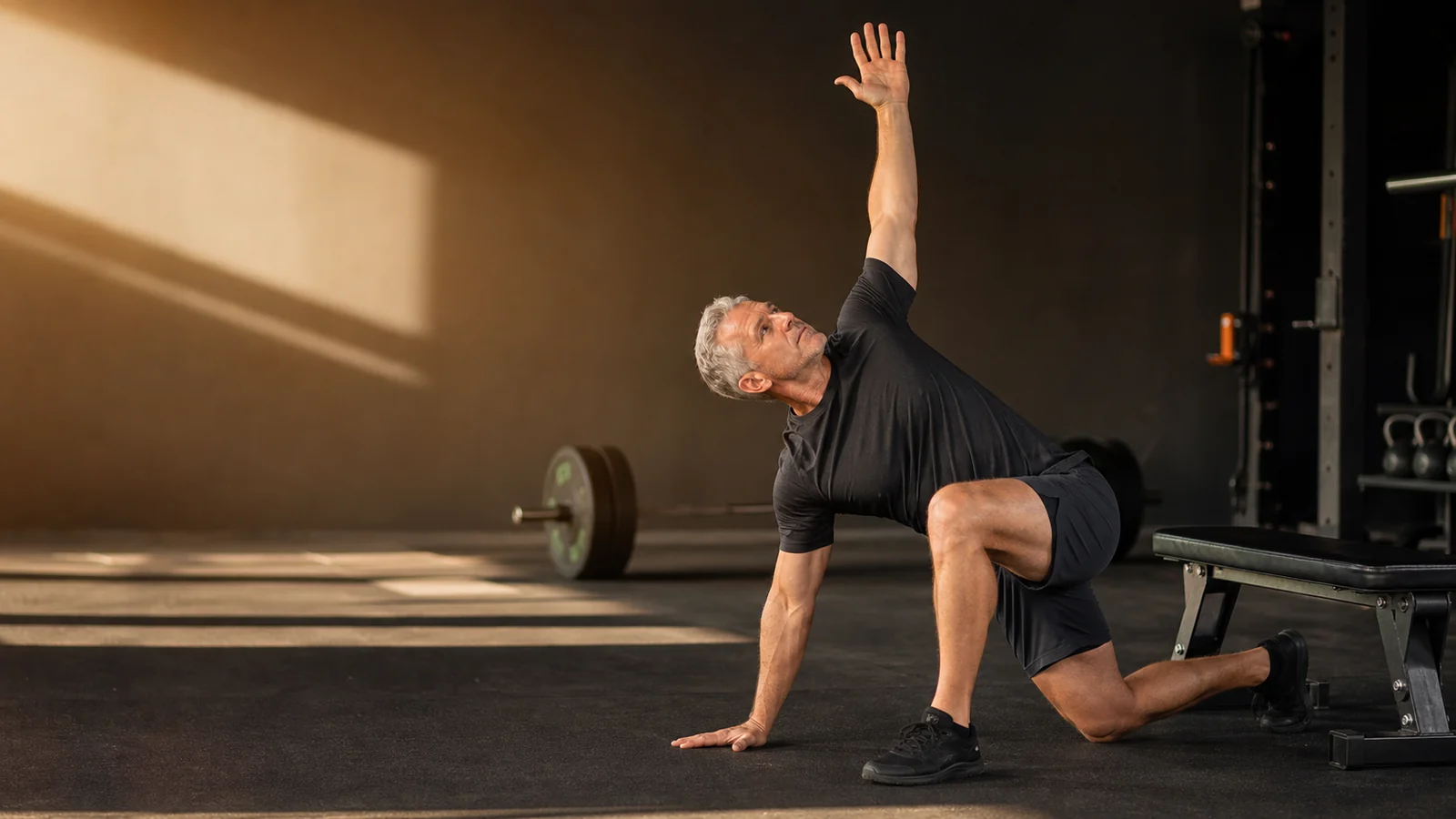
- Half-kneeling hip-flexor shift — 45 seconds per side
- Open-book thoracic rotation — 5 controlled reps per side
Continue only while comfortable
- Supported calf stretch — 45 seconds per side
- Doorway chest opener — 45 seconds per side
- Box squat rehearsal with reach — 6 slow reps
Use these movements to explore a comfortable range. They do not replace strength training. For additional range-of-motion progressions and stretch selection, use the general flexibility and stretching guide. Pair the routine with the core workouts for men over 50 and the broader fitness system after 50.
Frequently Asked Questions About Warm-Ups After 50
How long should a warm-up be after 50?
The builder offers five-, eight- and twelve-minute starting sequences. The time you need depends on the session, conditions and how you feel. Add gradual practice sets before heavy lifting or vigorous exercise.
Should I stretch before lifting?
Controlled dynamic movement and specific rehearsal usually fit better before training. Longer static stretching can be saved for another time when it does not reduce readiness.
Should a warm-up eliminate every feeling of stiffness?
No. The goal is improved readiness and control, not forcing every joint to feel perfect before you start.
Can I use the daily reset on rest days?
Yes, when the movements remain comfortable and low effort. It should leave you feeling the same or better, not more irritated.
What if one movement hurts?
Skip it rather than forcing range. Use a comfortable alternative and arrange assessment when pain persists, worsens, or changes normal movement.