Use squat, bench and deadlift around sport practice with a 12-week example, effort targets, season adjustments and a free planning worksheet.
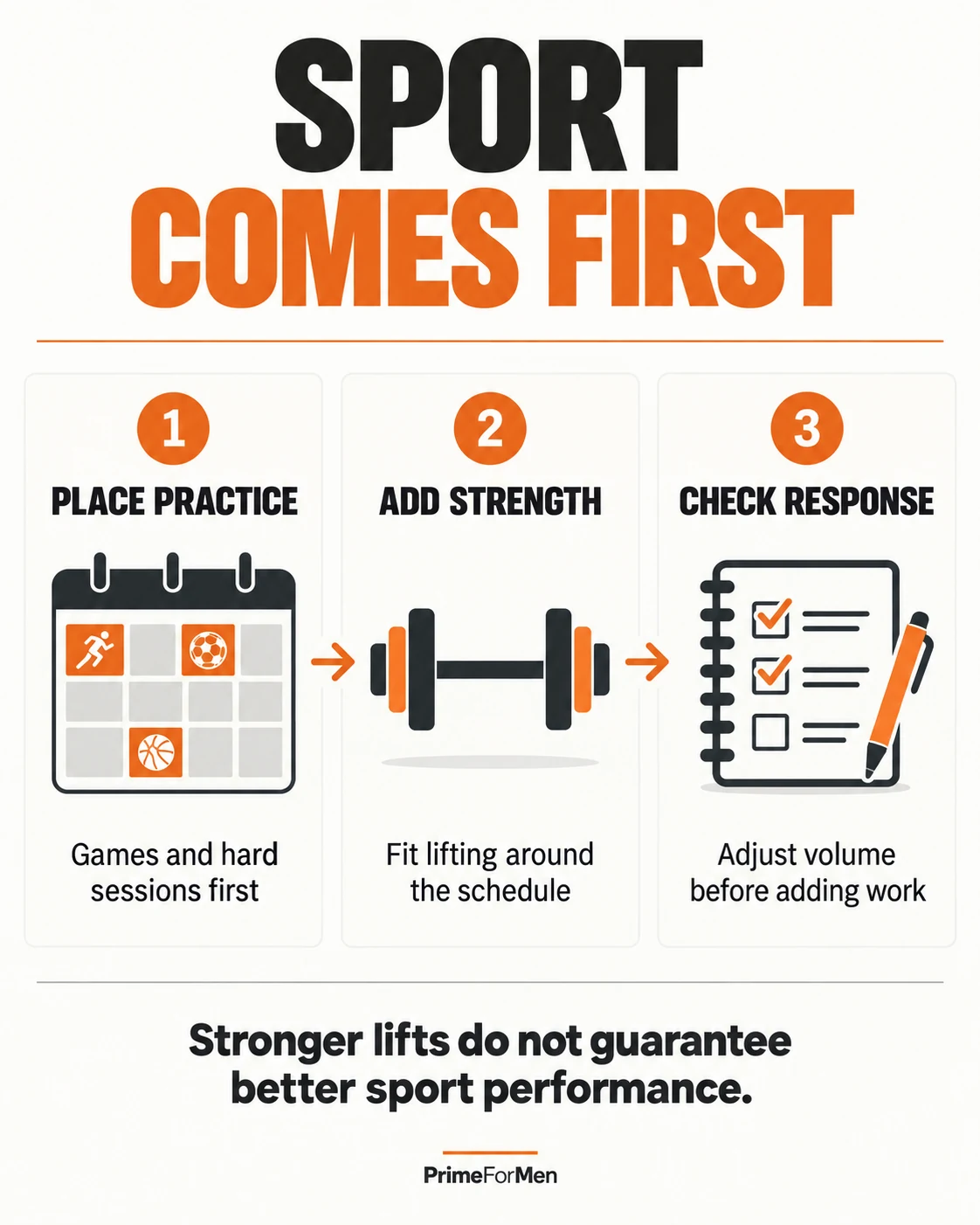
- Place sport practice and competition on the calendar first.
- Use submaximal main lifts and explicitly dosed accessories.
- Reduce lifting demands when the sport schedule gets harder.
Bottom line Map your next practice week with your coach before assigning the squat, bench and deadlift sessions.
An SBD program for athletes uses the squat, bench press and deadlift to support the sport schedule. It is not automatically a powerlifting peak. This example is for adults who already know the lifts and need a clear way to organize strength work around practice.
Quick Summary: Sbd Program For Athletes
- Place sport practice and competition on the calendar first.
- Use submaximal main lifts and explicitly dosed accessories.
- Reduce lifting demands when the sport schedule gets harder.
The Prime Perspective
The barbell numbers are only part of the result. If lifting compromises the sessions that matter for your sport, the plan needs adjustment even when the gym log looks impressive.
What This Twelve-Week Example Assumes
This is a coaching-oriented template for adult recreational athletes already competent in squat, bench press and deadlift variations. It is not a beginner barbell lesson, injury rehabilitation or a universal program for every sport. The big three are optional tools: a sport program can use different exercises when they fit the athlete better.
Start by writing down games, hard practices, sprint sessions and travel. Put lifting into the remaining recovery budget. The NSCA seasonal programming framework supports changing emphasis with season and individual needs. It does not make the same three lifting days appropriate during every competition schedule.
A Complete Off-Season Example Week
Use Monday, Wednesday and Friday only when the surrounding sport load allows it. Warm up with general movement and several progressively loaded rehearsal sets of the main lift. These do not count as work sets. Rest about two to three minutes between main-lift work sets and 60–120 seconds for accessories, extending rest when necessary.
On small screens, swipe the table sideways to see every column.
| Day | Strength work in the base phase | Optional sport preparation |
|---|---|---|
| Monday | Squat 3 × 5 at about RPE 6–7; supported row 2 × 8; supported split squat 2 × 6 each side; side plank 2 × 15–25 seconds each side. | If already practiced and appropriate: 2 × 3 small jump-and-stick repetitions before lifting, with full resets. |
| Wednesday | Bench press 3 × 5 at RPE 6–7; row 2 × 8; glute bridge 2 × 10; supine heel slide 2 × 6 each side. | Technical skill practice at an intensity that fits the week. No automatic extra conditioning. |
| Friday | Deadlift 2 × 5 at RPE 6–7; familiar push-up variation 2 × 6–10; row 2 × 8; suitcase hold 2 × 20 seconds each side. | Coach-planned speed work only if already part of the program. Do not add sprints merely to fill this column. |
RPE here refers to the difficulty of the set: approximately 6 means several repetitions remain, 7 about three and 8 about two. These are estimates, especially for less experienced lifters. They do not replace coaching or justify grinding through poor technique. Use a lighter load if the intended effort cannot be maintained.
Use appropriate rack safeties and competent spotting for bench and squat work. Set up with an empty or light bar first. If you do not know how to exit an unsuccessful attempt safely, get instruction before increasing load. Belts, sleeves and wraps cannot replace technique or a safe environment.
Turn the Week Into a Twelve-Week Block
On small screens, swipe the table sideways to see every column.
| Weeks | Main-lift adjustment | What stays controlled |
|---|---|---|
| 1–3 | Use the base week. Add only a small load when the prior exposure fits the target effort. | Same exercises and accessory volume; no mandatory weekly increase. |
| 4 | Review fatigue. If needed, use two main-lift sets and one accessory set. | Keep skill practice; do not test a maximum just because volume drops. |
| 5–7 | Squat and bench 3 × 4; deadlift 2 × 4, generally RPE 7–8. | Keep accessories at the base dose or reduce if practice demands rise. |
| 8 | Repeat the review and reduce work if needed. | Check sport performance alongside gym numbers. |
| 9–11 | Squat and bench 3 × 3; deadlift 2 × 3, generally RPE 7–8. | Lower reps do not mean maximal attempts; keep effort controlled. |
| 12 | Use fewer familiar sets and review the block. | Compare a familiar submaximal task; a one-rep maximum test is not required. |
The phase changes are an editorial example, not evidence that this precise sequence improves every athlete. If a sport season begins earlier, adapt then rather than finishing the calendar mechanically. Do not combine the highest set counts from several templates.
When the Same Week Contains a Game
Suppose the main game is Saturday. A coach might place a modest full-body strength session early in the week and a shorter familiar session later, while removing optional jump or sprint work already supplied by practice. There is no universal number of hours that guarantees recovery. Travel, playing time, sport demands and the athlete’s response all matter.
If warm-up loads feel unexpectedly difficult, reduce that day’s load to match the intended effort. If practice quality declines repeatedly, first review total work and remove optional accessories rather than adding recovery gadgets. Persistent pain or unusual fatigue needs appropriate assessment. The active-recovery guide can help distinguish an easy movement day from another workout.
Track one relevant sport observation, such as a familiar practice drill or coach-rated readiness, under similar conditions. Do not claim a faster sprint from a stronger squat alone. Strength changes create capacity; transfer also depends on skill and the rest of the program. The worksheet below keeps both gym and sport notes on the same page.
Use the Sport as the Scoreboard
Powerlifting and field or court sports can share exercises without sharing the same objective. A powerlifter is judged on a specific total under competition rules. A recreational athlete may need strength alongside repeated efforts, decision-making, acceleration and technical practice. Increasing the total is therefore not the complete evaluation of this program.
On small screens, swipe the table sideways to see every column.
| Decision | Sport-focused approach | What to avoid |
|---|---|---|
| Exercise selection | Choose technically familiar lifts that fit the athlete and facilities. | Forcing a competition variation when another option is more appropriate. |
| Accessory work | Use a small dose that serves an identified need. | Adding every weak-point exercise from a powerlifting template. |
| Progression | Consider effort and practice quality together. | Increasing load because the spreadsheet says so. |
| Testing | Compare familiar submaximal tasks and sport observations. | Assuming a new maximum proves better game performance. |
Make Substitutions Explicit
If you change a back squat to another squat variation, establish a suitable load for the new task. Do not carry the old number across automatically. The same applies when changing deadlift style, bench setup or equipment. A coach can help determine whether a substitution still serves the intended goal.
Use unilateral exercises as planned accessories when they fit, rather than treating them as a cure for every asymmetry. For jumping work, the landing and plyometric guide explains why a few controlled repetitions are different from a fatigue circuit.
Sport-specific articles can help frame the surrounding week: compare the football workout guide or the off-season baseball strength program only when that sport matches your needs. These are alternative planning references, not extra sessions to add to the SBD example.
Keep a fallback session ready
When travel or a demanding practice disrupts the week, a shorter familiar session may be more appropriate than moving all missed work to the next day. Decide which main movement matters most, reduce optional accessories and stay within the intended effort. If even warm-up work is unexpectedly difficult, lower the demand further or stop and reassess.
The progressive overload framework helps separate a sensible repeat from a stalled program. Do not “repay” a reduced week with an abrupt volume jump. Track the reason for the adjustment so you can tell whether the issue was temporary scheduling or a recurring mismatch between lifting and sport.
For a new barbell lifter, instruction comes before this twelve-week template. The beginner fitness guide offers a simpler general starting point, while competent in-person coaching can address the technical demands of the squat, bench and deadlift.
Download the Practical Worksheet
Use the one-page reference and three fillable fields to record your setup, what you completed and the next decision. Print it or save a filled copy using a PDF reader that supports forms. Read the full instructions and adaptations above before using the summary.
Optional Equipment: Buy for a Specific Job
The links below open Amazon category searches, not tested product recommendations. Compare the actual product instructions, dimensions and compatibility. Use equipment you already own when it fits the task.
As an Amazon Associate, PrimeForMen earns from qualifying purchases.
Conclusion: Make the Next Session Clear
Map your next practice week with your coach before assigning the squat, bench and deadlift sessions. Use the worksheet to make that decision visible. Repeating a manageable session is a valid choice; the calendar alone does not require a harder workout.
Frequently Asked Questions
Is this suitable for a first-time barbell lifter?
No. The example assumes competent technique and a suitable training environment. Learn the lifts with qualified instruction before using a multi-phase loading template.
Must athletes use all three lifts?
No. Squat, bench and deadlift are tools, not universal requirements. A coach may select different variations or exercises to fit the athlete, facilities and sport schedule.
Should I test my one-rep maximum at week twelve?
A maximum test is not required. Review familiar submaximal performance and relevant sport observations. A heavier single is not automatically the most useful measure of the block.
What changes during the competitive season?
Practice, games, travel and playing time change the available workload. Reduce or reorganize lifting with the coach instead of preserving the off-season example unchanged. Optional work is a reasonable place to review first.
Do belts and sleeves make the program safe?
They do not replace technique, coaching, rack safeties, spotting or sensible loading. Use equipment only for a defined purpose and according to its instructions; it is not a solution to unexplained pain.
Medical Disclaimer
This is general fitness education, not diagnosis, rehabilitation or an individualized exercise prescription. Choose movements appropriate to your situation. Stop for pain, dizziness or unusual symptoms and seek appropriate guidance. New or severe concerning symptoms warrant prompt medical assessment.
Our editorial policy explains our approach to sources and commercial independence. Exercise examples and illustrations do not represent individual coaching or product testing.
Affiliate Disclosure
Some links are affiliate links. We may receive a commission from qualifying purchases at no additional cost to you. Optional equipment is not a condition of benefiting from the guidance above.