Smartwatches buyer guide for men: compare Apple, Garmin, Samsung, fitness trackers, sensors, GPS, battery, subscriptions, and training fit.
- Choose the device class first: smartwatch, sport watch, fitness tracker, or ring.
- Match the watch to phone ecosystem, workout type, battery tolerance, and subscriptions.
- Use health metrics as trends, and add a chest strap when workout precision matters.
Bottom line The best smartwatch is the one that removes training friction without turning every metric into a diagnosis.
Smartwatches are worth buying only when the device fits your phone, your training style, your battery tolerance, and the data you will actually use. The best watch for an iPhone lifter is not automatically the best watch for a runner, a Samsung user, or a man who only wants better sleep consistency.
Use this guide to choose the category first, then the product. A smartwatch should reduce friction, make useful training feedback easier to see, and avoid turning every metric into a medical claim.
- Start with phone ecosystem: iPhone, Android, Samsung, or Pixel changes the best choice fast.
- Choose a sport watch for serious GPS, structured running, triathlon, and longer battery life.
- Use smartwatch health data for trends, not diagnosis or single-reading decisions.
- Check LTE, Always-On Display, GPS mode, and subscriptions before paying for an upgrade.
- If heart-rate precision matters, compare wrist data with a dedicated heart rate monitor.
The Prime Perspective
The right wearable is the one you will wear, charge, understand, and use to make better training decisions. More sensors do not help if the watch is uncomfortable at night, dead before a run, locked into the wrong phone ecosystem, or too complicated to act on.
For most men, the decision is not “Which watch has the most features?” It is: Which device solves my repeat training problem with the least daily friction?
Smartwatch vs Sport Watch vs Fitness Tracker vs Smart Ring
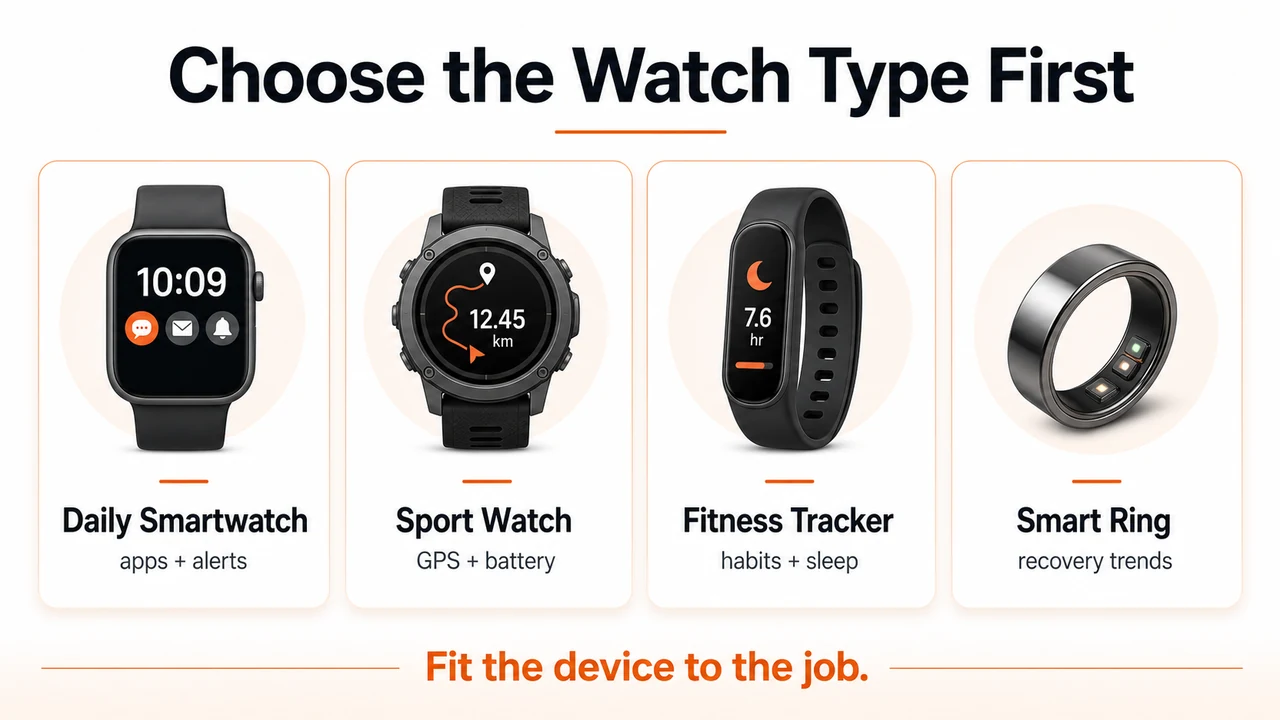
The first mistake is comparing every wearable as if it does the same job. These are different product classes. A daily smartwatch is built around phone integration. A sport watch is built around training. A fitness tracker is built around habits. A smart ring is mostly about recovery and sleep trends. A smart scale adds a different signal: repeatable body-weight trends, with body-composition figures treated as estimates.
| Device type | Best for | Not ideal for | Typical entities |
|---|---|---|---|
| Daily smartwatch | Apps, calls, notifications, general workouts, health trends | Long GPS races, multi-day sport battery, deep training metrics | Apple Watch, Galaxy Watch, Pixel Watch |
| Sport watch | Running, triathlon, hiking, GPS, maps, structured plans | Rich phone apps, messaging-heavy use, lifestyle polish | Garmin Forerunner, Garmin Fenix, COROS, Suunto, Polar |
| Fitness tracker | Steps, sleep, simple workouts, habit reminders, lower cost | Maps, serious GPS, advanced sport profiles | Fitbit Charge, Amazfit, basic bands |
| Smart ring | Sleep, readiness, recovery trends, low-profile wear | Workout display, GPS, calls, real-time coaching | Oura, WHOOP-style recovery systems |
Best Smartwatches for Men by Use Case
Apple Watch Series is the cleanest daily smartwatch choice if your phone, apps, workouts, and messages already live inside Apple.
Garmin Forerunner or Fenix makes more sense when GPS, workouts, maps, race prep, and battery life are the point.
Samsung Galaxy Watch or Pixel Watch should be judged by phone fit, battery, sleep features, app ecosystem, and comfort.
Look for rest timers, simple workout logging, comfort under wrist wraps, and sleep trends. Do not expect perfect wrist heart-rate data during gripping work.
Prioritize wearability, battery, low profile, and trend clarity over a loud feature sheet.
If steps, sleep, and habits are the real need, a fitness tracker may beat a premium smartwatch.
Amazon.com Picks: Smartwatch Categories Worth Comparing
Disclosure: this guide includes Amazon affiliate links. PrimeForMen may earn from qualifying purchases at no extra cost to you. The picks below are product examples for the main buying categories, not medical devices or performance guarantees.

Apple Watch Series 11
Best fit for iPhone users who want the strongest daily smartwatch experience plus broad fitness and health trend tracking.
- Best starting point if your phone, apps, messages, and training history already live in the Apple ecosystem.
- Strong for walking, lifting logs, casual cardio, reminders, calls, and everyday habit tracking.
- Skip if daily or near-daily charging will make you stop wearing it.

Garmin Forerunner 970
Best fit for runners, triathletes, and data-driven endurance training where GPS, battery life, and sport metrics matter more than apps.
- Built for structured running, triathlon, maps, workouts, and longer battery expectations.
- Better fit than a daily smartwatch when race prep, GPS reliability, and training load matter.
- Overkill if you mainly want notifications, short walks, or basic gym tracking.

Samsung Galaxy Watch8
Best fit for Android and Samsung users who want daily smartwatch features, sleep coaching, health trends, and phone integration.
- Makes the most sense inside the Android and Samsung phone ecosystem.
- Good category choice for sleep, coaching, notifications, and general fitness tracking.
- Compare battery and app needs before choosing it over a Garmin-style sport watch.

Fitbit Charge 6
Best fit when you mainly need habits, steps, sleep, basic workouts, and a lower-friction tracker instead of a full smartwatch.
- Useful if a smaller tracker is more wearable for sleep and daily habits.
- A practical cheaper step before buying a premium smartwatch you may not use.
- Not the right pick if you need advanced GPS, maps, or serious sport metrics.
Apple Watch vs Garmin vs Samsung: The Real Difference
Apple, Garmin, and Samsung compete in the same shopping conversation, but they do not solve the same problem. Apple is strongest as a daily iPhone smartwatch. Garmin is strongest as a sport-training tool. Samsung is strongest when Android phone integration and health coaching matter together.
| Decision point | Apple Watch Series | Garmin Forerunner | Samsung Galaxy Watch |
|---|---|---|---|
| Best for | iPhone users, apps, calls, daily health trends | Runners, triathletes, structured training, GPS | Android/Samsung users, sleep, coaching, phone integration |
| Phone ecosystem | iPhone first | Works across phone ecosystems, but sport ecosystem is the draw | Android first, strongest inside Samsung |
| Battery mindset | Expect frequent charging | Multi-day sport-watch expectations | Better than some daily watches, still feature-dependent |
| Training depth | Good general fitness and app support | Very strong endurance metrics and planning | Good general fitness, sleep, coaching, health trends |
| Best warning | Not ideal if charging friction bothers you | Too much watch if you only want notifications | Check Android ecosystem fit before buying |
How We Chose These Smartwatches
We treated this as a buying guide, not a lab test. The product shortlist is editor-researched from official product information, category fit, ecosystem logic, Amazon availability, and practical PrimeForMen use cases.
We weighted repeat use more heavily than novelty. A watch that helps you train every week is more valuable than one with ten features you never open. For product-review standards, we also checked Google guidance on high-quality reviews and used sponsored link attributes consistent with Google outbound link guidance.
ECG vs PPG: Why Smartwatch Health Data Has Limits
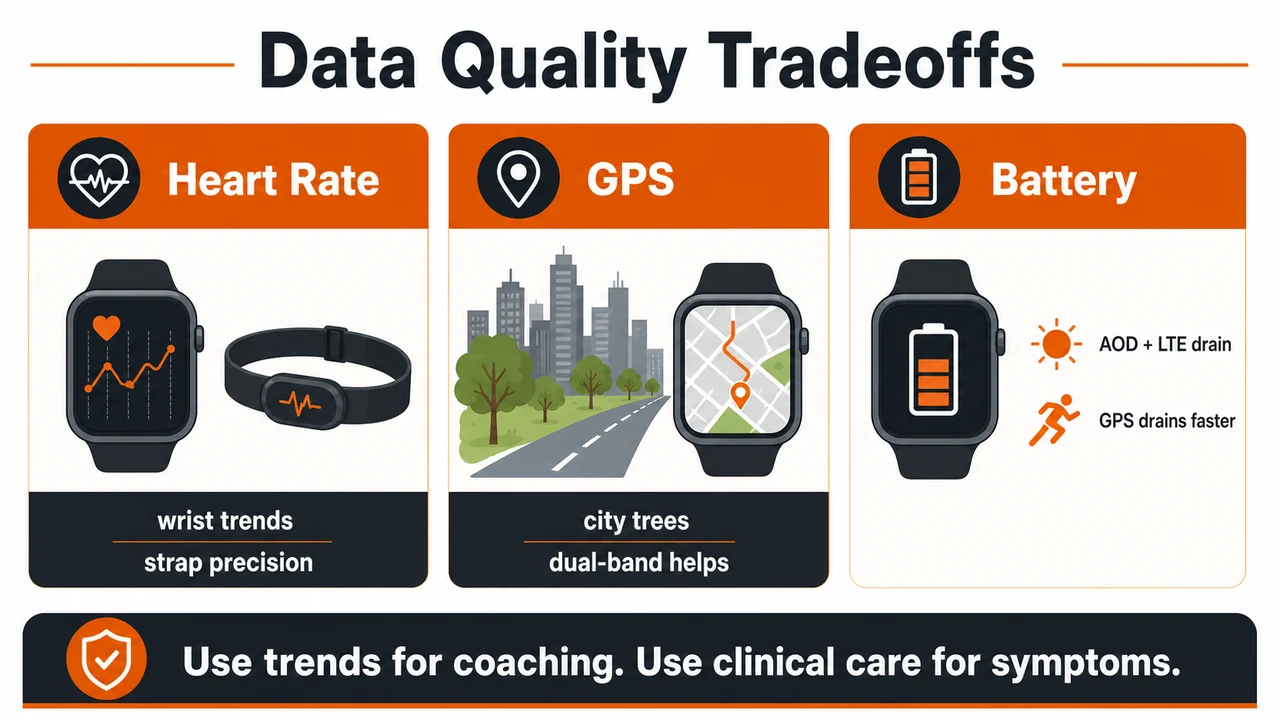
Most wrist heart-rate tracking uses optical sensing. That is useful for trends, steady cardio, and daily context. It can be less reliable when the watch moves, the skin is cold, the strap is loose, the wrist bends, tattoos interfere, or the exercise involves gripping.
Some watches also offer ECG-style features or health alerts. Treat those as prompts to pay attention, not as a diagnosis. If symptoms, medication, cardiovascular history, chest pain, dizziness, or shortness of breath are involved, use professional medical care instead of smartwatch interpretation.
GPS Accuracy and Battery Life
GPS accuracy matters most for running, cycling, hiking, and outdoor pacing. Dual-band GPS can help in difficult environments such as dense cities, trees, or tall buildings, but it can also use more battery. For treadmill work, a watch can still help with heart-rate trends and consistency, but indoor distance estimates are less important than repeatable effort.
| Feature | Why it matters | Buying rule |
|---|---|---|
| Normal battery life | Determines whether you actually wear the watch daily and overnight. | If charging annoys you, favor sport watches or trackers. |
| GPS battery | Long runs, cycling, hiking, and races drain faster than desk use. | Compare GPS mode, not only normal-use battery claims. |
| LTE | Useful for phone-free runs, calls, messages, and streaming. | Buy LTE only if you regularly leave the phone behind. |
| Always-On Display | Great for quick glances, but uses power. | Useful if visibility matters; skip if battery is the bigger pain. |
| Fast charging | Reduces missed sleep tracking and workout gaps. | Important for daily smartwatches with short battery cycles. |
Subscription Costs Before You Buy
The sticker price is not always the full cost. Some ecosystems sell optional coaching, guided workouts, recovery insights, or premium dashboards. That is not automatically bad, but it should be visible before checkout.
| Product class | Possible follow-up cost | Why it matters |
|---|---|---|
| Apple Watch | Apple Fitness+ optional | Workout experience can expand through a subscription. |
| Samsung Watch | App and health ecosystem add-ons | Coaching value depends on phone and app habits. |
| Pixel/Fitbit | Fitbit Premium depending on desired insights | Some coaching and deeper metrics may be premium. |
| Garmin | Many training tools included without a monthly plan | Strong value if sport data is the main reason you buy. |
| WHOOP/Oura-style recovery devices | Membership model | Do not compare device price without the membership context. |
What Most Buying Guides Miss
Most smartwatch guides rank products before defining the job. That is backwards. You should decide whether you need phone convenience, sport depth, habit tracking, or recovery trends before comparing model names. Otherwise, you end up buying the most impressive device instead of the most useful one.
How to Choose Without Overbuying
- Start with your phone. iPhone, Samsung, Pixel, and general Android use push you toward different ecosystems.
- Name the main workout. Running, lifting, walking, cycling, hiking, and sleep tracking do not need the same device.
- Decide your charging tolerance. Daily charging is fine for some men and a deal-breaker for others.
- Check sensor reality. Wrist data is useful, but a chest strap is better for hard cardio precision.
- Audit the total cost. Include subscriptions, bands, chargers, warranty, and replacement risk.
Smartwatch Fit for Common Training Setups
For treadmill workouts, pair the watch with realistic effort tracking and compare it with our treadmills guide. For indoor cardio, wrist sensors can be useful on elliptical trainers and exercise bikes, but watch fit still matters. For rowing, wrist flexion can make optical heart-rate data messy, so read the rowing machines guide and consider a strap if precision matters.
If you use readiness, HRV, or sleep scores to decide training intensity, combine the data with actual recovery habits from rest and recovery. If the data starts pushing you into more stress instead of better decisions, step back and use it as a trend, not a command.
Simple 24-Hour Buying Protocol
- Write down the one problem the watch must solve: phone convenience, running data, sleep, recovery, or basic habits.
- Pick the device class before picking the brand.
- Check whether the best features work with your phone.
- Compare battery in normal use, GPS use, LTE use, and Always-On Display use.
- Before buying, confirm return policy, band sizing, subscription cost, and whether you will wear it overnight.
Conclusion
The best smartwatch for men is not the most expensive watch. It is the one that fits your phone, your workouts, your charging habits, and the data you will actually use. Buy Apple Watch for the clean iPhone daily experience. Buy Garmin-style sport watches for structured endurance training. Buy Samsung or Pixel-style watches for Android health and phone integration. Buy a tracker if simple habits solve the real problem.
For the broader tech and gear context, continue with wearable fitness tech, fitness trackers, or the full fitness gear and equipment hub.
Sources and product documentation checked: Apple Watch Series 11, Garmin Forerunner 970, Samsung Galaxy Watch8, Google Pixel Watch 4 context, and Google product structured data guidance.
Medical Disclaimer: This article is educational and does not replace medical advice, diagnosis, or treatment. Smartwatch health features can be useful for trends, but symptoms, cardiovascular concerns, medication questions, chest pain, dizziness, fainting, or unusual shortness of breath should be discussed with a qualified clinician.
Affiliate Disclosure: This post contains Amazon affiliate links. PrimeForMen may earn a commission from qualifying purchases at no extra cost to you. Recommendations are based on category fit, ecosystem fit, training usefulness, battery friction, comfort, and practical ownership costs.
Frequently Asked Questions About Smartwatches
Is Apple Watch better than Garmin for fitness?
Apple Watch is usually better as an iPhone-first daily smartwatch. Garmin is usually better for serious running, triathlon, longer GPS sessions, battery life, and deeper sport metrics. The right answer depends on whether your main problem is daily convenience or structured training.
Is Garmin better than Apple Watch for running?
For many runners, yes. Garmin-style sport watches tend to focus more on GPS, training plans, race prep, recovery metrics, and multi-day battery life. Apple Watch can still be excellent for general fitness, especially for iPhone users.
Is Samsung Galaxy Watch good for fitness?
Yes, especially for Android and Samsung users who want a daily smartwatch with sleep, coaching, notifications, and general workout tracking. If your main goal is endurance training depth, compare it against Garmin before buying.
Pixel Watch vs Galaxy Watch: which is better for Android?
Pixel Watch usually makes more sense for Pixel and Google/Fitbit ecosystem users. Galaxy Watch usually makes more sense for Samsung phone users. Check battery, size, health features, app fit, and subscription needs before deciding.
Do I need LTE on a smartwatch?
LTE is useful if you run, walk, or commute without a phone and still want calls, messages, music, or emergency access. Skip it if your phone is almost always with you because it adds cost and can drain battery faster.
Does Always-On Display drain smartwatch battery?
Yes. Always-On Display is convenient, but it uses power. The same is true for LTE, long GPS workouts, bright screens, frequent notifications, and heavy app use.
Is smartwatch heart rate accurate enough?
It is usually useful for trends, steady cardio, and habit feedback. Wrist optical sensors can struggle during intervals, cold weather, poor fit, tattoos, and gripping exercises. Use a chest strap when precision matters.
Do I still need a chest strap?
You may need one if you care about interval accuracy, cycling, rowing, HRV checks, or fast heart-rate changes. A smartwatch is better for daily context; a chest strap is better for cleaner workout heart-rate data.
Is a smartwatch worth it for weightlifting?
It can be worth it for rest timers, workout logging, steps, sleep, recovery trends, and reminders. It will not replace a real strength log or progressive overload plan.
Is a smartwatch or fitness tracker better for beginners?
Beginners often do better with the simplest device they will actually wear. A fitness tracker may be enough for steps, sleep, and habit consistency. A smartwatch makes more sense when apps, calls, GPS, or ecosystem features matter.
Which smartwatch has the best battery life?
Dedicated sport watches usually beat daily smartwatches for battery life, especially with GPS use. Always compare normal use, GPS use, LTE use, Always-On Display, and charging speed instead of relying on one headline number.
Are smartwatch sleep scores accurate?
Sleep scores can be useful for trends, but they are not a clinical sleep study. Treat them as behavior feedback, especially for bed timing, consistency, and recovery patterns.
Can a smartwatch detect high blood pressure?
Some watches offer health alerts or blood-pressure-adjacent features, but a smartwatch is not a substitute for a validated blood-pressure cuff or medical care. Use clinician guidance for symptoms, medication, or cardiovascular risk.
What smartwatch features are worth paying extra for?
Pay extra for the features you will use weekly: phone ecosystem fit, GPS accuracy, battery life, comfort, readable display, water resistance, chest strap compatibility, and workout tools.
What smartwatch features are overhyped?
Calorie estimates, single sleep-stage readings, one-off HRV scores, and generic readiness scores can be overinterpreted. Trends are useful; single readings are easy to misread.