How to use foam rollers for calves, thighs and glutes, with evidence, pressure guidance, a four-minute routine and a free trial card.
- Choose one muscle area and control pressure.
- Use a short routine followed by active movement.
- Retest comfort instead of chasing pain.
Bottom line Try the same comfortable setup a few times and keep it only if it helps.
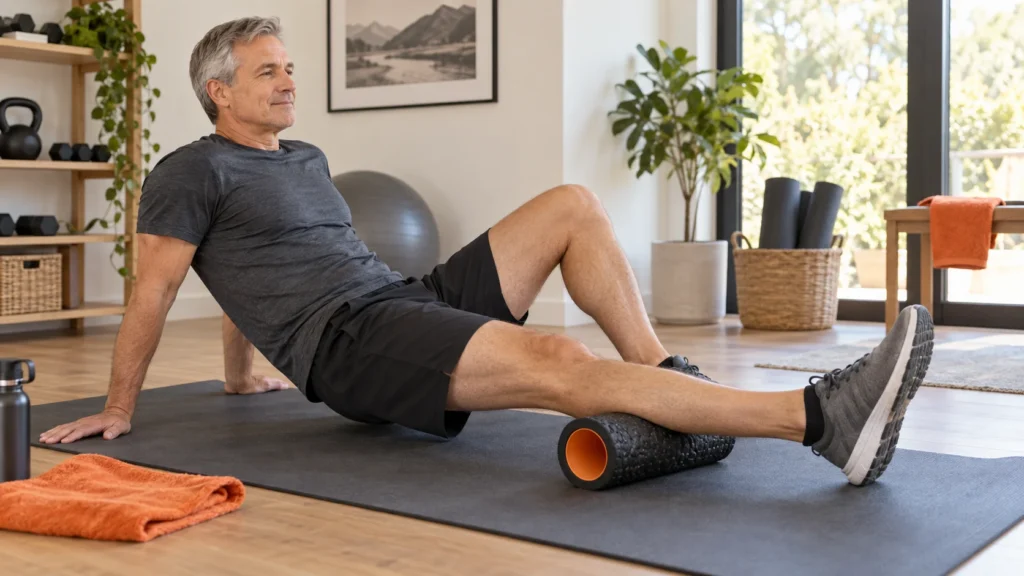
Foam rollers can help some people temporarily improve comfortable movement or reduce post-exercise soreness. Use one as an optional preparation or comfort tool, not a way to repair injured tissue. Start with light, controllable pressure on a muscle, then move and retest. If it adds no useful benefit, you do not need to keep rolling.
Quick Summary: Foam Rollers
- Short-term effects and changes after weeks of use are different outcomes.
- Harder rollers are not automatically better.
- Use slow passes without forcing a painful spot.
- Follow rolling with active movement in the range you need.
- Sharp, radiating, or unexplained pain needs a different response.
The Prime Perspective
A roller is useful when it helps you move better afterward. It is not useful because it hurts enough to feel impressive.
Choose Density by Tolerance and Goal
| Option or variable | What it changes | Decision rule |
|---|---|---|
| Soft/full foam | Beginners and sensitive areas | Easier pressure control |
| Medium textured | General quads, calves, glutes | Versatile, compact |
| Long smooth roller | Upper back and larger positions | More stable support |
| Extra-firm | Experienced users only | Easy to overdo |
| Vibrating | Convenience preference | Evidence does not justify a cure claim |
What the Evidence Supports
A 2019 meta-analysis of 21 studies separated rolling before exercise from rolling afterward. It found small flexibility benefits before exercise and some reduction in perceived muscle pain afterward, while many performance effects were small or negligible. Less soreness does not prove that tissue has repaired faster.
The 2022 review of repeated foam-rolling training addressed a different question: changes in joint range of motion across weeks. It included 11 studies and 290 participants, with a mean age of about 24. The pooled result favored rolling, but varied substantially between studies and muscle groups. Those findings should not be presented as a guarantee for older adults or an injured joint.
Swipe sideways on a small screen to read every column.
| Question | Reasonable interpretation | Do not infer |
|---|---|---|
| Will I move more comfortably now? | Some people gain short-term range or comfort. Retest a relevant movement. | That greater pressure must produce greater benefit. |
| Will soreness feel better? | Post-exercise rolling may reduce perceived soreness for some people. | That you are ready for another hard workout or an injury is resolved. |
| Can regular use change flexibility? | Repeated-use studies suggest range-of-motion gains, with variable responses. | That a four-minute routine guarantees lasting change in every joint. |
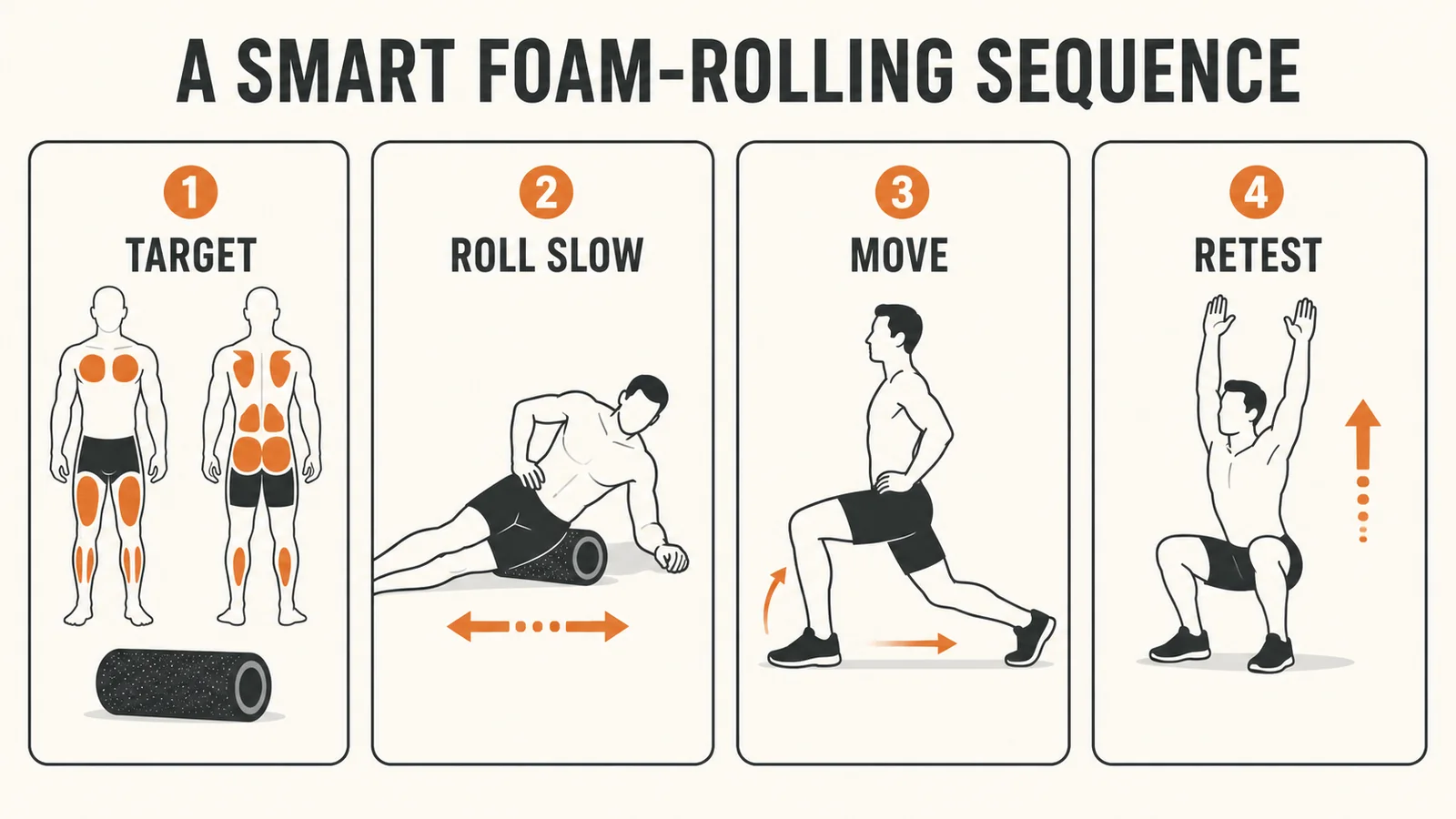
A Four-Minute Test-and-Retest Routine
This is an editorial starting example, not an optimal dose established for every muscle. Choose one area on each side; do not attempt a whole-body session in four minutes. A comfortable squat, calf raise or short walk can be your comparison movement. Do not use a painful movement as a self-diagnostic test.
Swipe sideways on a small screen to read every column.
| Time | What to do | Keep it controlled |
|---|---|---|
| 0:00–0:30 | Perform a few comfortable repetitions of the chosen movement. | Notice ease and range without forcing either. |
| 0:30–1:30 | Roll one selected muscle for 30–60 seconds. | Use the remaining time to reposition if you stop at 30 seconds. |
| 1:30–2:30 | Repeat on the other side for 30–60 seconds. | Match the setup; you do not need identical tenderness. |
| 2:30–3:30 | Perform several easy active repetitions. | For example, comfortable calf raises after rolling calves. |
| 3:30–4:00 | Repeat the original movement and record the result. | Better, unchanged or worse is enough; avoid invented percentage gains. |
If you need longer to get into position safely, allow more time. The clock is a planning aid, not a reason to rush. Stop the trial if symptoms worsen. If repeated trials bring no clear benefit, spend that time on a suitable warm-up or other recovery activity instead.
How Much Pressure Should You Use?
Start with enough weight supported through your hands, opposite foot or other stable contact that you can move the roller without bracing against pain. You should be able to breathe normally and stop or get off the roller easily. A soft roller can still feel intense when too much body weight is applied.
A tender sensation is not a target to maximize. Reduce pressure if you tense up, hold your breath or cannot control the movement. Sharp, burning, electric or radiating pain, numbness and tingling are stop signals. Do not use a numeric pain score as permission to tolerate those symptoms.
Slowly cover a small section of the muscle rather than racing from joint to joint. You can briefly remain over a tolerable area, but prolonged painful holds are unnecessary. No bruising is required, and you do not need to “break up” anything to have completed the session.
Three Areas You Can Set Up Carefully
Calves: keep the opposite foot planted
Sit with the roller under the fleshy middle of one calf and the opposite foot on the floor. Use your hands and planted foot to manage the pressure; start with only a small amount of weight on the roller. Make short, slow passes through the muscle belly. Stay away from the back of the knee, bony ankle and Achilles tendon. Do not stack the other leg on top to force more pressure.
Afterward, stand safely and try a few comfortable calf raises or the same short walk used before rolling. The NASM calf-rolling guide provides additional setup context. If floor support strains your wrists or shoulders, choose another warm-up option rather than struggle to hold the position.
Front of the thighs: avoid loading the kneecap
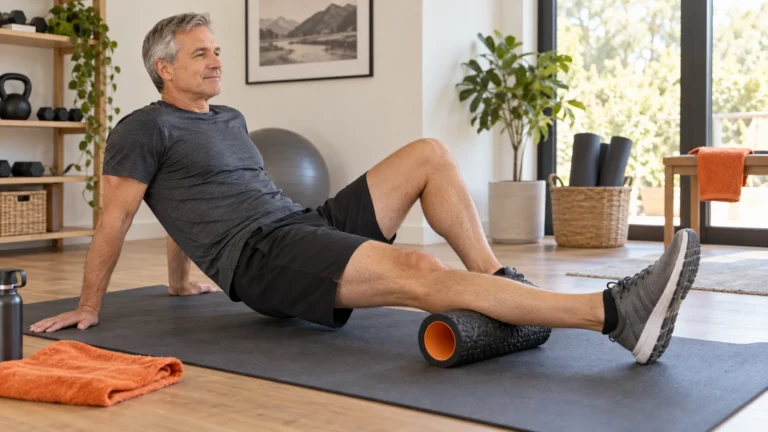
Support yourself on your forearms with the roller beneath the front thigh muscle, not directly on the kneecap or groin. Use your arms and the other leg to unload pressure. Roll a small controlled section of the quadriceps. Do not allow the lower back to sag as you move. Try both thighs lightly supported or one area at a time according to what you can control.
The NASM demonstration below illustrates positioning. Use the comfortable pressure and short trial described here; the video does not establish tissue repair or require you to buy a second roller.
Glutes: use a small shift, not a deep painful lean
Sit on the roller with hands supporting you and feet grounded. Shift a little weight toward one buttock and make short movements over the muscle. Stay off the tailbone and bony side of the hip. Keep the foot position simple; crossing a leg is not necessary if it makes the hip uncomfortable or balance difficult.
Stop if you feel pain shooting down the leg, tingling or numbness. Those sensations are not evidence that a knot is releasing. If sitting on the roller is difficult, skip this application; there is no requirement to roll every body region.
Before Training, After Training or on a Rest Day?
Swipe sideways on a small screen to read every column.
| Situation | Useful role | What comes next |
|---|---|---|
| Before strength work | Briefly test a specific area if it helps comfortable movement. | Use active movement and lighter rehearsal sets for your actual lifts. |
| After a demanding session | Optional short comfort session when normal pressure is tolerable. | Prioritize food, sleep and appropriate time before the next hard session. |
| Rest day | Try gentle movement first; rolling is optional. | Use walking or comfortable mobility without turning recovery into another painful task. |
For example, before a squat session, do a few easy squats, briefly roll a comfortable target area, then repeat the same squat and complete lighter practice sets. If the squat is unchanged, that is not a reason to roll harder or longer. The full-body home workout explains how the subsequent warm-up and work sets fit together.
After training, less soreness can be welcome, but it is only one observation. Check movement, fatigue and your overall schedule before deciding to add more loading. Our rest and recovery guide puts that decision in a wider context.
When to Skip Rolling and Get Advice
Avoid direct pressure on the front of the neck, abdomen, bony joints, varicose veins, fresh bruises, open wounds, and areas with unexplained swelling or altered sensation. Anticoagulant use, osteoporosis, neuropathy, recent surgery, and suspected injury deserve clinician or physical-therapy guidance.
Do not roll a newly swollen, hot or red calf to see whether it settles. Seek medical assessment, particularly with unexplained one-sided swelling. Sudden breathlessness or chest pain warrants urgent help. Persistent pain is also a reason for assessment rather than repeated self-massage. This guide does not diagnose the cause of symptoms.
The research is dominated by young healthy adults and short-term outcomes. A temporary toe-touch improvement does not prove remodeled fascia or better long-term performance.
Pair Rolling With Training
Use our stretching guide, active recovery workouts, recovery guide, massage and muscle growth evidence, and strength basics to turn temporary comfort into repeatable movement capacity.
What to Do This Week
- Pick one restricted movement and one likely muscle target.
- Roll for 30–60 seconds at tolerable pressure.
- Perform five controlled active repetitions.
- Retest the original movement.
- Keep the tool only if function or comfort meaningfully improves.
Keep a Short Record Before Buying a Harder Roller
Try the same comfortable setup on two or three separate occasions. Record the target area, approximate duration, pressure you could control and the same movement before and after. Consistency makes the comparison more useful than switching tools and exercises every time.
Download the foam-rolling trial card (fillable PDF)
Save the PDF, open it in a reader that supports forms and save again after entering notes. Entries stay in your file; this page does not collect them.
An example entry is “Calves, 30 seconds each, light pressure; five calf raises felt the same; no need to increase pressure.” An unchanged result is useful information. Keep the roller only when it earns its place in your routine.
Amazon Product Shortlist
These models illustrate soft, medium, and basic long-roller formats. PrimeForMen has not independently tested them.

TriggerPoint CORE Foam Roller
A softer-compression option for beginners or sensitive muscles.
- Less aggressive starting feel.
- Available in different lengths.
- Still requires pressure control.

TriggerPoint GRID 1.0
A compact medium-density choice for routine lower-body work.
- Portable 13-inch format.
- Textured multi-density surface.
- Avoid grinding directly on joints.

Amazon Basics High-Density Roller
A simple longer roller when stability and broad contact matter.
- 18-inch smooth cylinder.
- Easy to clean and store.
- Firmness may be too much for some beginners.
*As an Amazon Associate, PrimeForMen earns from qualifying purchases. Availability and prices can change.
Conclusion
Roll a specific muscle briefly, move through the new range, and retest function; stop treating pain intensity as proof of effectiveness.
Next Step: Use the Full PrimeForMen Guide
Continue with the advanced fitness techniques guide to place mobility tools beside strength work and recovery.
Frequently Asked Questions About Foam Rollers
How long should I foam roll each muscle?
Start with 30–60 seconds and reassess. Longer, more painful sessions are not automatically better.
Should foam rolling hurt?
Pressure can feel tender, but sharp, burning, radiating, or escalating pain is a stop signal.
Does foam rolling break up fascia?
That phrase overstates what a roller can mechanically do. Benefits are better described as short-term changes in tolerance and motion.
Should I roll before or after training?
Before training, use a short dose followed by movement. After training, use it for comfort if it does not aggravate symptoms.
Can foam rolling replace stretching?
No single tool is required. Rolling and stretching can both change short-term range, while strength through range supports lasting capacity.
This article is educational and has not received an independent clinical review. It does not diagnose or treat injuries. Ask an appropriately qualified clinician about unexplained pain, swelling, altered sensation, blood-thinning medication, osteoporosis or recent surgery before applying pressure. The featured image is an AI-generated illustration, not a documented treatment.
Some links are affiliate links. PrimeForMen may earn a commission at no extra cost to you. Product inclusion does not override evidence, fit, or safety.