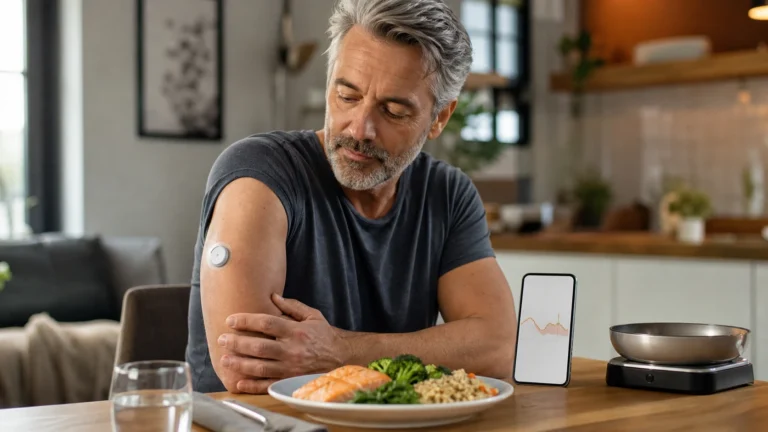
Nutritional wearables explained: compare CGMs and emerging sweat sensors, understand accuracy and interpretation limits, and decide whether the data is useful.
- An FDA-cleared CGM uses a sensor under the skin; no smartwatch or ring is authorized to measure glucose on its own without piercing skin.
- Evidence for healthy people remains limited and interpretation benchmarks are unsettled.
- Emerging sweat sensors are promising but face calibration, motion, and person-to-person variability problems.
Bottom line Use a nutritional wearable only when you can name the decision it will inform, standardize the comparison, and avoid turning normal biological variation into fear or food restriction.
Quick Summary: Nutritional Wearables
- CGMs measure glucose in interstitial fluid and naturally lag blood glucose during rapid change.
- One meal trace cannot isolate food from sleep, exercise, stress, timing, and sensor variability.
- A healthy glucose curve does not prove the meal was nutritionally complete; a rise after carbohydrate is not automatically harmful.
- OTC CGMs are not intended for people using insulin or those with problematic hypoglycemia.
- Unexpected or concerning data should be confirmed through appropriate clinical testing, not a consumer dashboard.
PrimeForMen Perspective
More data is useful only when it improves a decision. If the device makes you avoid fruit, whole grains, or social meals because of a single spike, the feedback loop may be reducing health rather than improving it.
Nutritional wearables capture a biological signal that may relate to meals, metabolism, or hydration. The most mature consumer example is a continuous glucose monitor (CGM), which samples interstitial glucose through a small sensor under the skin and sends readings to an app.
What Current and Emerging Devices Measure
| Device | Signal | What it may help with | What it cannot establish |
|---|---|---|---|
| CGM | Interstitial glucose | Patterns around meals, activity, and sleep | Overall diet quality or diagnosis by itself |
| Smartwatch/ring | Heart rate, activity, temperature proxies | Context around training and recovery | Noninvasive glucose without an authorized sensor |
| Sweat patch | Electrolytes, lactate, pH, other biomarkers | Emerging hydration or exercise research | Validated nutrition prescription for everyone |
| Smart food tool | Weight, images, or logged entries | Portion calibration and records | Absorption or complete nutrient status |
The FDA has warned consumers not to use smartwatches or smart rings claiming to measure glucose without piercing the skin. No such device was authorized, cleared, or approved at the time of that safety communication.
Amazon Product Shortlist
These tools measure simpler, interpretable trends before adding a specialized wearable. PrimeForMen has not independently tested them. Verify current device clearance, cuff or platform fit, app privacy terms, and specifications.

Etekcity Smart Food Nutrition Scale
For short, defined portion-learning experiments when eyeballing foods repeatedly causes large logging errors.
- Scale plus app-based nutrition calculations.
- Useful for calibration periods rather than mandatory lifelong weighing.
- Database values and recipes still require human checking.

OMRON Body Composition Monitor and Scale
For tracking body-weight trends alongside a plan while treating body-composition estimates as rough, hydration-sensitive values.
- Hand-to-foot measurement format.
- Weight trend is generally more interpretable than daily body-fat estimates.
- Do not use a consumer scale to diagnose muscle loss or disease.

Greater Goods Bluetooth Upper-Arm Blood Pressure Monitor
For a clinically relevant home trend when blood pressure—not a vague wellness score—is the decision target.
- Upper-arm cuff with app connectivity.
- Cuff fit and standardized positioning matter.
- Repeated concerning readings require clinical follow-up.
*As an Amazon Associate, PrimeForMen earns from qualifying purchases. Availability and prices can change.
CGM: Useful Signal, Incomplete Nutrition Story
CGMs measure glucose in fluid between cells, not food quality. Readings are affected by meal composition, timing, sleep, activity, stress, sensor lag, and ordinary day-to-day variation. A rise after eating carbohydrate is expected physiology; the shape of one curve cannot label a food universally good or bad.
A 2024 narrative review of CGM use in people without diabetes found a lack of consistent high-quality evidence for detecting abnormality, producing behavior change, or improving metabolic health in that population. A newer 2026 systematic review and meta-analysis of 23 studies found some improvement in mean glucose and adherence, but no significant BMI effect and little glycemic benefit in healthy normoglycemic participants. These are not contradictory: benefit appears context-dependent and a device does not create behavior change by itself.
Who May Have a Clearer Use Case?
| User | Potential question | Appropriate support |
|---|---|---|
| Person with diabetes | Therapy and time-in-range decisions | Diabetes care team and indicated device |
| Adult with prediabetes or higher risk | Structured behavior experiment | Clinician or qualified program |
| Endurance athlete | Fuel timing during long sessions | Sports dietitian plus performance context |
| Healthy curious adult | Response to standardized meals | Short trial with a stop rule |
| Person prone to restriction or anxiety | Likely low-value or harmful | Avoid self-tracking; seek individualized support |
The FDA’s 2024 clearance of the first over-the-counter CGM covered adults age 18 and older who do not use insulin, including people without diabetes. It was not intended for problematic hypoglycemia, and the agency cautioned users not to make medical decisions without consulting a healthcare provider.
It can reveal a repeatable glucose response under controlled conditions, but it cannot judge protein quality, fiber adequacy, micronutrients, satiety, cardiovascular effects, or the value of a whole dietary pattern. Personalization must remain nutritionally complete.
A Better Two-Week Experiment
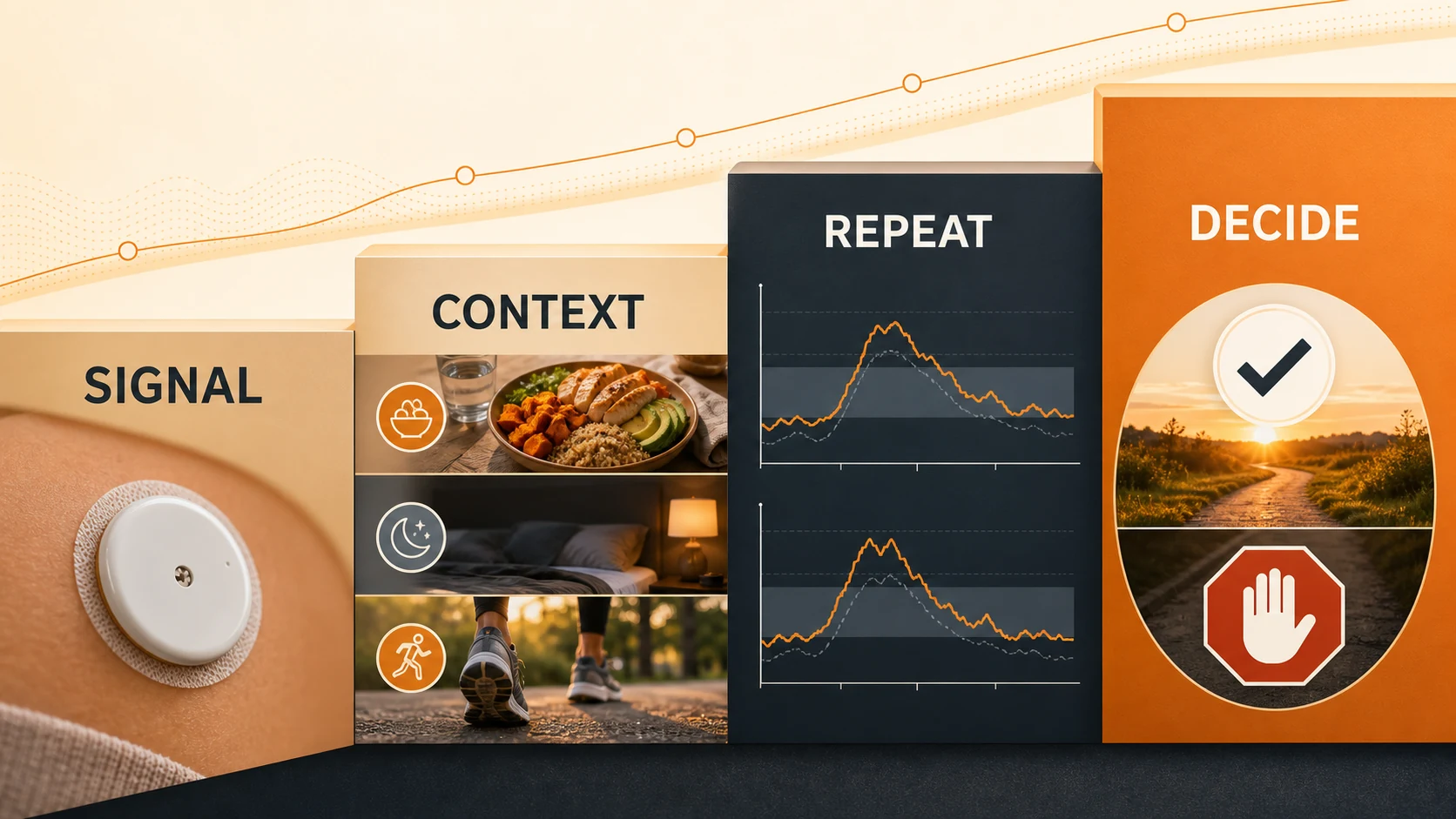
- Define one question, such as whether a ten-minute post-meal walk changes the repeated response to the same lunch.
- Repeat each condition at least twice instead of judging one trace.
- Record sleep, training, meal timing, portion, and unusual stress.
- Compare the full response and how you felt, not only the highest point.
- Keep fruit, legumes, and whole grains unless a qualified professional identifies a reason to change them.
- Stop after two weeks if the data does not improve a concrete decision.
Why Sweat Nutrition Sensors Are Not Yet a Shortcut
Sweat sensors may eventually help estimate electrolyte loss or monitor exercise biomarkers. Current reviews emphasize calibration, motion artifacts, sweat-rate differences, contamination, and person-to-person variability. Sweat sodium, for example, does not directly reveal whole-body hydration without context from fluid intake, body-mass change, environment, and exercise duration.
Privacy and Behavioral Risk Belong in the Buying Decision
- Read what the app stores, shares, and exports before linking health accounts.
- Use the minimum permissions required for the defined experiment.
- Do not assume a wellness app has the same protections as a clinical record.
- Stop if normal variation creates food fear, compulsive checking, or compensatory exercise.
- Confirm persistent abnormal data with appropriate clinical measurement.
Use Simpler Nutrition Decisions First
Before adding another stream of data, review actual gaps with the multivitamin guide, omega-3 guide, and prebiotic guide. Match training fuel to the work with post-workout supplements, and use caffeine alternatives when stimulant use clouds sleep and appetite signals. Endurance context belongs inside triathlon training, not in a glucose score alone.
What to Do This Week
- Write one decision question before buying or wearing a device.
- Standardize meals, timing, sleep, and activity enough to make comparisons interpretable.
- Review whether the data changed a useful behavior after two weeks; stop if it mainly creates anxiety or restriction.
Conclusion
Use a nutritional wearable only when you can name the decision it will inform, standardize the comparison, and avoid turning normal biological variation into fear or food restriction.
Next Step: Turn the Answer Into a Measured Plan
Use the linked PrimeForMen guides to connect this decision with training, nutrition, and recovery instead of treating one method, mineral, or device as a complete system.
Frequently Asked Questions About Nutritional Wearables
What are nutritional wearables?
They are sensors that capture biological signals related to food, metabolism, or hydration. Current consumer examples center on continuous glucose monitoring; many sweat-based nutrition claims remain emerging.
Can a smartwatch measure blood glucose without a needle?
No device that claims to measure glucose solely from a smartwatch or smart ring without piercing the skin is FDA-authorized as of this update. Avoid using such readings for medical decisions.
Are CGMs useful if I do not have diabetes?
Possibly for a defined, supervised question, especially in structured programs or higher-risk groups. For healthy normoglycemic adults, evidence of meaningful long-term benefit remains limited.
Can a CGM tell me which foods are healthy?
No. It shows a glucose response, not fiber, protein quality, micronutrients, satiety, processing, or long-term dietary pattern. Compare repeated standardized meals and preserve overall nutrition quality.
What should I do with an abnormal wearable reading?
Check device instructions and context, then confirm persistent or concerning patterns with a qualified clinician and appropriate laboratory or clinical measurements.
This article is educational and does not replace individualized medical advice, diagnosis, or treatment. Discuss persistent symptoms, hormone concerns, cardiovascular risk, digestive problems, medications, or exercise restrictions with a qualified clinician.
Some links are affiliate links. PrimeForMen may earn a commission at no extra cost to you. Product inclusion does not override evidence, fit, or safety.