
Does ipamorelin increase testosterone? Compare human GH research, FDA safety concerns and the evidence needed for a testosterone claim.
- The human pharmacology study measured growth hormone, not a testosterone benefit.
- A mechanistic explanation does not establish treatment effectiveness.
- Persistent symptoms need a clinical assessment before a treatment decision.
Bottom line Check the study endpoint and population before accepting a testosterone claim, and bring unresolved symptoms or treatment questions to a qualified clinician.

Does ipamorelin increase testosterone? The checked human studies do not establish a useful testosterone benefit. Ipamorelin has been studied for growth-hormone release and postoperative bowel recovery. Those outcomes do not show that it raises resting testosterone, improves low-testosterone symptoms or works as a testosterone treatment.
If you arrived here after seeing a clinic offer, check what its cited research actually measured. This guide separates the endpoints, explains the limits of the US safety information and gives you a worksheet for questions you can bring to an appointment.
Quick Summary: Does Ipamorelin Increase Testosterone?
- Growth hormone (GH) and testosterone are different endpoints. A change in one cannot stand in for a measured benefit in the other.
- The 1999 human pharmacology paper measured ipamorelin and GH, not a demonstrated testosterone treatment benefit.
- A postoperative intravenous trial studied food tolerance after bowel surgery, a very different question from treating low testosterone.
- FDA identifies potential safety concerns and gaps in information for certain injectable routes.
- Persistent symptoms need clinical context. A peptide offer, testimonial or home testing purchase does not provide a diagnosis.
The Prime Perspective
Ask the provider to show the study supporting the outcome they are offering you. A paper can be real, peer reviewed and carefully conducted while answering a different question. Save the exact claim beside the actual endpoint before deciding whether the research applies.
Our editorial policy explains how we handle evidence and commercial recommendations. This is an editorial research review; we have not tested ipamorelin or performed a clinical assessment of you.
What ipamorelin research is about
Ipamorelin is described as a growth-hormone secretagogue, a compound studied for stimulating GH release. The 1998 selectivity paper used laboratory rat pituitary cells and animal experiments. Its selectivity findings describe responses under those experimental conditions. They do not establish long-term safety or treatment effectiveness in men.
On a sales page, the word “selective” needs its experimental context. It describes the responses measured and compared in a study. It does not mean that every other hormone was monitored indefinitely, that adverse effects are impossible or that a proposed human use has been validated.
Testosterone is a separate hormone with its own clinical assessment. You need evidence for the specific claim being made: a repeatable testosterone change, a symptom benefit, or both. Broader language such as “hormone optimization” leaves the actual outcome unclear.
Human evidence: population, endpoint and limits
The table focuses on directly relevant human studies and the FDA review. It is not an exhaustive review of every peptide paper. The central check is whether the study evaluated ipamorelin for the testosterone outcome you care about.
| Source and setting | What was measured | What you can conclude | What remains unestablished |
|---|---|---|---|
| Gobburu and colleagues, 1999: healthy male volunteers; dose-escalation pharmacology | Ipamorelin concentrations and the GH response; eight men at each dose level | A human GH response was observed under that study protocol. | A lasting testosterone increase, improvement in low-T symptoms or an effective treatment course. |
| Beck and colleagues, 2014: hospitalized adults after bowel resection; intravenous ipamorelin versus placebo | Safety and time to tolerate a standardized solid meal; 114 patients in the safety/modified analysis | This was a postoperative bowel-recovery trial. The primary meal-tolerance comparison was not statistically significant. | Testosterone benefit, gym recovery or safety of an outpatient injection plan. |
| FDA’s 2024 compounding advisory briefing | Available pharmacology, clinical evidence and safety information for proposed uses | The review identifies important effectiveness and safety gaps. | A regulator-confirmed testosterone indication or assurance that a proposed regimen is safe. |
The 1999 study supports its measured GH finding. It cannot establish a testosterone benefit that it did not measure.
For the 2014 trial, “tested in humans” leaves out the clinical setting and purpose. Hospital patients after abdominal surgery, an intravenous route and a bowel-recovery endpoint differ from an otherwise healthy man considering a peptide for energy or muscle. The article’s abstract reported similar overall adverse-event incidence between groups and described treatment as well tolerated. That does not erase the route-specific concerns in FDA’s wider review or validate a different use.
Separate the evidence
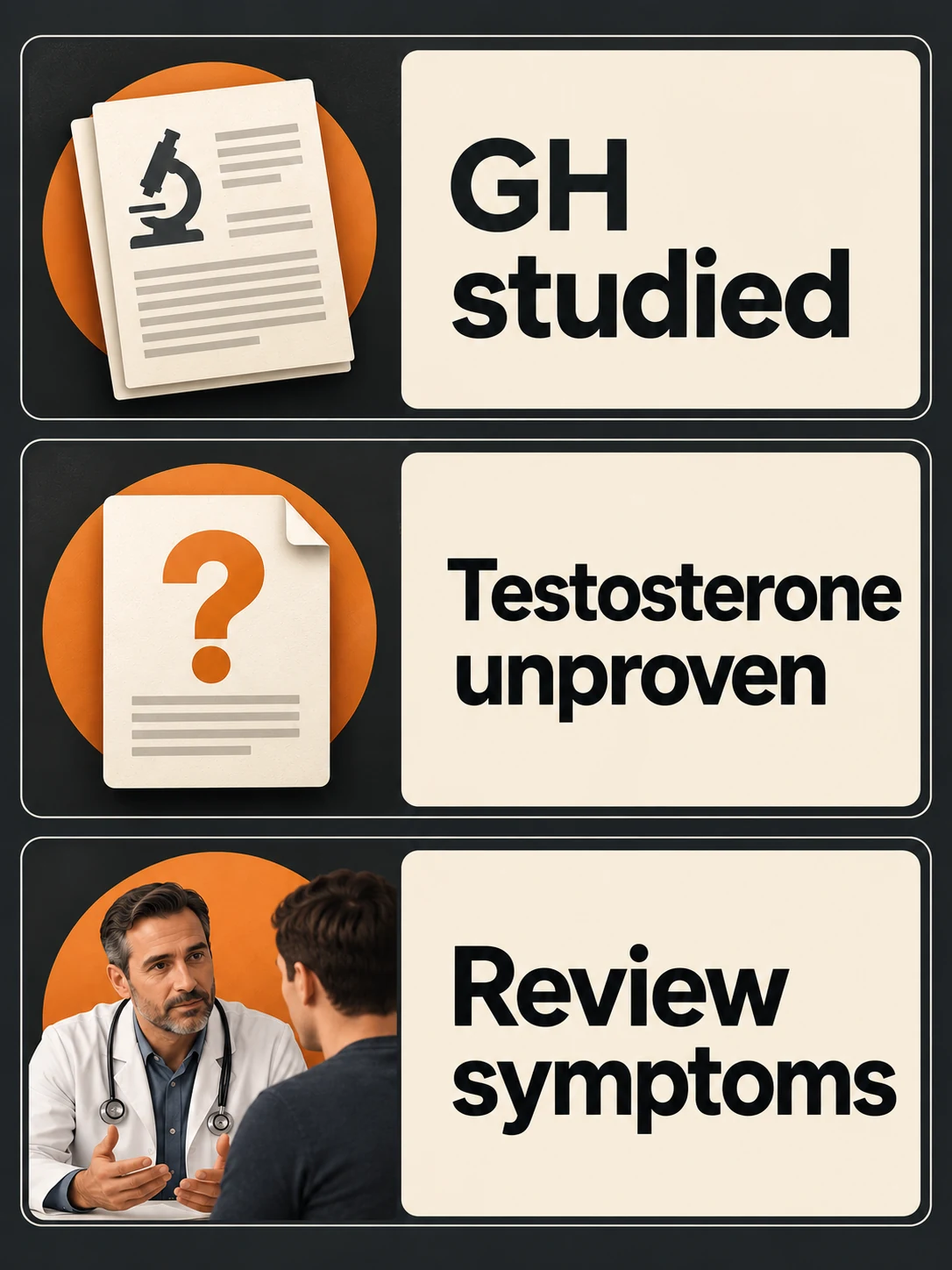
GH research and testosterone evidence answer different questions. Studying GH does not establish a testosterone benefit. Persistent symptoms need a qualified assessment; unproven does not mean a zero effect has been demonstrated.
Silent, 8.5 seconds. Open the animation directly. Playback pauses offscreen; reduced-motion preferences keep playback manual. Essential explanations remain in readable text.
What a testosterone claim would need to show
A useful clinical claim needs a clearly defined population and outcome. An investigation of men with confirmed testosterone deficiency would answer a different question from a single GH response in healthy volunteers. It would also need enough follow-up to assess whether any improvement lasts and what adverse events occur.
When reading a claim, separate these four questions:
- Did the investigators measure testosterone with an appropriate method and collection schedule?
- Was there a comparison that helps distinguish treatment effects from ordinary variation or other changes?
- Did the participants experience a meaningful improvement in the symptoms or function the offer promises?
- Were harms, discontinuations and follow-up reported for the actual route and treatment being proposed?
A mechanistic explanation may suggest a research question. It cannot fill in missing clinical outcomes. The same evidence check applies to claims about peptides and testosterone: a shared word such as “hormone” does not make different compounds interchangeable.
A worked example: a correct citation with an unsupported promise
Suppose an offer says, “This human study proves ipamorelin improves testosterone and energy,” then links to the 1999 paper. Read the methods and measured outcomes first. If the cited evidence is a GH pharmacology study, write “GH response” in the endpoint field. Ask where the testosterone and symptom results are reported.
If the offer changes to “it may improve hormones indirectly,” the evidence requirement still depends on the promised outcome. “Indirectly” describes a proposed route of action; it does not establish that the outcome happened. A cautious-sounding phrase should not replace a study result.
Combination treatment makes attribution harder
A before-and-after result from someone using testosterone therapy and several other products cannot isolate ipamorelin’s effect. The same applies if their training, food intake or health changed during the comparison. Record what else was used and ask how the proposed evidence separated those influences.
Research on another GH secretagogue also needs its own identity check. A study of a different compound, mixture or route cannot automatically support ipamorelin. Our peptide and muscle-growth guide discusses that broader evidence problem.
FDA safety information: read the route and setting
On the FDA safety-risk page checked for this update, ipamorelin acetate appears under category 2 of the 503B interim policy and in the additional safety-risk section. FDA raises potential immunogenicity concerns involving aggregation or peptide-related impurities and reports insufficient safety information for certain other injectable routes.
The page also notes serious adverse events, including death, reported in literature involving intravenous use for gastric motility. That statement does not establish that ipamorelin caused each event or give a risk rate for subcutaneous fitness use. It does establish a reason to take the reported uncertainty seriously.
Compounding status and drug approval are different matters. FDA explains that compounded drugs are not FDA approved; the agency does not review their safety, effectiveness and quality before marketing. A prescription or a licensed pharmacy therefore does not, by itself, prove the promised testosterone benefit. Compounding can serve legitimate medical needs, but its availability is not evidence for every advertised use.
The practical questions are specific: What is the proposed product? What outcome is being treated? What evidence covers that population and route? What uncertainties should be discussed? This article does not provide injection instructions, sourcing advice or a dosing schedule.
Check what an ipamorelin claim would need
Select the claim and the evidence you have actually found. The helper identifies questions to check; it does not verify a paper, diagnose a condition or recommend treatment.
Use the evidence table to compare the actual endpoint, participants and treatment with the claim. A GH study cannot establish a testosterone benefit. Persistent symptoms and any proposed treatment need a qualified clinical assessment.
Persistent symptoms: prepare for an assessment
Fatigue or a change in libido can prompt a clinical conversation without identifying the cause. The Endocrine Society’s July 2026 statement emphasizes symptoms together with consistently low, accurately measured testosterone. Symptoms alone do not diagnose hypogonadism, and population screening of asymptomatic men is not generally supported by sufficient evidence.
Bring the timeline, current medicines and supplements, recent illness and any existing results. If a clinician recommends testing, ask how to prepare and whether a repeat early-morning fasting sample is needed. Avoid interpreting a single number without the method, reference range and clinical context. The Society’s patient guide explains the assessment and why the cause matters.
You do not need to arrive with a self-selected panel of pituitary, thyroid and metabolic tests. Let the assessment determine which further investigations are appropriate. A useful opening is: “This symptom has persisted since this date. What explanations should we consider, and what would change the next step?”
When low-testosterone symptoms need a clinical conversation
Mayo Clinic urologist Gregory Broderick explains why symptoms of testosterone deficiency deserve a discussion with a healthcare team. This short clip provides clinical context; it does not discuss ipamorelin or demonstrate its effectiveness.
Watch this Mayo Clinic clip on YouTube if the embed does not play.
Questions worth taking to a treatment discussion
- What diagnosis or unresolved symptom is this proposal intended to address?
- Which human study supports the specific benefit being offered?
- Does it match the actual product, route, population and length of treatment?
- What uncertainty remains, and what alternatives should be considered?
- Who should I contact if I feel unwell or have concerns about a treatment already in use?
For ordinary training decisions, our weight-lifting evidence guide and rest and recovery guide keep exercise planning separate from diagnosis. Neither turns a training habit into proof of treatment for testosterone deficiency.
Keep your review with you
Use the eight-field research and appointment sheet to keep the quoted claim, study endpoint and unanswered questions together. No purchase is needed. You can fill and save the PDF or print a blank copy.
Download my research and appointment notes (fillable PDF). The helper print button creates a separate record with your current choices, notes and checkmarks.
What to do this week
- Save the exact claim and its citation. A screenshot of the sales claim can help keep the wording consistent during your review.
- Read the population, comparison and measured endpoint. Use the table and helper to identify any mismatch.
- If symptoms persist or treatment has been offered, bring your questions and current treatment list to a qualified clinician.
- Keep any agreed next step in the worksheet. Do not add a peptide or hormone-testing purchase simply because an advertisement supplies a link.
Conclusion: check the promised outcome
The checked human GH and postoperative studies do not establish ipamorelin as a testosterone treatment. Record what a cited paper actually measured, then ask for evidence covering the benefit and use being offered. For continuing symptoms, a clinical assessment provides the context a sales claim cannot.
Use our testosterone evidence hub to compare other lifestyle and supplement claims, including their limits.
Frequently asked questions
Does ipamorelin increase testosterone directly?
The checked human papers do not establish a clinically useful direct testosterone increase. Their GH and bowel-recovery findings cannot be substituted for testosterone outcomes. This evidence gap is not proof that every possible effect is zero.
Is ipamorelin the same as testosterone therapy?
No. Ipamorelin is studied as a GH secretagogue. Testosterone therapy and its clinical indications involve a different treatment question. One is not established as a substitute for the other.
Does a rise in GH prove better energy, muscle or libido?
Those are separate outcomes. A study needs to measure the promised benefit under relevant conditions; a GH result alone does not establish it.
Does medical supervision make ipamorelin risk free?
No. Supervision can support a clinical discussion, but it does not remove missing evidence, product-quality concerns or the safety uncertainties FDA identifies. Ask about the actual route, use and product.
Should I buy a home testosterone test before deciding?
This guide does not recommend a test purchase. If symptoms or existing results concern you, ask a clinician whether testing is appropriate and how its timing, method and interpretation should be handled.
Medical Disclaimer
This article is educational and does not diagnose a hormone condition or recommend a drug, compounded product or treatment change. Discuss persistent symptoms and any proposed or current treatment with a qualified healthcare professional. Serious or rapidly worsening symptoms require appropriate urgent care.