

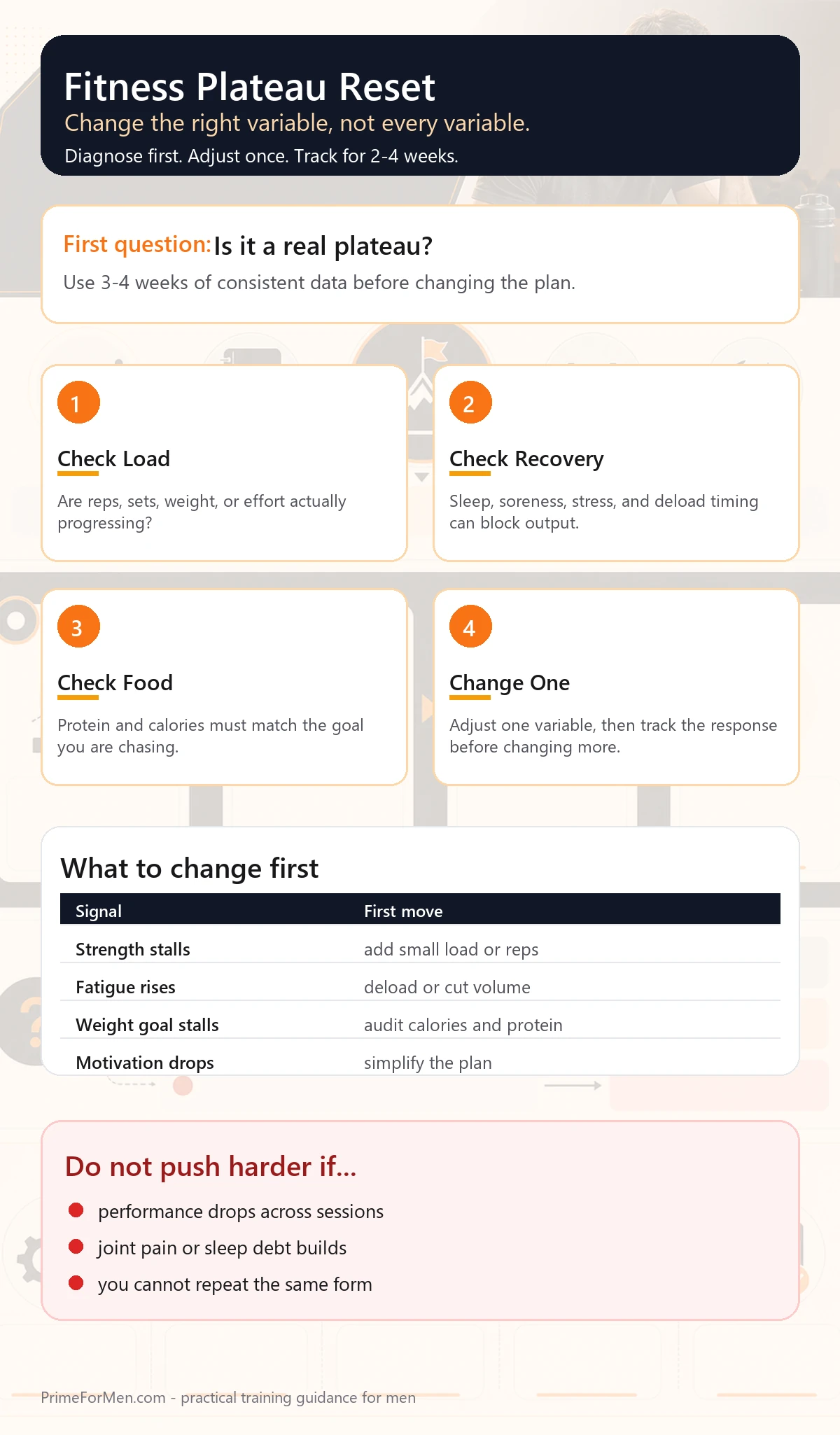
Overcoming fitness plateaus starts with diagnosis, not more random effort. If your lifts, body composition, endurance, or motivation have stalled, the first move is to confirm what stopped progressing, then adjust one variable at a time: load, volume, recovery, nutrition, or exercise selection.
TL;DR
- Do not panic after one bad week. Treat it as a real plateau only after 3-4 weeks of consistent tracking.
- Start with the metric. Strength, muscle, fat loss, and conditioning plateaus need different fixes.
- Change one variable. Add load, reduce fatigue, adjust calories, or simplify the plan, but do not change everything at once.
- Recovery is not optional. Poor sleep, stress, and no deload can look like a training problem.
- Use a 2-4 week reset. Make one targeted change and track the response before making the next move.
The Prime Perspective
A plateau is not proof that you need a harder workout. It is feedback that your current inputs no longer match your goal. The disciplined move is to stop guessing, review the data, and make the smallest effective correction.
For most men, the fix is not a completely new program. It is better progression, cleaner recovery, and fewer random changes.
What Counts as a Real Fitness Plateau?
A real plateau is a measurable stall despite consistent training, nutrition, and recovery. One flat workout is normal. A stressful week is normal. A plateau is when the same metric refuses to move for several weeks while your inputs stay mostly stable.
That distinction matters because many men try to solve normal fatigue with program chaos. They add exercises, change rep ranges, cut calories harder, or chase a new split before they know what actually broke.
| Plateau Type | What It Looks Like | First Check |
|---|---|---|
| Strength plateau | Same weight, reps, or bar speed for 3-4 weeks. | Progression method, fatigue, exercise order, and deload timing. |
| Muscle-gain plateau | Measurements and photos stop changing. | Weekly hard sets, proximity to failure, protein, calories, and sleep. |
| Fat-loss plateau | Scale and waist stop moving across multiple weekly averages. | Calories, steps, tracking accuracy, weekend intake, and water shifts. |
| Conditioning plateau | Pace, heart-rate response, or work capacity stalls. | Intensity distribution, recovery, and whether every session is too hard. |
If your issue is mostly training structure, start with strength training basics. If your issue is fatigue, look at muscle recovery techniques before adding more volume.
Why Fitness Plateaus Happen
Most plateaus come from one of five causes: the stimulus stopped increasing, fatigue is hiding your fitness, recovery is too weak, nutrition no longer matches the goal, or the plan is too inconsistent to measure.
The American College of Sports Medicine’s resistance-training guidance emphasizes progression, specificity, and appropriate manipulation of training variables. In plain English: your body adapts to what you repeatedly ask it to do, so progress requires planned changes, not random novelty. The ACSM resistance training position stand infographic is a useful high-level reference for that logic.
Stimulus Is Too Low
The workout feels familiar because it is familiar. Same loads, same reps, same rest, same result.
Fatigue Is Too High
You may be fit enough to progress, but too tired to express it. This is where deloads matter.
Inputs Are Too Messy
If sleep, calories, steps, and sessions swing wildly, it is hard to know what caused the stall.
The 2-4 Week Plateau Reset Plan
This is the practical reset. Do it before you change your entire program. The goal is to create a clean signal: one targeted change, enough time to respond, and no panic edits after every workout.
| Week | Action | What to Track |
|---|---|---|
| Week 0 | Confirm the plateau with 3-4 weeks of logs, photos, measurements, or performance data. | Training load, reps, body weight averages, sleep, soreness, and energy. |
| Week 1 | Choose one lever: add load, add reps, reduce fatigue, adjust food, or simplify the split. | The exact variable changed and how performance feels. |
| Week 2-3 | Hold the plan steady. Do not keep editing because one session feels off. | Trend line, not single-day noise. |
| Week 4 | Decide: keep the change, deload, or make the next targeted adjustment. | Whether the main metric moved and whether fatigue improved. |
If you train mostly at home, this reset works well with strength training at home or a full body home workout. The principle is the same: measure the main lift or movement pattern, then progress it deliberately.
Useful Tools for Breaking a Plateau
You do not need more gadgets to restart progress. These three categories help only if they make tracking, loading, or variation easier.
Training Log or Workout Journal
Best fit if you keep guessing what you lifted last week.
- Makes progressive overload visible instead of vague.
- Helps spot repeated stalls before you overreact.
- Useful for tracking sleep, soreness, and session quality alongside sets.
Resistance Bands
Best fit if you need more pulling, warm-up, assistance, or joint-friendly variation.
- Adds rows, face pulls, and band pull-aparts without a full cable station.
- Helps vary resistance without rewriting the whole program.
- Useful for deload weeks, warm-ups, and higher-rep accessory work.
Adjustable Dumbbells or Fractional Plates
Best fit if your current load jumps are too large to progress smoothly.
- Supports smaller increases when big weight jumps stall.
- Works well for home training where equipment options are limited.
- Helps keep progression measurable across presses, rows, squats, and hinges.
*Affiliate disclosure: PrimeForMen may earn a commission if you buy through these links, at no extra cost to you. Recommendations are based on use-case fit for this article.
Which Variable Should You Change First?
The best change depends on the signal. This is where many plateau fixes go wrong. Men often add volume when they actually need recovery, or change exercises when they simply need smaller load jumps.
If Strength Is Stuck
Add the smallest practical load increase, add one rep per set, or use a top-set plus back-off structure. If performance is dropping, deload first.
If Muscle Growth Is Stuck
Check hard sets, exercise execution, protein, and calories. More sets help only when recovery can support them.
If Fat Loss Is Stuck
Use weekly averages. Then audit calories, protein, steps, and weekend intake before cutting harder.
If Energy Is Stuck
Reduce noise. Sleep, stress, and too many hard sessions can create the feeling of a plateau even when the plan is fine.
The American Council on Exercise gives a similar practical frame: plateaus often come from repeating the same stimulus, insufficient recovery, or nutrition and lifestyle mismatches. Their guidance on why people hit fitness plateaus is useful because it does not treat harder training as the only answer.
When a Deload Beats More Work
A deload is a planned reduction in training stress. It is not quitting. It is a way to let fatigue drop so performance can show up again.
Consider a deload if your performance is falling across multiple sessions, joints feel worse, sleep is poor, motivation is unusually low, or every set feels heavier than it should. During a deload, reduce volume, load, or both for several sessions, then resume progression.
If you need a lower-stress bridge week, use active recovery workouts instead of forcing another max-effort block.
Do Not Push Harder If These Are Present
- Joint pain is increasing or changing your technique.
- Performance is dropping across multiple workouts, not just one session.
- Sleep, appetite, mood, or motivation are clearly worse than normal.
- You cannot repeat the same form with the same load.
- You are using intensity to compensate for poor tracking.
Nutrition Fixes for Fitness Plateaus
Nutrition depends on the plateau type. For strength and muscle gain, too few calories or too little protein can limit adaptation. For fat loss, the issue is often calorie creep, lower daily movement, or relying on single weigh-ins instead of weekly averages.
Start simple: protein at each meal, a consistent calorie target, enough carbs around demanding sessions, and hydration that does not depend on feeling thirsty. If you use supplements, keep them secondary. Basics matter more than a new product stack.
For recovery support, post workout supplements can be useful only after food, training structure, and sleep are already in order.
Conclusion
Overcoming fitness plateaus is not about proving you can suffer more. It is about finding the missing constraint. Confirm the plateau, identify the metric, choose one variable, and track the response for 2-4 weeks.
If the signal is low stimulus, progress the training. If the signal is high fatigue, deload. If the signal is inconsistent food or sleep, fix the inputs before blaming the workout. The goal is not novelty. The goal is progress you can repeat.
Medical Disclaimer: This article is for general fitness education only. It is not medical advice, diagnosis, or treatment. If you have pain, injury symptoms, cardiovascular concerns, or a medical condition, talk with a qualified professional before changing training intensity.
Affiliate Disclosure: Some product links may earn PrimeForMen a commission at no extra cost to you. Recommendations are based on practical fit for the training problem discussed.
Frequently Asked Questions About Overcoming Fitness Plateaus
How long does a fitness plateau last?
A real plateau usually means the same metric has stalled for at least 3-4 weeks despite consistent training and recovery. One bad week is usually not enough evidence.
Should I train harder or deload?
Train harder if performance is stable and the stimulus is too low. Deload if performance is dropping, soreness is rising, sleep is poor, or joints are irritated.
How do I know if nutrition is causing the plateau?
Check protein, calorie consistency, body weight averages, and weekend intake. If these are inconsistent, fix them before changing the program.
Which training variable should I change first?
Change the variable most tied to your goal: load or reps for strength, hard sets for muscle, calories and steps for fat loss, and intensity distribution for conditioning.
When should I ask a trainer or clinician?
Ask a trainer if technique, programming, or progression is unclear. Ask a clinician if pain, dizziness, unusual fatigue, or injury symptoms appear or persist.