Rowing workout guide: learn stroke sequence, drag factor, pacing, beginner intervals, endurance sessions, strength support, and a four-week plan.
- The rowing stroke is a sequence, not a simultaneous full-body pull.
- Higher drag is not automatically a harder or better workout.
- Split time should improve without sacrificing posture or stroke length.
Bottom line Own the sequence at a sustainable stroke rate, build easy minutes, then add intervals only while the same stroke survives fatigue.
Rowing Workout works when every session has a defined job and the weekly load remains recoverable. The plan below separates technique, endurance, speed, strength, and recovery so effort produces adaptation instead of random fatigue.
This is a general training framework, not an individualized medical or coaching prescription. Adjust it for your sport history, current capacity, equipment, and competition calendar.
Quick Summary: Rowing Workout Guide
- The drive sequence is legs, body swing, arms; recovery reverses it to arms, body, legs.
- Drag factor changes the feel of the flywheel but does not replace effort or technique.
- Easy rowing, threshold work, and sprint intervals create different adaptations and should not be blended blindly.
- Fatigue can increase lumbar flexion at the catch, especially during prolonged ergometer work.
- Persistent back pain, chest symptoms, faintness, or neurological changes require qualified assessment.
The Prime Perspective
Rowing feels brutally honest because every rushed recovery and early arm pull appears on the monitor. Use that feedback to improve the stroke—not to chase one impressive split at the expense of the next thousand meters.
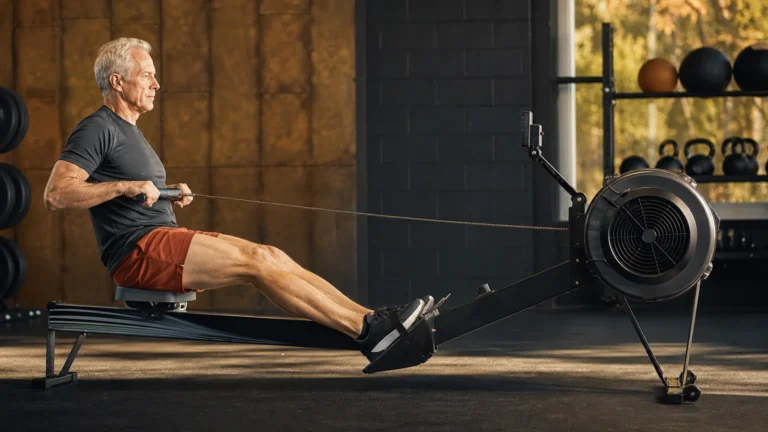
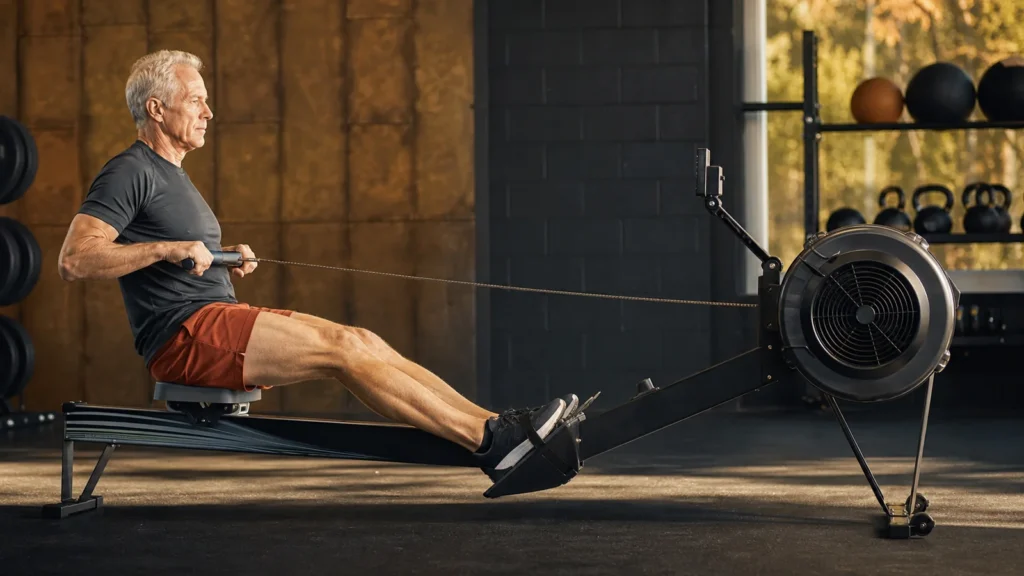
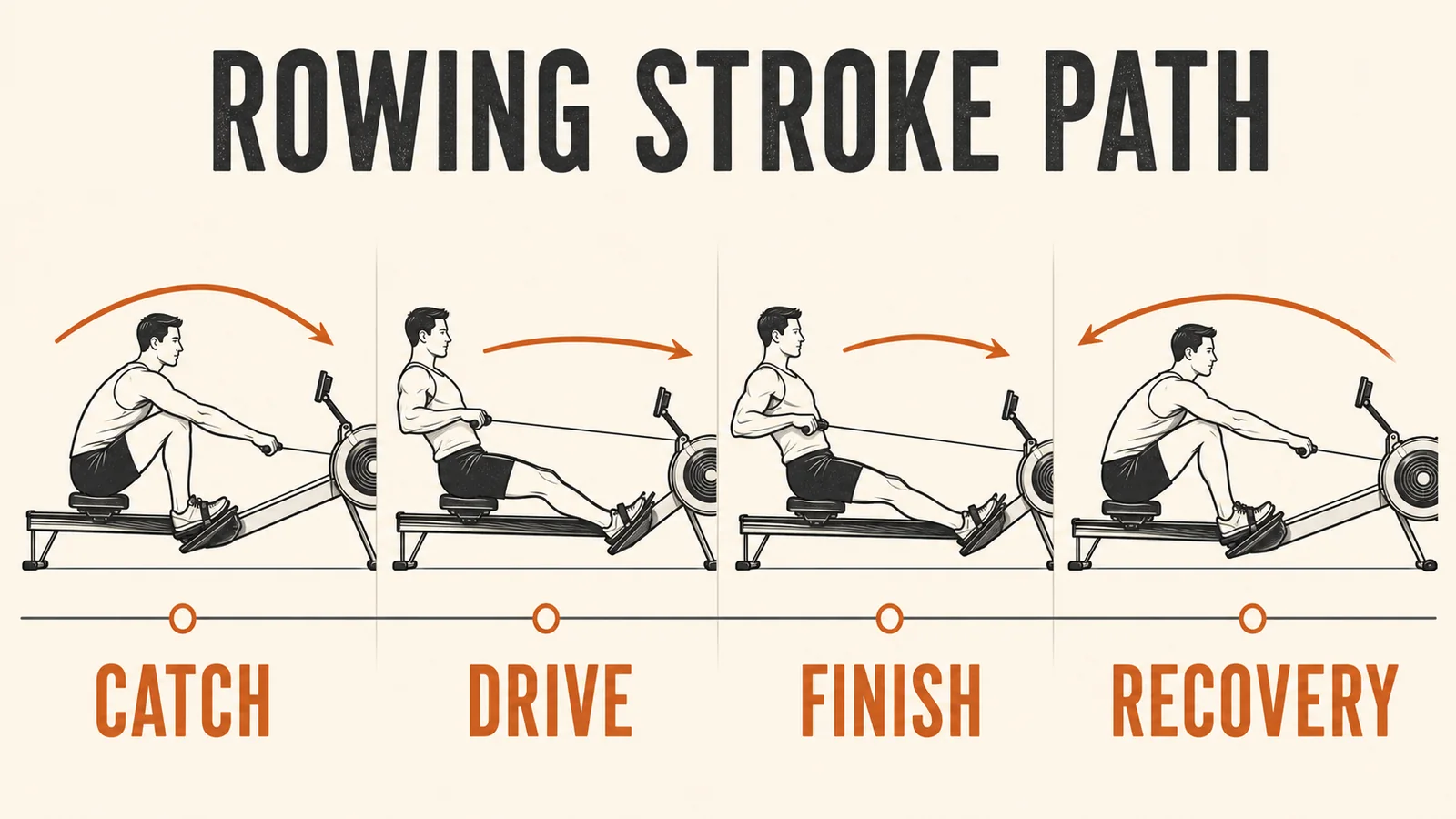
The drive is legs, body, then arms. The recovery reverses that order: arms away, body pivots forward, then knees bend and the seat rolls toward the catch. Keeping those phases distinct prevents the handle and knees from colliding.
Learn the Stroke Before You Chase the Split
| Phase | Body position | Primary action | Common error |
|---|---|---|---|
| Catch | Shins near vertical, torso braced | Prepare pressure | Overreaching and rounding |
| Drive 1 | Arms long | Push the machine away with the legs | Pulling early with the arms |
| Drive 2 | Legs nearly straight | Open the hips | Throwing the shoulders back |
| Finish | Handle near lower ribs | Complete with the arms | Leaning excessively |
| Recovery | Arms, body, then legs | Return calmly | Rushing the slide |
Use the pick drill to isolate the order: row with arms only, then arms plus body, then half slide, then full strokes. Keep pressure low enough that you can feel when the sequence changes.
Amazon Product Shortlist
These products address access, comfort, and floor setup. PrimeForMen has not independently tested them. A new machine or cushion cannot correct poor technique or diagnose back pain.

YOSUDA Magnetic Rowing Machine
For home users who need a foldable magnetic rower and have confirmed the machine fits their dimensions and training needs.
- Magnetic resistance and foldable frame.
- Tablet holder and app support.
- Compare rail length, footprint, and service before buying.

Rowing Machine Gel Seat Cushion
For rowers whose seat comfort—not technique or back pain—is limiting otherwise appropriate sessions.
- Designed for several common rower seats.
- Non-slip gel pad format.
- Confirm dimensions and stop if posture worsens.

Rowing Machine Floor Mat
For protecting floors and stabilizing a home rower in a dedicated training space.
- Sized for common indoor rowers.
- Helps contain sweat and floor wear.
- Check footprint and floor compatibility.
*As an Amazon Associate, PrimeForMen earns from qualifying purchases. Availability and prices can change.
Use a moderate damper setting and, when available, check the machine’s drag factor. The goal is a connected stroke that allows acceleration without yanking. Higher drag is not equivalent to better fitness and may increase technical strain.
Damper, Drag Factor, Stroke Rate, and Split
- Damper: changes airflow into the flywheel on many machines.
- Drag factor: the monitor estimate of flywheel deceleration; dust and machine condition can change it at the same damper number.
- Stroke rate: strokes per minute. Rate tells you frequency, not force quality.
- Split: projected time per 500 meters. Lower is faster, but it is meaningful only with consistent conditions and technique.
Beginners often raise rate to go faster, shortening the drive and rushing recovery. First learn to create more useful pressure per stroke at roughly 18 to 24 strokes per minute. Then practice higher rates without losing length.
Four Rowing Workouts With Different Purposes
Technique session — 20 minutes
5 minutes easy, then 5 rounds of 2 minutes smooth rowing and 1 minute drill work. Finish with 5 minutes easy.
Endurance session — 30 to 45 minutes
Continuous conversational rowing at 18 to 24 strokes per minute. Split should remain stable or improve slightly without extra strain.
Threshold session — 3 x 8 minutes
Row hard but controlled with 4 minutes easy between pieces. The final interval should stay within a few seconds per 500 meters of the first.
Short interval session — 8 x 1 minute
Row briskly with 90 seconds easy. Use enough recovery to preserve the stroke sequence and target pace.
A Four-Week Beginner Progression
| Week | Session 1 | Session 2 | Session 3 |
|---|---|---|---|
| 1 | 20 min technique | 6 x 1 min / 2 min easy | 20 min easy |
| 2 | 25 min easy | 8 x 1 min / 90 sec easy | 20 min technique |
| 3 | 30 min easy | 4 x 4 min / 3 min easy | 20 min technique |
| 4 | 20 min easy | 6 x 1 min relaxed | Optional benchmark or rest |
Keep strength training on one or two nonconsecutive days. Do not add rowing time, interval intensity, and lifting volume simultaneously.
Rowing does not guarantee back pain, but prior symptoms, prolonged ergometer exposure, fatigue, and loss of hip-pelvis control can raise risk. Reduce load when technique deteriorates and seek assessment for persistent or neurological symptoms.
A systematic review of rowing biomechanics and low-back pain found that fatigue increased lumbar flexion at the catch, especially on an ergometer, and that rowers with pain showed different pelvic and trunk patterns. The authors could not recommend one ergometer type as safer.
A broader scoping review of 78 rowing studies identified prior back pain and prolonged ergometer use as meaningful risk factors while also describing fragmented evidence. That supports load management and coaching—not fear or one rigid posture rule.
Strength Work That Supports the Stroke
Rowing uses the legs to create force, the trunk to transfer it, and the upper body to finish the stroke. Use squats or leg presses, Romanian deadlifts, split squats, rows, pulldowns, and anti-flexion trunk work. Keep the hinge controlled and avoid exhausting the lower back immediately before hard rowing.
A network meta-analysis on rowing performance reported that usual rowing already includes varied intensity and found only small additional effects from some training and nutrition strategies. See the rowing performance review. The practical lesson is to evaluate the whole program, not chase one exotic interval.
Benchmark Without Turning Every Week Into a Test
A 2,000-meter test is demanding and useful for some competitive goals. Beginners can use a 10-minute steady piece, 20-minute distance, or fixed-heart-rate split as a lower-cost benchmark. Repeat the same machine, drag factor, warm-up, and conditions so the comparison means something.
Stroke rate and split are not technique measures. A faster display can hide shortened strokes, rushed recovery, and more spinal flexion. Use video, force feel, and repeatability alongside monitor data.
Build the Full Rowing Base
Use cardio workouts, home core training, strength-training basics, unilateral training, foam-roller guidance, and recovery planning.
What to Do This Week
- Film ten easy strokes from the side.
- Practice legs–body–arms and arms–body–legs at low pressure.
- Complete two 20-minute easy sessions.
- Add one controlled 6 x 1-minute interval session.
- Stop adding volume if posture or back symptoms worsen.
Conclusion
Own the sequence at a sustainable stroke rate, build easy minutes, then add intervals only while the same stroke survives fatigue.
Next Step: Build the Full Sports-Specific System
Connect this program to the PrimeForMen sports-specific training guide so skill, strength, conditioning, and recovery support the same goal.
Rowing Workout: Frequently Asked Questions
What is a good rowing workout for beginners?
Start with 15 to 20 minutes alternating two minutes easy rowing and one minute very easy. Keep stroke rate controlled and stop the interval if sequence or posture deteriorates.
How long should a rowing workout be?
Beginners may start with 10 to 20 minutes; conditioned rowers may use 30 to 60 minutes or structured intervals. Purpose and technical quality matter more than duration alone.
What stroke rate should I use on a rowing machine?
Many easy sessions work around 18 to 24 strokes per minute, but body size, skill, intensity, and machine differ. Use the lowest rate that supports a long, connected stroke.
Should I set the rowing-machine damper to 10?
Usually no. A high damper creates a heavier feel and can encourage poor mechanics. Start moderate, check drag factor if available, and generate intensity through force and pace.
Is rowing bad for the lower back?
Rowing is not inherently bad for the back, but prior pain, excessive fatigue, prolonged ergometer exposure, and poor hip-spine coordination can raise risk. Progress gradually and seek help for persistent symptoms.
This article is educational and does not replace individualized medical advice, diagnosis, or treatment. Discuss persistent symptoms, hormone concerns, cardiovascular risk, digestive problems, medications, or exercise restrictions with a qualified clinician.
Some links are affiliate links. PrimeForMen may earn a commission at no extra cost to you. Product inclusion does not override evidence, fit, or safety.