

Testosterone for muscle growth is the “master amplifier” of the male body, turning your hard work in the gym into actual, visible results. If you’ve been hitting the iron, eating your protein, and still looking the same in the mirror as you did six months ago, you aren’t crazy—you might just be running low on the biological fuel required to build a physique.
This isn’t just about “getting huge.” It’s about how your body functions at a cellular level. In this guide, we’re going to strip away the locker-room myths and look at the hard science of how testosterone builds muscle, how to know if you’re deficient, and whether medical intervention or natural optimization is your best path forward.
Key Takeaways (TL;DR)
- The Protein Engine: Testosterone builds muscle primarily by increasing protein synthesis and activating satellite cells for repair.
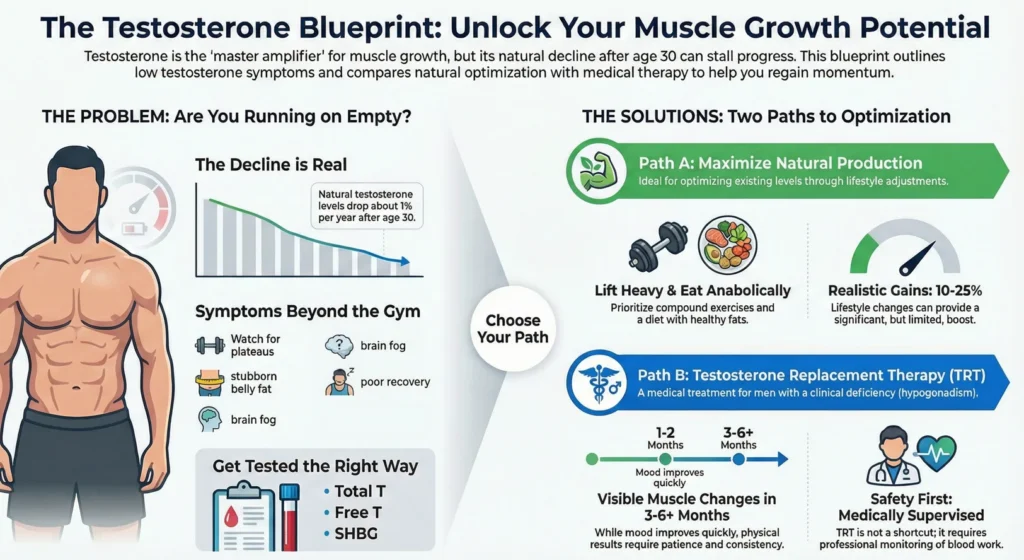
- The Decline is Real: Natural T levels drop about 1% per year after age 30, making “lifestyle gains” harder to keep.
- Natural vs. Medical: You can see a 10-25% bump from lifestyle changes, but clinically low levels often require Testosterone Replacement Therapy (TRT).
- Beyond the Gym: Optimal T affects mood, energy, and fat loss just as much as it affects your bench press.
- Safety First: TRT is a medical treatment, not a “cycle.” It requires professional monitoring of blood markers like estradiol and hematocrit.
🏃♂️ The Prime Perspective
I remember hitting my late 40s and feeling like the “rules” of the gym had suddenly changed without my permission. I was still following the same heavy lifting programs that made me strong in my 30s, but the recovery just wasn’t there. I’d wake up feeling like I’d been hit by a truck after a basic leg day.
My joints hurt, my motivation was flagging, and—worst of all—I was getting weaker despite trying harder. I assumed it was just “part of getting old.” It wasn’t until I took a hard look at my blood work that I realized my biological “foreman” (testosterone) had basically walked off the job site. Once I addressed the hormonal gap, the work I put in finally started showing up in the mirror again. The lesson? You can’t out-hustle a hormone deficiency.
The Science of Gains: How Testosterone Actually Builds Muscle
When we talk about testosterone for muscle growth, we aren’t talking about magic. We’re talking about biology. Testosterone acts like a chemical messenger that enters your muscle cells and delivers a specific set of instructions: Build more.
The Foreman on the Construction Site: Increasing Protein Synthesis
Think of your muscle cells like a construction site. You provide the bricks (protein) and the labor (lifting weights). But without a foreman to tell the workers to get moving, those bricks just sit in a pile. Testosterone is that foreman. It binds to androgen receptors in your muscle tissue, triggering “protein synthesis.” This is the process where your body repairs the micro-tears caused by lifting, making the fibers thicker and stronger than before.
Repairing and Rebuilding: The Role of Satellite Cells
Lifting weights creates damage. To fix that damage, your body uses “satellite cells”—specialized stem cells that live on the outside of your muscle fibers. Testosterone makes these cells more active. They rush to the site of the damage, fuse with your muscle fibers, and donate their nuclei. This doesn’t just repair the muscle; it actually increases its capacity for future growth.
The Defensive Line: Testosterone’s Anti-Catabolic Shield
Building muscle is only half the battle; you also have to keep it. Cortisol is the “stress hormone” that likes to break down muscle tissue for energy (catabolism). Testosterone acts as a shield, blocking cortisol from binding to your cells. This is why guys with high T can stay leaner and more muscular even when they’re stressed or in a slight calorie deficit.
💡 What Most Guys Miss
Most articles focus on “Total Testosterone,” but that’s a mistake. About 98% of your T is “bound” to proteins like SHBG (Sex Hormone-Binding Globulin), making it useless for muscle growth. What really matters is your Free Testosterone—the unbound fraction that is actually bioavailable to hit those androgen receptors and trigger growth. If your SHBG is too high, you can have a “normal” total T score and still feel like you have Low T.
The Limiting Factor: Could Low Testosterone Be Holding You Back?
If you’re doing everything right—progressive overload, hitting your protein, and sleeping—but you’re still soft, it’s time to look at the numbers.
Symptoms That Go Beyond the Gym
Low T doesn’t just make you small; it makes you miserable. Watch out for these red flags:
- The Plateau: You haven’t added weight to your main lifts in months.
- The “Spare Tire”: You’re gaining fat around the middle despite a clean diet.
- Brain Fog: You feel unmotivated, indecisive, and sluggish.
- Poor Recovery: You’re sore for four days after a moderate workout.
- Low Libido: The “fire” just isn’t there like it used to be.
How to Get Tested (The Right Way)
Don’t just ask your doctor for a “testosterone test.” You need a full panel to see the whole picture. According to the Endocrine Society, you should get your blood drawn early in the morning. Ask for:
- Total Testosterone
- Free Testosterone (The muscle-builder)
- SHBG (The T-grabber)
- Estradiol (E2) (To check your estrogen balance)
- LH & FSH (To see if your brain is signaling production)
Path A: Maximizing Your Natural Testosterone Production
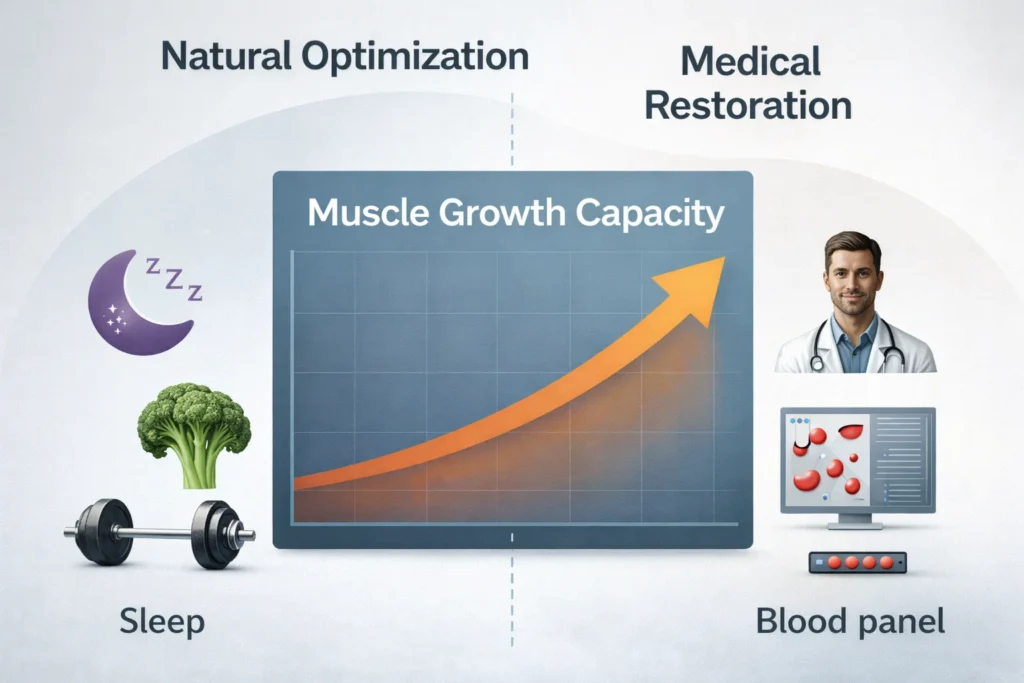
Before you jump to the needle, you need to make sure your lifestyle isn’t sabotaging you. You can often see a significant bump in levels by fixing the basics.
Lift Heavy and Smart
Not all exercises are created equal. To spike T, you need compound movements that recruit the most muscle mass. We’re talking squats, deadlifts, and heavy presses.
The Anabolic Diet
Your body needs cholesterol to make testosterone. If you’re on a “zero-fat” diet, you’re starving your hormone production. Focus on:
- Healthy Fats: Eggs, avocados, and olive oil.
- Adequate Calories: Prolonged cutting phases crash your T levels.
- Zinc and Magnesium: Check out our guide on Magnesium for Testosterone.
Realistic Expectations: What the Science Says You Can Achieve Naturally
Lifestyle changes can produce a meaningful increase—usually between 10% and 25%. For a guy with a level of 400 ng/dL, that might get him to 500 ng/dL. While significant for mood and health, it may not be enough to overcome a clinical deficiency or “hypogonadism.”
Path B: A Deep Dive into Testosterone Replacement Therapy (TRT)
Sometimes, “natural” isn’t enough. If your testicles or pituitary gland aren’t doing their job, no amount of kettlebell complexes will fix it.
The TRT Timeline: What to Expect
TRT is not an overnight fix. Here is the typical timeline for testosterone for muscle growth:
- Weeks 1-4: Improved mood, better sleep, and a “kick” in libido.
- Months 1-3: Better recovery time and increased gym stamina.
- Months 3-6+: Visible changes in lean muscle mass and fat loss.
Comparing TRT Methods
| Method | Pros | Cons | Typical Monthly Cost |
| Injections | Most stable and effective for growth. | Requires needles; peaks and troughs. | $20 – $100 |
| Gels/Creams | No needles; easy to use daily. | Risk of transference; varied absorption. | $100 – $300 |
| Pellets | “Set it and forget it” for months. | Minor surgery; harder to adjust dose. | $300 – $500 |
✅ Your 24-Hour Action Plan
- Step 1: Call your doctor and schedule a morning blood panel for Total T, Free T, and SHBG.
- Step 2: Audit your sleep. Set a strict “no-screen” rule 60 minutes before bed tonight.
- Step 3: Swap your isolation workout tomorrow for a session focused on heavy compound lifts.
Testosterone for Muscle Growth FAQ
How long does it take to see muscle growth from increased testosterone?
Visible changes in muscle mass typically take 3 to 6 months of consistent resistance training once testosterone levels are optimized.
Can lifestyle changes really increase testosterone for muscle growth?
Yes. Improving sleep quality, reducing stress, and lifting heavy compound weights can increase natural T levels by 10-25%.
What is the best blood test for testosterone for muscle growth?
You should request a panel that includes Total Testosterone, Free Testosterone (the bioavailable portion), and SHBG.
Does TRT build muscle without exercise?
Studies show TRT can increase lean mass slightly without exercise, but for significant muscle growth, resistance training is still required.
Is TRT safe for long-term muscle growth?
When medically supervised and monitored via regular blood work, TRT is considered a safe treatment for men with clinical hypogonadism.