

Track workouts for distance runners: choose 200s, 400s, 800s, threshold reps, race-pace work, and recovery with a practical progression.
- Faster is useful only when it matches the target adaptation.
- The first repeat should not sabotage the last repeat.
- Track volume belongs inside the full weekly running load.
Bottom line Choose the workout by the race demand, keep the repetitions controlled, and stop when pace or mechanics prove the session has changed purpose.

Track Workouts For Distance Runners works when every session has a defined job and the weekly load remains recoverable. The plan below separates technique, endurance, speed, strength, and recovery so effort produces adaptation instead of random fatigue.
This is a general training framework, not an individualized medical or coaching prescription. Adjust it for your sport history, current capacity, equipment, and competition calendar.
Quick Summary: Track Workouts for Distance Runners
- Short repetitions build speed and economy; longer intervals increase time near high aerobic demand; threshold reps train sustained control.
- Recovery duration changes the workout even when repeat distance stays the same.
- Beginner distance runners should establish consistent easy mileage and strides before adding large interval volume.
- Strength training can improve performance and running economy without necessarily increasing VO2max.
- Bone pain, altered gait, chest symptoms, faintness, or persistent tendon pain require qualified assessment.
The Prime Perspective
The track is a measuring tool, not a courtroom. One bad split does not prove you are unfit, and one heroic repeat does not prove the workout worked. The useful signal is repeatability.
Track workouts are measured repetitions used to train relaxed speed, running economy, high-aerobic power, threshold control, or race pace. Repeat distance, pace, recovery, and total volume must all match the chosen goal.
Choose the Session by the Adaptation
| Workout | Primary target | Example | Recovery |
|---|---|---|---|
| Strides / 100s | Relaxed mechanics and speed | 6–8 x 15–20 sec | Walk or jog until ready |
| 200 m reps | Economy and controlled turnover | 8–12 x 200 m | 200 m easy jog |
| 400 m reps | 5K pace or faster aerobic work | 6–10 x 400 m | 60–120 sec |
| 800–1,000 m reps | VO2-oriented aerobic power | 4–6 repetitions | 2–3 min easy |
| Threshold reps | Sustainable high aerobic work | 3–5 x 5–8 min | 60–120 sec jog |
| Race-pace set | Specific rhythm and confidence | Volume depends on race | Enough to preserve target pace |
Amazon Product Shortlist
These tools help measure and organize the session. PrimeForMen has not independently tested them, and watch pace should not override track markings, symptoms, or coaching judgment.

Garmin Forerunner 55
For runners who want GPS pace, lap timing, and training logs without a top-tier watch price.
- GPS running and lap tracking.
- Daily suggested workout features.
- Use track markings when instant GPS pace is noisy.

Flat Track Marker Cones
For marking start points, drill zones, or safe recovery lanes when a track lacks clear markings.
- Low-profile flat-disc design.
- Useful for warm-up drills and stations.
- Place only where they do not obstruct other runners.

TriggerPoint GRID Foam Roller
For short self-massage sessions when they improve comfort without replacing load management.
- Compact multi-density surface.
- Useful for calves, quads, and glutes.
- Do not roll directly over acute injury or bone pain.
*As an Amazon Associate, PrimeForMen earns from qualifying purchases. Availability and prices can change.
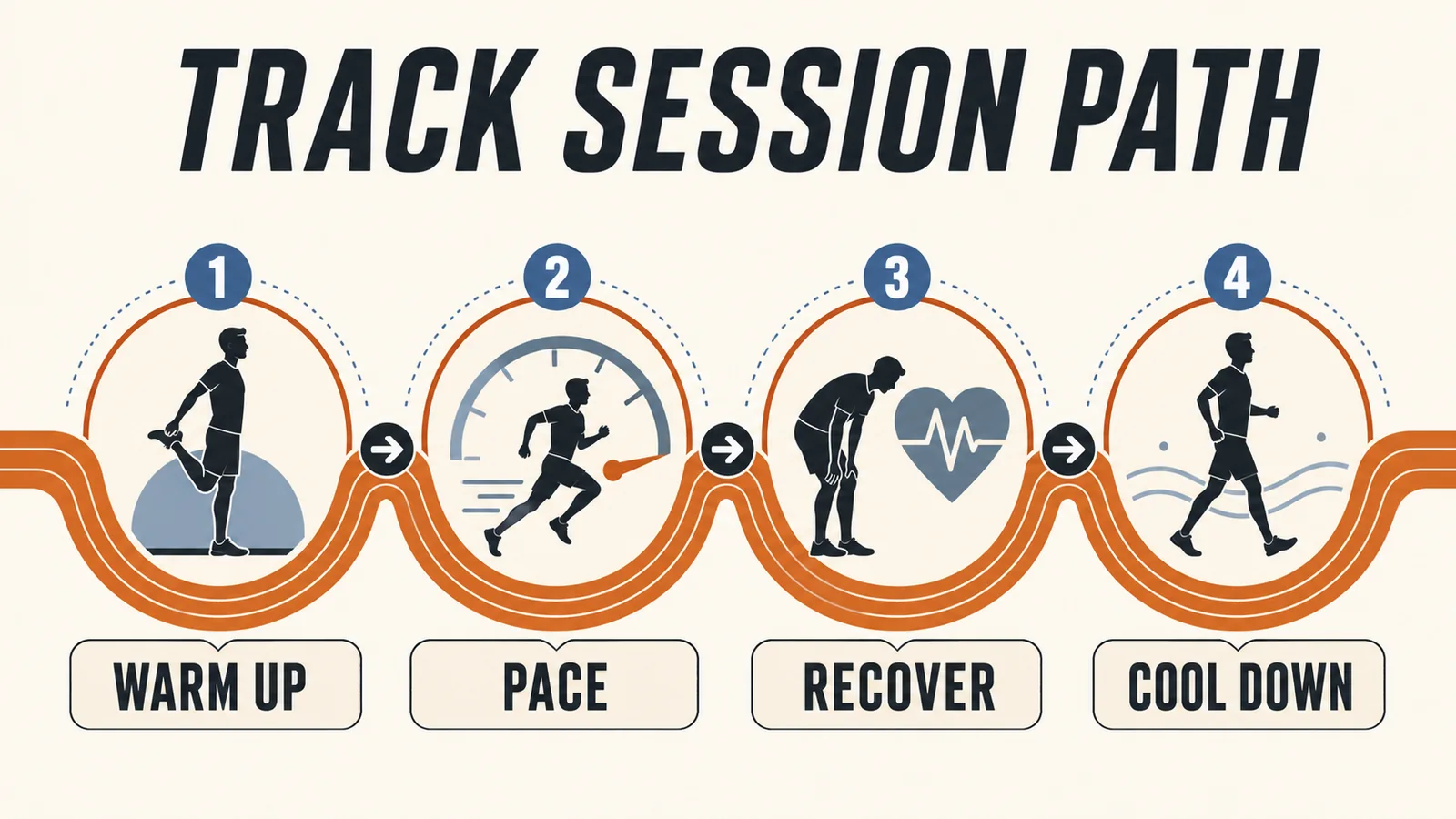
Warm Up for Speed, Not Just Sweat
- Run easily for 10 to 15 minutes.
- Use dynamic ankle, calf, hip, and trunk movements.
- Complete two or three drills that feel familiar.
- Run four progressive strides, stopping short of a sprint.
- Begin the first interval slightly conservative.
On cold days, older runners, and early-season sessions, extend the warm-up. A long static stretching routine immediately before fast running is not a substitute for progressive running speed.
Set interval pace from a recent race, controlled time trial, or current training evidence. The correct pace lets you complete the planned repetitions with stable mechanics and small split variation; it is not the fastest first repeat you can survive.
Five Practical Track Sessions
Beginner economy — 8 x 200 meters
Run at a relaxed fast rhythm, roughly current mile to 3K effort, with 200 meters easy jogging. Keep shoulders loose and finish able to do two more.
5K support — 6 x 400 meters
Run around current 5K pace with 90 seconds easy. Add repetitions before making the pace faster.
Aerobic power — 5 x 800 meters
Run around current 3K to 5K effort with 2 to 3 minutes easy. The final repetition should remain technically recognizable.
Threshold control — 4 x 6 minutes
Run at a comfortably hard effort with 90 seconds easy jogging. This can be done by time on a track rather than forcing exact lap splits.
10K race rhythm — 3 x 2,000 meters
Experienced runners can use controlled 10K pace with 2 to 3 minutes easy. Reduce volume if this exceeds roughly 25 to 35 minutes of quality work.
Recovery Changes the Workout
Short active recovery keeps aerobic demand elevated and fits threshold or 5K-oriented work. Longer walking or standing recovery better preserves speed for shorter, faster repetitions. There is no universally superior recovery because it is part of the prescription.
A 2024 systematic review of active and passive interval recovery found that both approaches can improve fitness across varied populations and protocols. The heterogeneity means the practical decision should follow the intended session quality.
A 2024 systematic review and meta-analysis found that high-load, plyometric, and combined strength methods can improve distance-running performance and important determinants such as running economy, without requiring an increase in VO2max.
The 2024 running strength-training meta-analysis included middle- and long-distance runners and supports two concise strength exposures when they fit the weekly load. Use squats or leg presses, hinges, split squats, calf work, and low-volume jumps based on training age.
How to Progress Track Volume
Increase one variable: repetition count, repeat duration, pace, or shorter recovery. Beginners can add one repeat every one or two weeks. Experienced runners can extend total quality time while keeping pace stable. Use a down week after several loading weeks or when racing.
Fast volume should remain a modest fraction of total weekly running for recreational athletes. The exact percentage depends on event, history, and durability. Do not count warm-up and cool-down miles as irrelevant; they are part of the week's tissue load.
Place the Session Inside the Week
| Day | Example | Why |
|---|---|---|
| Monday | Easy or rest | Recover from weekend |
| Tuesday | Track workout | Fresh enough for quality |
| Wednesday | Easy run | Absorb the session |
| Thursday | Strength + short easy run | Support economy and tissue capacity |
| Friday | Easy or rest | Protect long-run quality |
| Saturday | Long easy run | Durability |
| Sunday | Recovery run or rest | Close the week without forcing pace |
Know When to Stop
- Stop if gait changes, pain localizes to bone, or a tendon worsens with each repetition.
- End the set when pace drops substantially despite equal effort and recovery.
- Do not sprint the last repeat to rescue a poorly paced workout.
- Use an easy surface and different training mode when impact tolerance—not cardio—is the limitation.
A workout name does not define a stimulus. Eight 400s at mile pace with full recovery and eight 400s at 10K pace with a short jog are different sessions. Pace, recovery, and total work must be read together.
Build the Runner Around the Track
Use cardio workouts, home cardio options, lower-body strength, unilateral training, foam-roller guidance, and recovery planning.
What to Do This Week
- Choose one race goal and one track-session purpose.
- Warm up with 10 to 15 easy minutes plus drills and strides.
- Complete six controlled 200-meter repetitions with generous recovery.
- Record every split and stop before form deteriorates.
- Keep the next day easy and review symptoms before progressing.
Conclusion
Choose the workout by the race demand, keep the repetitions controlled, and stop when pace or mechanics prove the session has changed purpose.
Next Step: Build the Full Sports-Specific System
Connect this program to the PrimeForMen sports-specific training guide so skill, strength, conditioning, and recovery support the same goal.
Track Workouts For Distance Runners: Frequently Asked Questions
What is the best track workout for distance runners?
The best session depends on the goal. Start with 6 to 8 relaxed 200-meter repetitions or strides, then progress to 400s, 800s, threshold reps, or race-pace work as training history grows.
How often should distance runners do track workouts?
One demanding session per week is enough for many recreational runners. Experienced runners may use two quality days, but total mileage, long runs, strength work, and recovery determine tolerance.
How fast should 400-meter repeats be?
Set pace by the session goal and current fitness, not by ego. A 5K-oriented workout should be controlled and repeatable; shorter economy reps may be faster with longer recovery.
Should I jog or stand during interval recovery?
Both can work. Easy jogging maintains aerobic demand; standing or walking can preserve speed and mechanics. Choose the recovery that serves the intended quality.
Can beginners do track workouts?
Yes, after building consistent pain-free running. Begin with strides or short relaxed repeats, keep total fast volume low, and allow generous recovery.
This article is educational and does not replace individualized medical advice, diagnosis, or treatment. Discuss persistent symptoms, hormone concerns, cardiovascular risk, digestive problems, medications, or exercise restrictions with a qualified clinician.
Some links are affiliate links. PrimeForMen may earn a commission at no extra cost to you. Product inclusion does not override evidence, fit, or safety.