Choose a wall-mounted home gym with clear rack and cable comparisons, a space planner, mounting checks and a free measurement worksheet.
- Choose the format around the exercises you do.
- Stored depth is not the space you need to train.
- Confirm the exact model and mounting plan before ordering.
Bottom line Mark the equipment and exercise area on the floor, rehearse loading and storage, and get the installation plan confirmed before buying.
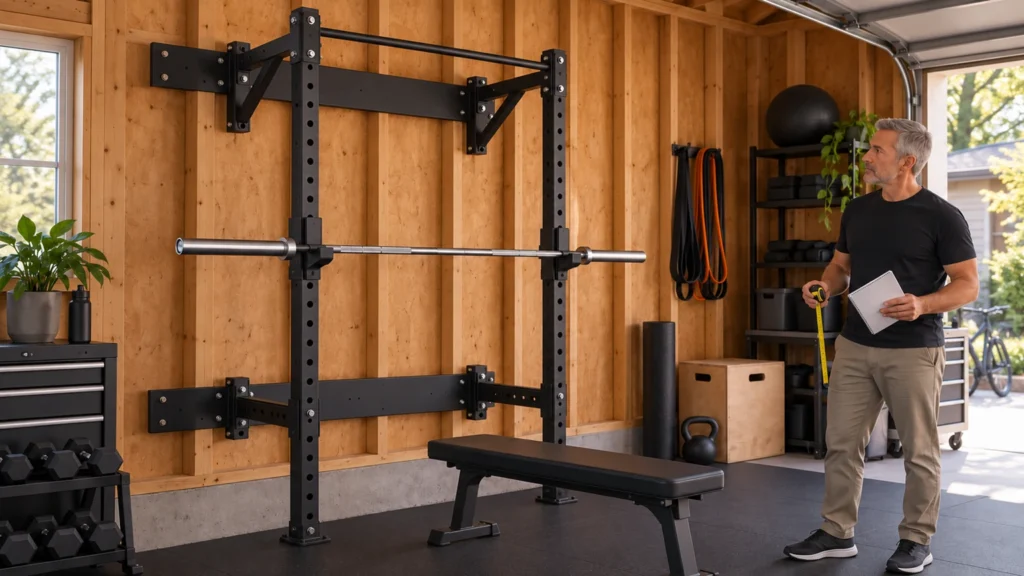
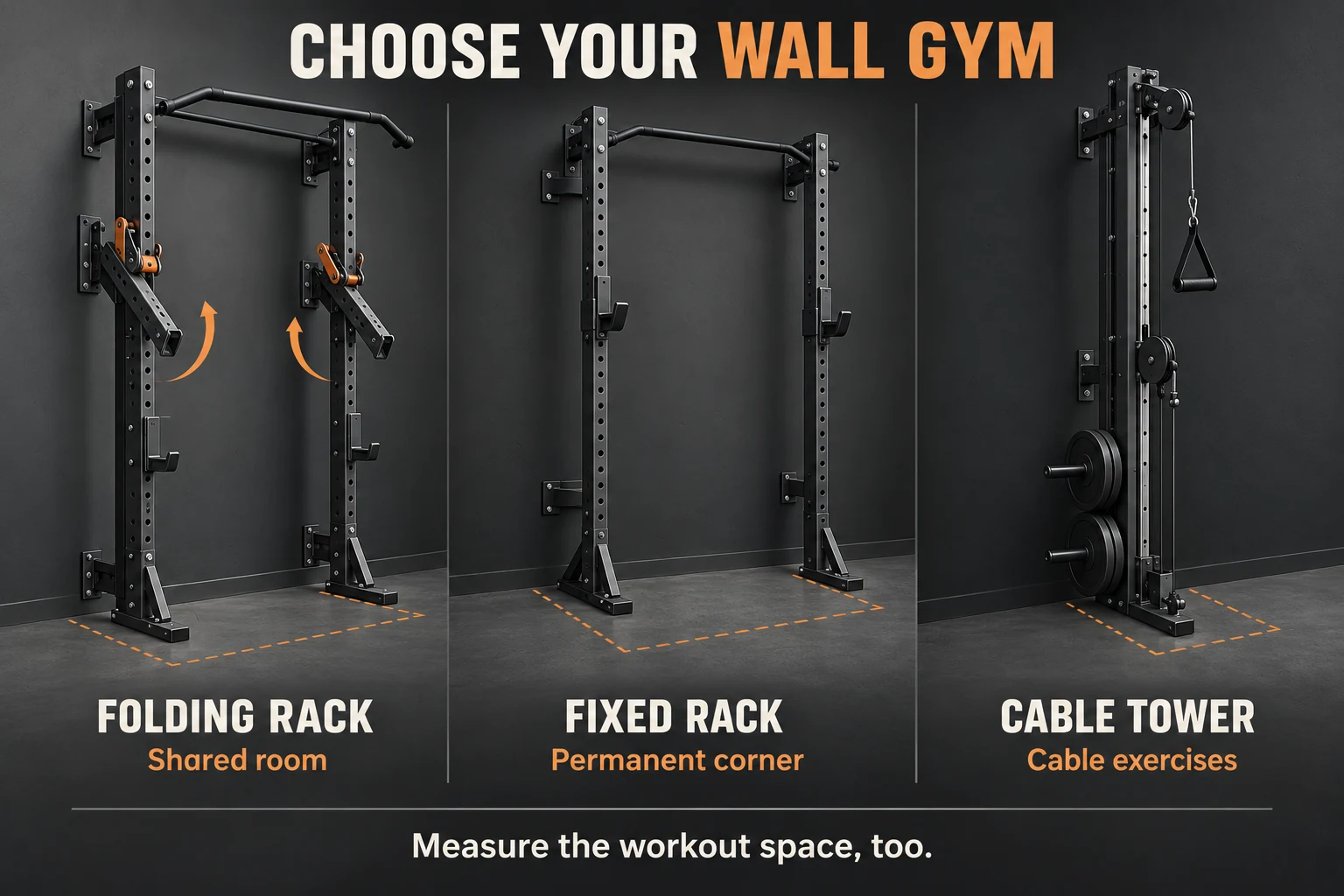
A wall-mounted home gym makes sense when you have a suitable wall and want to keep equipment near it. Choose a folding rack for barbell training in a shared space, a fixed shallow rack for a permanent lifting corner, or a cable tower for cable exercises. The deciding measurement is the space you need while training, not just the depth of the stored machine.
Use the measurements and checklists to plan your setup. They do not replace a structural installation assessment. We have not hands-on tested these models.
Quick Summary: Wall-Mounted Home Gym
- Need the room back? A folding barbell rack can reclaim some floor space after training. The bar, plates and bench still need storage.
- Leaving it open? A fixed shallow rack avoids the folding routine, but remains in the room.
- Mainly rows, presses and accessories? A cable tower may suit your exercise list. It does not replace a barbell rack.
- Before you buy: confirm wall suitability, mounting permission, the exact configuration and the full exercise area.
The Prime Perspective
Start with the exercises you actually do. A folding rack is a poor purchase if you dread moving the bench and unloading the bar every session. A small cable station is a poor purchase if your main goal is barbell squats. For men over 50, handling the equipment comfortably matters as much as fitting it into the room. Check whether you can reach the pins, move the bench and load plates without awkward workarounds.
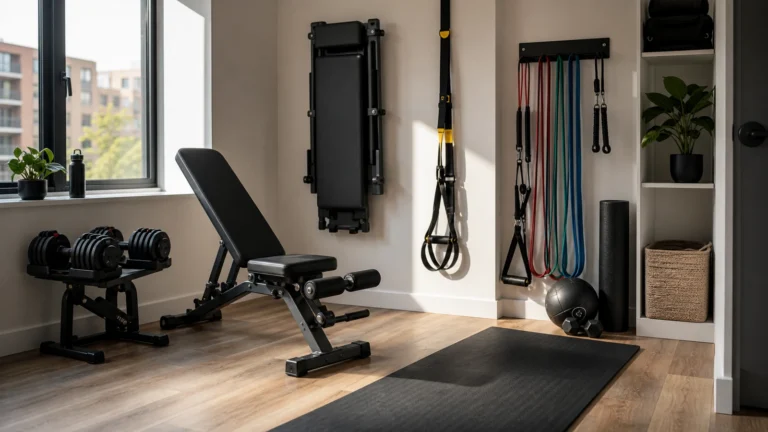
Our quick picks are folding for shared-space barbell training, fixed for a permanent barbell corner, and cable for cable-focused training. If you cannot mount equipment, start with a freestanding alternative in our home gym equipment guide.
Which wall-mounted system suits your training?
Folding barbell rack
Best for: a garage or multipurpose room that must be cleared between sessions.
Hinged sides fold toward or along the wall. You still need the correct bar, weights, bench where appropriate and manufacturer-approved protection for your lifts.
Skip it if: setup and storage would stop you training, or the folding path crosses shelving, a door or other equipment.
Fixed shallow wall rack
Best for: a lifting corner that can stay assembled.
A fixed rack stays ready between sessions. Its shallow frame may leave space in front for other tasks, although the equipment remains in place.
Skip it if: you need the entire floor area back or want the enclosed lifting space of a full freestanding power rack.
Wall-mounted cable tower
Best for: adjustable-height cable rows, presses and accessory exercises.
Check the handle travel and your position relative to the pulley. A narrow tower can still require a wide or deep area for a particular exercise.
Skip it if: you expect it to support a barbell, or your exercise list needs two widely separated cable origins.
A folding rack with integrated cables adds another question: what still moves when the plates, handles and attachments are installed? Confirm its approved operating positions and storage procedure. Do not assume that every “all-in-one” rack folds with all accessories attached. Our power rack guide covers broader rack selection, while the cable machine guide explains tower versus crossover layouts.
What about a smart wall gym? Digital-resistance systems are another category. Compare their installation service, electrical needs, accessories, software support and any membership terms separately. They are outside this guide’s mechanical rack-and-tower comparison; a screen on the wall does not remove the need for exercise space.
Real dimensions: three manufacturer examples
These examples show how differently manufacturers describe size. They are not a ranking or a claim that we tested the equipment. Dimensions below are in inches and were checked on October 5, 2026. Read the current drawing for the exact variant before ordering.
| Example and format | Published width | Published depth | Height | What to check |
|---|---|---|---|---|
| Rogue RML-3W: folding rack | 56.1875 overall on wall | 24.75 or 43.75 from wall | 90.375 | The named 21.5 and 41.5 options refer to inside depth. Optional stringers affect the mounting envelope. |
| Rogue RML-90SLIM: fixed rack | 49 outside uprights | 14 from mounting surface in specification table | 90.375 | The crossmember description separately gives 15 to the front face. Optional stringers are 59 wide; confirm your configuration. |
| Titan Short 80.5: cable tower | 25 overall | 27.5 overall | 80.5 | The tall 84.5 version is different. Confirm room for plates and cable travel; mounting hardware is not included. |
Source: the linked US manufacturer pages. Width definitions differ, so these figures do not establish which system needs the least usable wall space. A manufacturer’s machine rating does not certify your wall or its fasteners.
Include the space around the equipment
A rack’s frame width is not the width of your bar. A tower’s base depth is not the distance you stand from it. Measure the equipment, your movement and the routes you need to keep clear. A smaller advertised footprint can still be the wrong choice for your exercises.
Measure the space in six steps
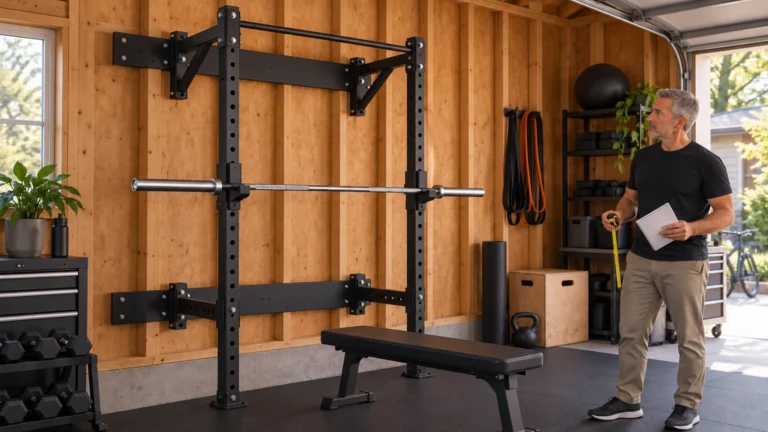
- Record the usable wall, not the room’s total width. Mark doors, outlets, baseboards, windows and stored items. Note the mounting surface and give the exact model’s drawing to the person assessing the installation.
- Check height through the entire movement. Include the equipment, pull-up use if planned, your standing overhead reach, lights and the garage door’s tracks and moving panels. A frame fitting below the ceiling does not prove that every exercise fits.
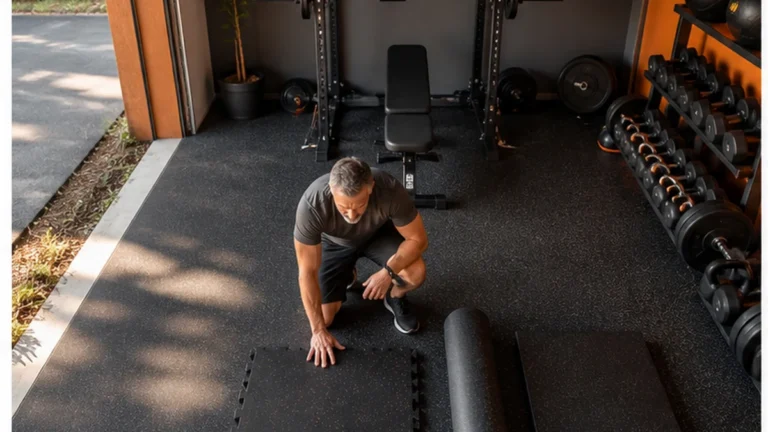
- Mark both the stored and open positions. Use removable floor tape. For a folding rack, check the swing path and access to all locking pins. Include attached storage and anything that must be removed first.
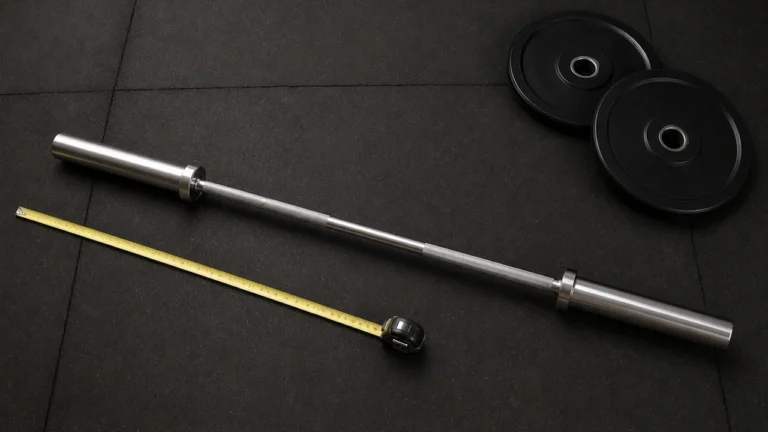
- Lay out the bar, plates and bench. Use your bar’s actual overall length and leave room to load both sleeves. Position the bench where you would lift, then check how you enter, leave and move it. See our short rackable barbell guide before substituting a shorter bar: overall length and rackable shaft length are different measurements.
- Rehearse cable positions and access routes. Walk through the intended movements without resistance or unsecured equipment. Check the space needed to step back, move sideways and change pulley height. Keep the vehicle route, household exits and doors clear.
- Check the finished floor and storage plan. Garage slope and the final flooring thickness can affect how the equipment sits and folds. Have the installer resolve this against the manual; do not improvise shims. Decide where the bench, bar and plates go after training.
Use our home gym layout guide for room planning and the flooring guide before finalizing installation height. Flooring does not correct an unsuitable wall or an installation error.
Watch: stored, open and in use
The rack opens, then the bar, bench and exercise area appear. These are three separate space checks. The schematic is not to scale and gives no minimum clearance.
Silent animation, under ten seconds. Open the animation directly. Playback pauses offscreen; reduced-motion preferences keep playback manual.
Planning example: an eight-foot wall
Suppose a usable wall measures 96 inches across and your bar is 84 inches long. Centering the bar leaves just 6 inches at each end before you account for loading plates or adjacent obstacles: (96 − 84) ÷ 2 = 6. That is a geometry example, not a recommended clearance. Try the actual loading movement and follow the equipment instructions. The rack itself could fit while the barbell setup remains impractical.
The same principle applies to a cable tower: mark where you stand at the end of a row, not only where the machine’s feet sit.
Choose a format and save your measurements
Use this planner to choose a starting point and record the room. It does not approve an installation, calculate wall strength or confirm that a particular machine fits.
Before choosing equipment: confirm the mounting plan
While permission or the wall assessment is pending, collect the exact model’s drawing and have the proposed installation checked.
Example room notes: wall width 96 in; clear height 96 in; floor depth 84 in.
Without JavaScript, use the format comparison above and the downloadable measurement sheet. Confirm mounting first, then mark the stored machine, open machine and exercise area separately.
Take the measurements with you
Use the free two-page, fillable worksheet for room dimensions, storage, installation questions and your own itemized costs. Save your completed copy before sharing it with an installer.
Mounting and solo training: checks before purchase
Drywall alone is not a mounting structure. Wall-mounted training equipment needs the supporting structure and attachment method specified for that model. A stud finder can help locate framing; it cannot certify the framing’s condition, fastener suitability or hidden utilities. If the wall construction is uncertain, get it assessed before buying.
Rogue’s RML-3W page specifically calls for a contractor to check how and to what the rack is secured when using spotter arms. Treat that as a model-specific warning, not permission to fit any arm that happens to match the holes. Ask about the loads from the activities you intend to perform, including a failed lift, rather than relying on an advertised static capacity.
- Renting: get written permission for the proposed mounting and eventual repair. If mounting is prohibited, choose an appropriate freestanding setup.
- Hardware: follow the current manual for your exact model and wall construction. A supplied screw is not automatically suitable for every wall.
- Accessories: confirm the upright size, pin diameter, hole spacing, clearance and manufacturer approval. Similar dimensions do not guarantee compatibility.
- Barbell training alone: use an approved protection setup suited to your lifts. Do not treat an open wall rack as a full cage or attempt a heavy lift without a suitable failure plan.
- Before each session: check the prescribed locking points, attachment condition, cable condition where relevant and clear movement paths. Stop using equipment if something is loose, damaged or behaving unexpectedly.
Ask the manufacturer or a qualified installer to resolve uncertainty. This article does not specify universal anchors, drilling patterns or a safe working load for your wall.
Watch the manufacturer explain its mounting system
Rogue Fitness shows how its stringers and rack brackets go together on the RML-3W. Watch to understand the components you will discuss with an installer. This older, model-specific demonstration does not replace the current manual or approve a different rack, wall or mounting method.
Watch on YouTube. Source: Rogue Fitness, published September 19, 2017; availability checked October 5, 2026.
Compare the full setup cost and daily work
The advertised machine price is only part of the decision. Request an itemized setup cost before comparing systems. Keep one-time costs separate from recurring charges and check which components are actually included.
| Cost or task | Rack setup | Cable tower setup |
|---|---|---|
| Installation | Assessment, approved hardware or stringers, assembly and wall repair where applicable | Assessment, mounting hardware and assembly |
| Training equipment | Rackable bar, plates, collars, suitable protection and a bench if needed | Compatible plates or the specified stack, handles and attachments for your exercises |
| Storage and floor | Bar, plates and bench storage; appropriate finished floor | Plate and handle storage; appropriate finished floor |
| Ongoing work | Opening, locking, unloading and clearing a folding setup; prescribed inspections | Moving plates, changing pulley height and prescribed cable inspections |
For a plate-loaded tower, confirm plate-hole compatibility and the pulley routing. Titan describes a 2:1 ratio with a 1:1 option on its current model; do not compare the loaded plate weight directly with another machine’s handle resistance. Routing and friction matter. Check minimum resistance and small load increments if those affect your training.
Reuse equipment that meets the requirements. An existing bench or measuring tape may be enough. If your bench is difficult to move, compare storage dimensions and handling in our weight bench guide. The equipment finder can help you plan the rest of the setup after choosing the format.
Equipment to compare on Amazon
Affiliate disclosure: As an Amazon Associate, PrimeForMen earns from qualifying purchases. These are options to compare after checking your room and mounting plan. We have not hands-on tested them. Confirm the exact variant, manual, seller and current availability before buying.
Choose equipment for the task
Buy only what your plan requires. The Amazon models below are separate from the Rogue and Titan dimension examples; do not transfer those measurements or accessories to these products.

HulkFit Pro Series Wall-Mounted Folding Rack
Best for: Barbell training in a room you need to clear. Skip it if wall mounting is prohibited or folding would be impractical.
Current Amazon listing: HulkFit Pro Series Wall Mounted Folding Power Rack Cage with J Hooks and Height Adjustable Pull Up Bar - Black
- Folding rack format with J-hooks and an adjustable pull-up bar.
- Check the current manual, mounting envelope and locking procedure for this exact Pro Series variant.
- Plan separate storage for the bar, plates and bench; confirm approved protection for your lifts.

Valor Fitness BD-62 Wall-Mounted Cable Station
Best for: Cable exercises from a compact wall station. Skip it if you need barbell supports or a wide crossover layout.
Current Amazon listing: Valor Fitness Wall Mounted Cable Machine with Dual Adjustable Pulley System, 16 Height Positions, Compact Home Gym for LAT Pulldowns, Rows, Triceps, and Full Body Strength Training
- Adjustable pulley heights let you change the cable origin for different exercises.
- Confirm compatible plates, required adapters and the handle travel for your exercise list.
- Check retailer availability separately from the manufacturer and arrange model-specific mounting.

FLYBIRD WB5 Adjustable Weight Bench
Best for: A rack setup where the bench needs to move after training. Skip it if your existing bench already meets your needs.
Current Amazon listing: FLYBIRD WB5 Weight Bench, ASTM-Certified 800LBS Adjustable Weight Bench Workout Bench Foldable for Home Gym, 90° to -30° FID and 30in Extended Backrest for Bench Press Strength Training Exercise
- Adjustable backrest supports different pressing and supported-row positions.
- Check the exact bench dimensions, pad height and storage procedure rather than assuming it fits the rack.
- Confirm handling, stability and the manual's total-load limit for your intended use.
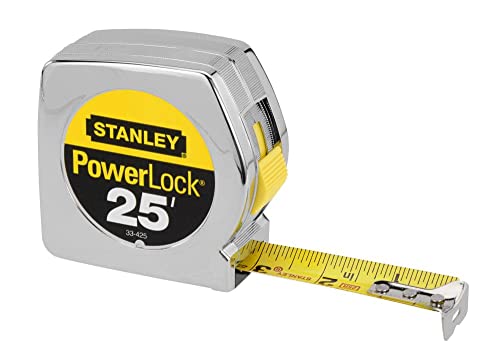
STANLEY 25-Foot Tape Measure (33-425)
Best for: Recording wall, bar and floor measurements before ordering. Skip it if you already own a suitable measuring tape.
Current Amazon listing: STANLEY Tape Measure, Chrome, 25-Foot (33-425)
- Measure the usable wall and the equipment's stored and open positions.
- Record bar length and available loading space on the worksheet.
- A measuring tool does not assess wall strength, locate utilities or replace installation advice.
* As an Amazon Associate, PrimeForMen earns from qualifying purchases.
Conclusion: choose the format, then confirm the installation
The right wall-mounted home gym supports your exercise list and the way you use the room. Choose folding when clearing the room is essential, fixed when the lifting corner can stay open, or cable when cable work is the priority. Mixed training may require more than one piece of equipment.
Before ordering, complete the measurement sheet, rehearse the loading and storage routine, and obtain an installation plan for the exact model. If any of those steps fails, change the layout or equipment choice before spending money.
Frequently asked questions
Can I install a wall-mounted gym in an apartment?
Possibly, if the building’s structure, permitted mounting method and available exercise space suit the equipment. Get mounting permission first and have the wall assessed. Where mounting is prohibited, use a suitable freestanding alternative.
How much space does a folding rack need?
There is no universal clearance. Check its stored depth, open depth, swing path and mounting envelope, then add the actual bar, bench, loading access and exercise movement. The smallest stored measurement does not describe the workout area.
Does a wall rack save more space than a cable tower?
It depends on the model, the exercises and whether you need the room cleared afterward. A folding rack can reduce its stored depth, while a fixed tower keeps its footprint. Neither comparison accounts for the bar, plates, bench or your movement until you measure them.
Can I add any spotter arms to a wall-mounted rack?
No. Check physical compatibility and the manufacturer’s approval, then have the mounting arrangement assessed for the intended use. Rogue explicitly calls for a contractor check on spotter-arm use. Matching holes alone does not establish a suitable setup.
Will a cable tower replace a complete home gym?
It can cover many cable exercises, but it does not provide barbell supports. A single narrow tower also differs from a wide two-column crossover. Make a list of your intended exercises and verify the handle positions, travel and resistance before choosing it.
How we selected these examples
PrimeForMen checked US manufacturer specifications and Amazon catalog listings on October 5, 2026. The examples illustrate format, space and setup differences. We did not conduct hands-on load tests or certify installations. Manufacturer dimensions and retailer variants can change; verify the current manual and listing. See our editorial policy.
Sources and installation references
- Rogue RML-3W specifications and spotter-arm warning
- Rogue RML-90SLIM dimensions and installation options
- Titan current Short 80.5 pulley tower specifications
- Valor BD-62 manufacturer information
- Rogue’s model-specific installation video reference
Safety note: This guide provides equipment-planning information, not structural engineering or individual exercise advice. Follow the current manufacturer instructions and qualified installation advice. The generated hero, infographic and animation are illustrations, not product photographs or installation drawings.