
Cycling-specific training guide: build endurance, threshold power, VO2 capacity, strength, and a balanced weekly plan without recovery debt.
- Most weekly riding should remain repeatable and controlled.
- Threshold, VO2, and sprint sessions solve different problems.
- Strength work must be placed where soreness does not ruin key rides.
Bottom line Build the aerobic base, give every hard session one purpose, preserve strength, and judge progression by repeatable power rather than exhaustion.

Cycling-Specific Training works when every session has a defined job and the weekly load remains recoverable. The plan below separates technique, endurance, speed, strength, and recovery so effort produces adaptation instead of random fatigue.
This is a general training framework, not an individualized medical or coaching prescription. Adjust it for your sport history, current capacity, equipment, and competition calendar.
Quick Summary: Cycling-Specific Training
- Cycling endurance comes from consistent low-intensity volume plus limited, purposeful hard work.
- Threshold intervals improve sustained output; VO2 intervals target shorter high-aerobic power; sprints train neuromuscular speed.
- Heavy strength training may improve cycling performance and efficiency, although the certainty and ideal prescription remain limited.
- Cadence is a tool, not a universal score—terrain, gearing, comfort, and event demands change the useful range.
- Sudden chest symptoms, faintness, neurological symptoms, or persistent joint pain require qualified assessment.
The Prime Perspective
A strong cyclist is not the rider who can suffer hardest on Tuesday. It is the rider who can repeat useful power late in a ride and still absorb the next training day.
Cycling-specific training is planned bike work that develops the exact aerobic endurance, sustained power, high-aerobic capacity, sprint ability, cadence control, handling, and fatigue resistance required by a rider’s event or goal.
Start With the Demand of Your Ride
A century rider, short-course mountain biker, commuter, criterium racer, and indoor-cycling beginner do not need the same week. Define the longest continuous effort, the number of hard surges, the terrain, and the skill constraints. Then train the smallest set of qualities that closes those gaps.
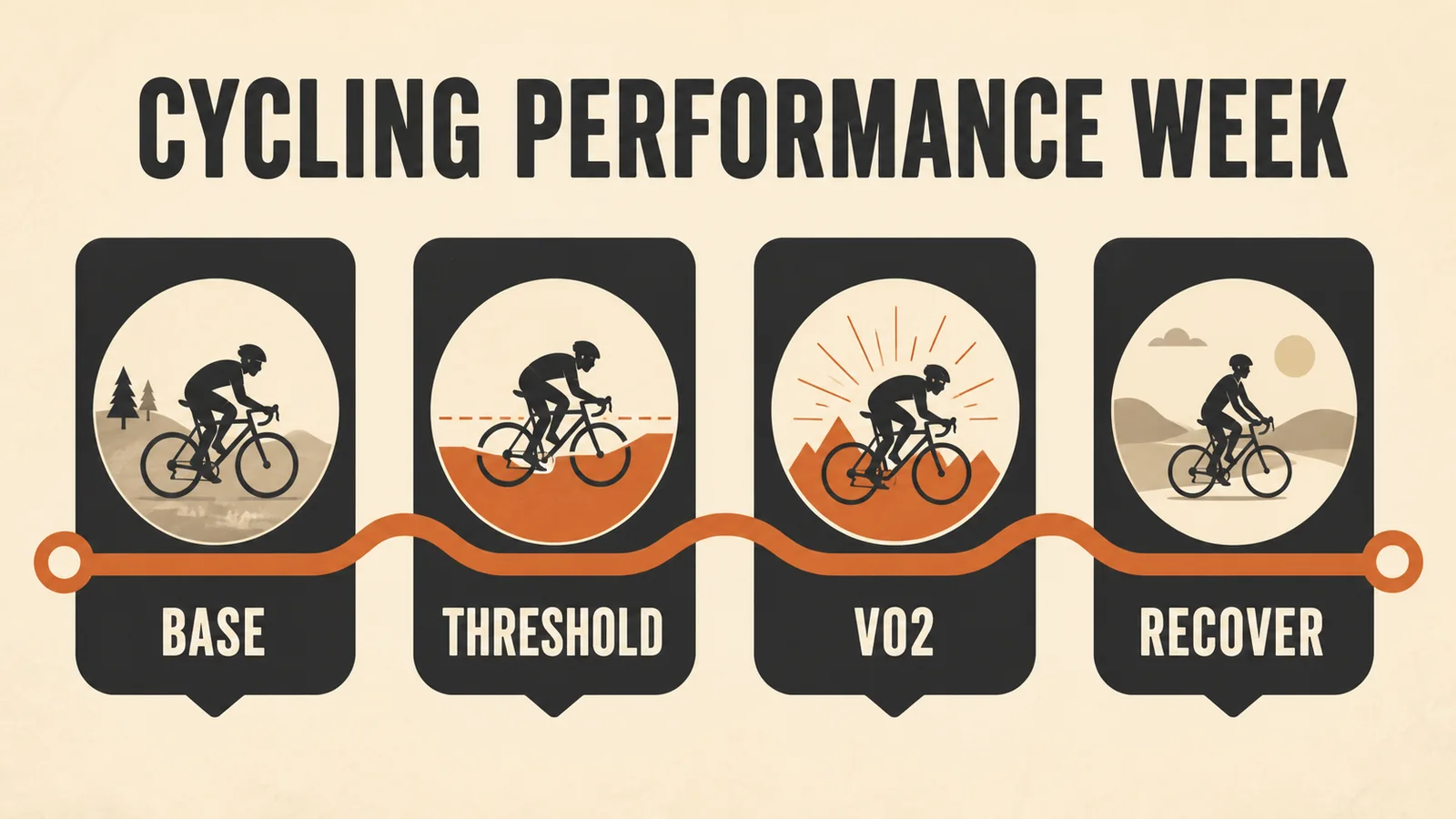
| Training quality | What it develops | Example | Recovery need |
|---|---|---|---|
| Aerobic endurance | Repeatable low-intensity work | 60–150 minutes conversational | Low to moderate |
| Tempo / sweet spot | Sustained sub-threshold pressure | 2–3 x 12–20 minutes | Moderate |
| Threshold | Power near maximal steady effort | 3–4 x 8–12 minutes | High |
| VO2 intervals | High aerobic power | 4–6 x 3–5 minutes | High |
| Neuromuscular sprint | Rapid force and coordination | 6–10 x 8–12 seconds | Full recovery between efforts |
| Strength | Force, tissue capacity, aging support | Squat, hinge, split stance, calf, trunk | Schedule away from key rides |
Amazon Product Shortlist
These tools help measure a repeatable session. PrimeForMen has not independently tested them, and a device cannot choose the right training dose for you.

Garmin Cadence Sensor 2
For riders who want a repeatable cadence signal during drills without buying a power meter.
- Crank-mounted cadence measurement.
- Pairs with compatible Garmin and ANT+/Bluetooth devices.
- Cadence data should guide—not dictate—technique.

Wahoo TRACKR Heart Rate Monitor
For tracking aerobic and interval effort when wrist readings are inconsistent on the bike.
- Chest-based heart-rate signal.
- Bluetooth and ANT+ compatibility.
- Training data is not a medical reading.

COOSPO BC107 GPS Bike Computer
For logging speed, distance, and compatible sensor data in a simple handlebar display.
- GPS-based ride recording.
- Supports ANT+ sensor connections.
- Confirm app and sensor compatibility before purchase.
*As an Amazon Associate, PrimeForMen earns from qualifying purchases. Availability and prices can change.
Use Intensity Zones Without Worshiping the Number
Power, heart rate, breathing, and perceived effort each describe a different part of the session. Power responds immediately but requires a power meter. Heart rate lags and changes with heat, hydration, stress, and medication. Perceived effort is always available but improves with experience.
For easy endurance work, breathing should remain controlled and conversation possible. Threshold work feels hard but organized. VO2 intervals create heavy breathing quickly, yet the power target should remain close across repetitions. If output collapses, the set is no longer training the intended quality.
Most recreational cyclists should keep the majority of weekly riding easy enough to repeat. Exact percentages are not universal; the practical rule is that hard sessions remain distinct, while endurance days do not drift into constant moderate fatigue.
A Balanced Four-Day Cycling Week
Day 1 — Endurance
60 to 90 minutes at conversational effort. Keep cadence comfortable and finish feeling that another 15 minutes was possible.
Day 2 — Strength
Squat or leg press, Romanian deadlift, split squat, calf raise, row, and anti-rotation: 2 to 4 sets each, leaving two repetitions in reserve.
Day 3 — Purposeful intervals
Warm up 15 minutes, then 4 x 6 minutes at a controlled hard effort with 3 minutes easy. Cool down 10 minutes. Beginners can start with 4 x 3 minutes.
Day 4 — Long ride plus skill
90 to 180 minutes easy to moderate. Practice fueling, cornering, braking, climbing gears, and sustainable pacing in the environment relevant to your goal.
Threshold, VO2, or Sprints: Choose One Primary Target
Threshold intervals prepare you to sustain power near a time-trial or long-climb demand. VO2 intervals target shorter, higher aerobic work and require more recovery. Sprints train rapid force and coordination; they belong early in a ride, with several minutes of easy pedaling between efforts.
Do not combine a full threshold set, a full VO2 set, and exhausted sprints because the workout looks advanced. Rotate emphasis across four- to eight-week blocks. One quality progresses while the others receive maintenance.
A 2025 systematic review and meta-analysis found that heavy strength training improved cycling efficiency, anaerobic power, and performance, but the certainty of evidence was low and no single optimal prescription could be established.
The 2025 review of heavy strength training in endurance cyclists included 17 studies and 262 adults. The useful takeaway is not that every cyclist must lift maximally; it is that progressive force training can complement endurance work when fatigue is controlled.
Place the hardest lifting after an easy ride or on a separate day, not immediately before your most important interval or long ride. New lifting can create muscle damage that reduces peak power and raises perceived effort, a concern reinforced by a 2024 meta-analysis on muscle damage and cycling performance.
Cadence Drills: Useful, but Context Dependent
Cadence is how quickly the cranks turn. It is not a technique grade. For most rides, use a comfortable self-selected cadence. Add short drills at a slightly higher cadence for coordination or controlled lower-cadence work for event-specific torque, provided knees and hips remain comfortable.
- Fast legs: 6 x 30 seconds smooth at high cadence, not bouncing, with 90 seconds easy.
- Climbing torque: 4 x 4 minutes seated at a modestly lower cadence and sub-threshold effort.
- Sprint mechanics: 6 x 8 seconds from a safe rolling start with full recovery.
A sensor makes cadence visible. It does not tell you whether a drill fits your event or joint history.
Fuel the Work You Want to Repeat
Short easy rides may need only normal meals and water. Longer or harder rides require a deliberate carbohydrate and fluid plan. Practice the exact products, bottle placement, and timing before an event. Do not wait for race day to learn that a gel, drink concentration, or large pre-ride meal upsets your stomach.
Progression and Recovery Rules
- Add duration to one easy ride before adding another hard day.
- Progress interval time by one repetition or slightly longer work bouts—not both.
- Repeat a successful week before increasing total stress.
- Reduce training when sleep, mood, resting fatigue, or power at normal effort worsens for several days.
- Taper event preparation by reducing volume while retaining small doses of event-specific intensity.
Durability is the ability to preserve useful power after accumulated work. Test it by comparing a controlled interval early and late in a longer ride—not by turning every long ride into a race.
Build the Supporting System
Combine this plan with triathlon training, cardio programming, lower-body strength, unilateral training, core stability, recovery tools, and rest and recovery.
What to Do This Week
- Choose one measurable cycling goal for the next six weeks.
- Complete two conversational endurance rides.
- Add one threshold or VO2 session—not both at first.
- Perform one full-body strength session away from the hardest ride.
- Review fatigue, soreness, and repeatable output before adding volume.
Conclusion
Build the aerobic base, give every hard session one purpose, preserve strength, and judge progression by repeatable power rather than exhaustion.
Next Step: Build the Full Sports-Specific System
Connect this program to the PrimeForMen sports-specific training guide so skill, strength, conditioning, and recovery support the same goal.
Cycling-Specific Training: Frequently Asked Questions
What is cycling-specific training?
Cycling-specific training develops the exact endurance, power, cadence control, handling, and fatigue resistance needed for your riding goal through purposeful bike sessions plus supporting strength and recovery.
How many hard cycling workouts should I do each week?
Most recreational riders improve with one or two hard sessions. The right number depends on total volume, training age, sleep, strength work, and whether group rides already become intense.
Does strength training improve cycling performance?
It can. Recent evidence suggests heavy strength training may improve cycling efficiency, anaerobic power, and performance, but it must be progressed and scheduled so soreness does not compromise key rides.
What cadence should cyclists train at?
There is no universal ideal cadence. Use a comfortable self-selected range for most riding, then practice modest high- and low-cadence variations for coordination and event-specific demands.
How long should a cycling training plan last?
A focused block commonly lasts four to eight weeks before a recovery week and reassessment, but beginners may progress longer with the same simple structure.
This article is educational and does not replace individualized medical advice, diagnosis, or treatment. Discuss persistent symptoms, hormone concerns, cardiovascular risk, digestive problems, medications, or exercise restrictions with a qualified clinician.
Some links are affiliate links. PrimeForMen may earn a commission at no extra cost to you. Product inclusion does not override evidence, fit, or safety.