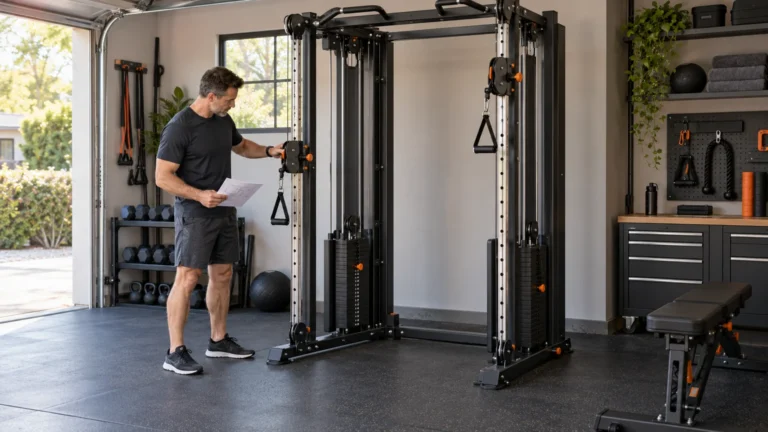
Compare cable loading, independent stacks and pulley ratios. Check usable resistance and exercise changes with the selection helper and worksheet.
- Choose loading around your exercise changes.
- Confirm independent sources, outlet labels and ratio.
- Check minimum resistance and full working space.
Bottom line Bring two planned exercise transitions and the worksheet to a demonstration; confirm the exact connection and complete delivered package before ordering.
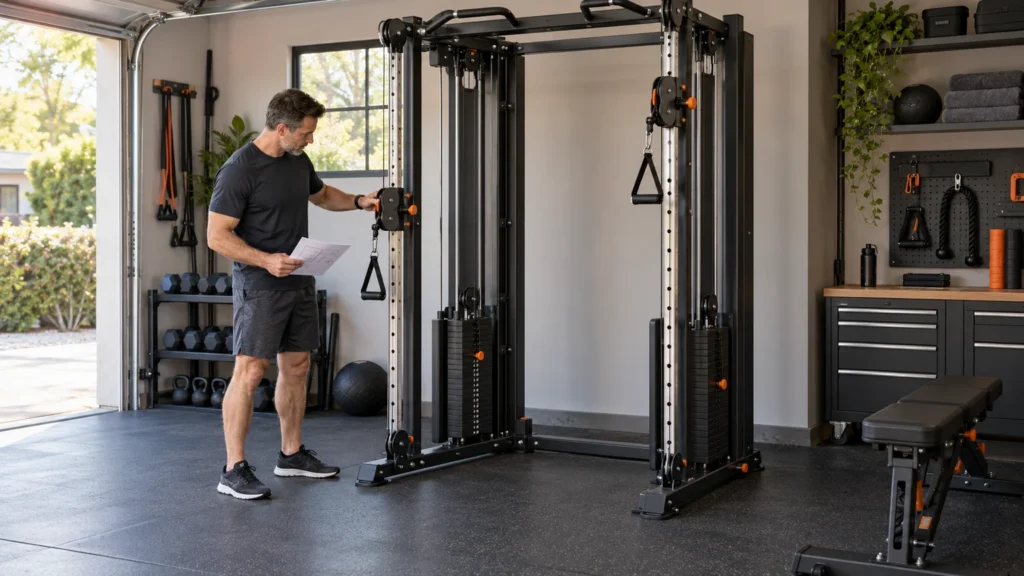
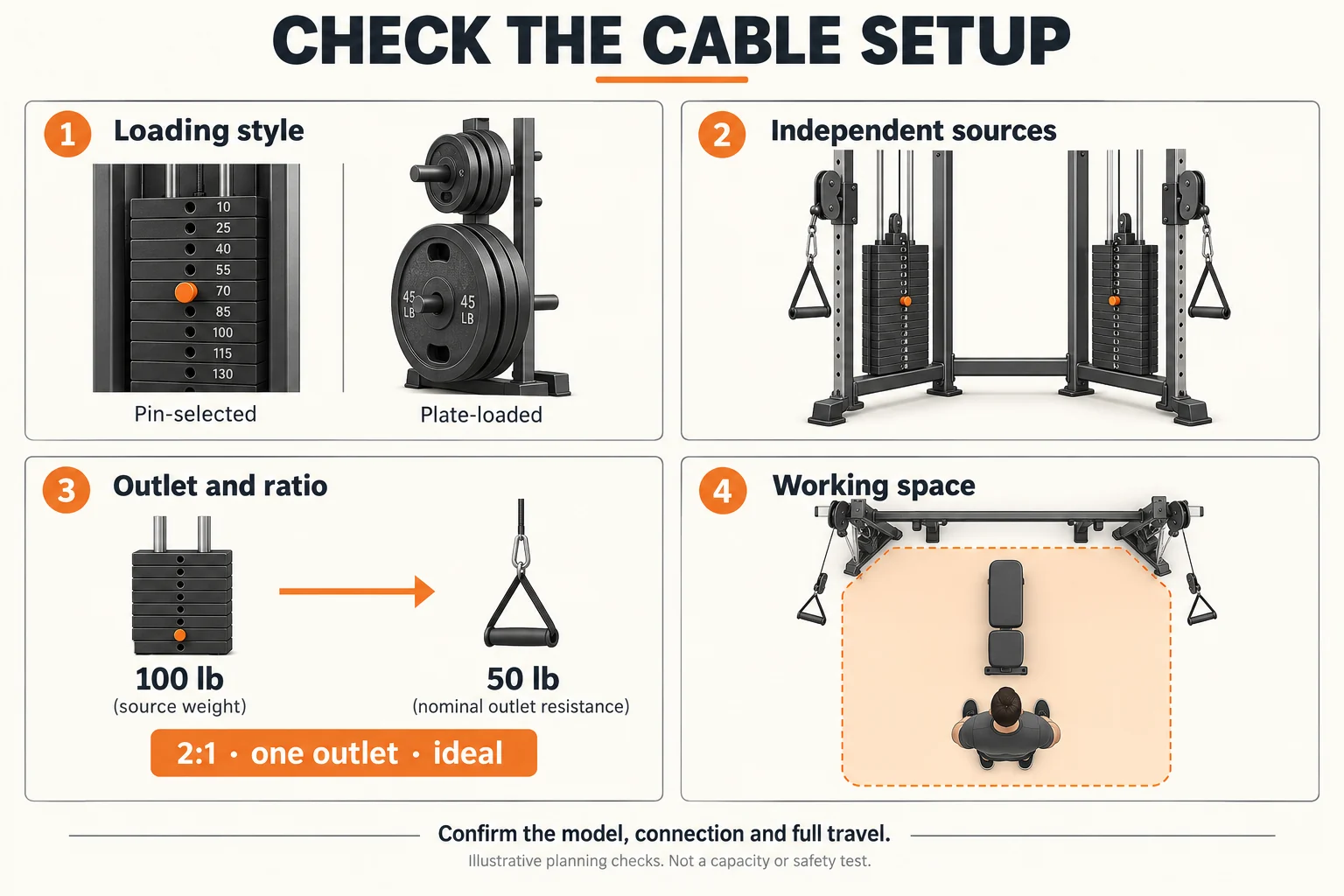
The best cable machine for home gym training fits your planned movements, provides manageable starting resistance and enough resistance at the outlet you will actually use. Choose selectorized weights for frequent changes, plate loading when your existing plates and workflow suit it, and independent cable sides when you need separate resistance for each arm. Check the connection, full cable travel and working area before comparing headline stack weights.
A single tower can cover many one-sided movements. A shared-stack trainer can offer two adjustable cable positions without two independent weight sources. A dual-stack functional trainer lets you set each side separately. None of those formats guarantees comfortable movement, safe mounting or enough resistance for your heaviest planned pull.
Quick Summary: Best Cable Machine for Home Gym
- Decide how often you will change resistance and pulley height. Pin-selected weights simplify frequent changes; plate loading requires plate access and storage.
- Count independent weight sources, not just handles. Two outlets can share one source.
- Read the label basis and configured ratio. A physical 200 lb stack at an ideal 2:1 outlet corresponds to about 100 lb-force there, before real-world effects.
- Test the lightest usable setting, heaviest required pull and complete movement with the intended handle and bench position.
- Confirm mounting, cable maintenance, delivery, complete package contents and replacement parts.
The Prime Perspective
For a man rebuilding a consistent strength routine, the useful upgrade may be easier transitions between a row, pressdown and one-arm raise. A heavier stack adds little if its minimum setting is too heavy for a raise, its handle runs out of travel or you need to move a bench every set.
We checked manufacturer pages, linked manuals and current Amazon product identities. We have not load-tested these machines or measured their cable force. Our editorial policy explains how researched recommendations differ from hands-on testing. Bring your actual exercise list to a demonstration and record what the exact configuration supports.
Selectorized or plate-loaded: compare the workout you will do
| Choice | Useful when | What a change involves | Check or reason to skip |
|---|---|---|---|
| Selectorized stack | You change loads often, alternate users or use several cable exercises per session | Return the stack fully, select the permitted pin position and verify engagement | Minimum outlet resistance, effective increment and available stack upgrades; fixed jumps may be too large |
| Plate-loaded tower | You already own compatible plates and use a compact cable station | Unload the carriage as instructed, change plates and secure the load using the specified hardware | Sleeve length, plate clearance, loading limits, storage and mounting; skip if frequent changes would disrupt your routine |
| Plate-loaded crossover | You want two separated stations and have room for their full span | Change each side’s plates and check both connections | Operating width, loading access and whether pulley heights are adjustable or fixed high/low |
| Portable resistance unit | You need accessories in a room that cannot hold a permanent frame | Change the unit’s resistance components and permitted mounting position | Its own rated resistance and approved mount; ordinary hanging-weight arithmetic may not apply |
Plate loading is not automatically cheaper once you include plates, collars, delivery and mounting. Selectorized machines still require assembly, inspection and compatible accessories. Compare complete delivered quotes in the home gym cost guide; list the compatible plates you already own before pricing replacements.
| Configuration | What it gives you | Practical limitation |
|---|---|---|
| One tower, one outlet in use | One-sided rows, curls, pressdowns and many rotational setups from different trolley heights | Switch sides or change height between movements; demonstrate long pulls and body clearance |
| One source with two outlets | Two available cable positions or manufacturer-approved combined connections | The outlets may interact through the shared source. Do not assume separate full-stack resistance at both handles |
| Two independent sources | Separate load selection and movement on the left and right, useful for bilateral pressing or fly setups | Working width and body position still matter; two stacks do not become one heavy-row source automatically |
| Rack-integrated cables | Cable work inside an existing rack footprint | Exact rack compatibility, bench and bar conflicts, cable routing and separate station limits |
Two independent sides are worth considering when your routine needs separate loads or cable angles for each arm. A single tower may be enough when you mainly train one side at a time. A close-spaced pair of outlets on one tower is not the same geometry as a wide crossover. For combined barbell and cable training, compare the all-in-one system guide and the power-rack guide before adding another frame.
Compare four Amazon options by cable setup
These options serve different needs: separate pin-selected stacks, two adjustable sides sharing one stack, a plate-loaded tower, and a portable cable unit. Choose the format first. Check the exact seller, model revision and included accessories before ordering.
As an Amazon Associate, PrimeForMen earns from qualifying purchases. Prices, seller terms and package contents can change.
Recommended Products

Powerline PFT100 Dual-Stack Functional Trainer
Best for: Separate resistance on each side and frequent pin-selected changes. Skip it if the minimum load, working width or installed height does not suit your movements.
Current Amazon listing: Body-Solid Powerline (PFT100) Cable Crossover Exercise Machine for Home & Commercial Gym, Functional Training Center with Dual 160lbs. Weights Stack for Cable Workout
- The verified listing identifies PFT100 with two 160 lb stacks; it is not a plate-loaded crossover.
- The maker states 2:1 operation: a base 160 lb source gives an ideal 80 lb-force per outlet, before friction and other effects.
- Confirm the exact stack option, minimum setting, cable travel and bench clearance on the delivered model.

Best Fitness BFFT10 Shared-Stack Trainer
Best for: Two adjustable cable positions where a single shared source fits your exercise plan. Skip it when independently selected loads on both sides are essential.
Current Amazon listing: Body-Solid Best Fitness Functional Trainer Cable Machine, Full Body Workout Weight Stacks, Chest and Shoulder Exercise Home Gym LAT Pulldown Machines with 190lb Weights Stack Midnight Black
- The verified listing names a 190 lb Best Fitness trainer; confirm its BFFT10 revision against the current manual.
- The current BFFT10B manufacturer data identifies one 190 lb stack, not two independent stacks.
- Ask for the outlet resistance under single- and dual-handle use; the stack figure alone does not settle those values.
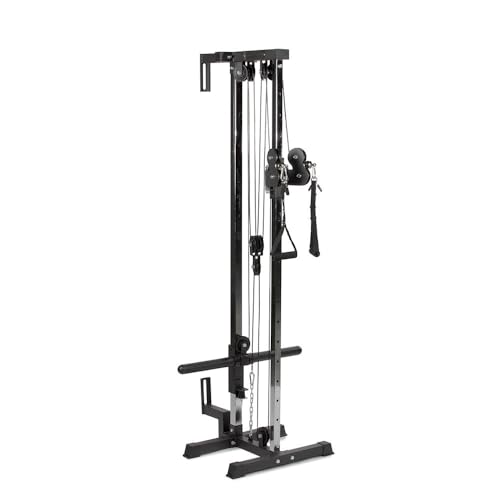
Titan Short V3 Plate-Loaded Pulley Tower
Best for: A narrow cable station using compatible plates you already own. Skip it if mounting, loading access or full handle travel remains unresolved.
Current Amazon listing: Titan Fitness 80.5" Short Wall Mounted Pulley Tower, 350 LB Capacity Plate-Loaded Cable Machine, Adjustable Trolly Height, Standard & Olympic Plate Compatibility, Dual D-Handles Included
- The verified listing identifies the 80.5-inch short V3 plate-loaded tower; confirm the delivered revision.
- The maker's 350 lb loading capacity is not a measured 350 lb outlet force; check the intended 2:1 or approved 1:1 connection.
- Quote mounting hardware and any missing plates or collars, and confirm the exact manual before installation.
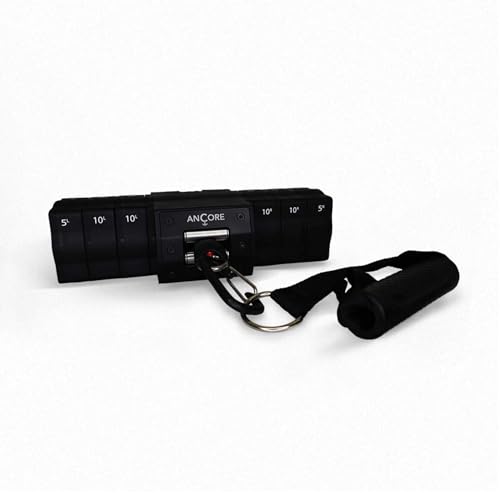
ANCORE Pro Portable Cable Unit
Best for: One-sided accessory work where a permanent frame is impractical. Skip it if you need a dual-stack station or resistance beyond the verified package rating.
Current Amazon listing: Ancore Pro: Home Gym Cable Machine | Portable Workout System for Strength Training | Comes with Mount for a Squat Rack or Pole | Full-Body Workout | Used by 100+ Pro Teams
- ANCORE uses a torque-loaded spring mechanism; its resistance components are not Olympic weight plates.
- Check Standard versus Plus contents, resistance components and included mounting strap; package ratings differ.
- Verify the approved mounting surface and usable eight-foot cable travel for your intended movement.
* As an Amazon Associate, PrimeForMen earns from qualifying purchases.
Pulley ratio: read the outlet, connection and label together
In the simplified examples below, ratio means source load divided by nominal resistance at one outlet. At 2:1, a 100 lb source corresponds to about 50 lb-force at that outlet, while the handle travels twice as far as the source rises. At 4:1, the same source corresponds to about 25 lb-force, with four times the travel in the ideal arrangement.
Manufacturers may write the ratio in the opposite order: Titan describes an independent handle as 1:2 in one part of its selectorized tower page and 2:1 elsewhere. Ask for the actual selected-source-to-outlet relationship for your connection. A specification written as “200 lb resistance” may already be an outlet figure; dividing it again would give the wrong result.
Same 100 lb source, different ideal outlet force
Each row uses one physical 100 lb hanging source and one outlet. All bars share a zero-to-100 lb-force scale. These are simplified static examples, not force measurements or specifications for a particular model.
The source remains 100 lb in every example. Friction, acceleration, carriage contributions and tolerances are omitted. The travel examples are relative units, not the machine’s available cable length. Confirm whether a real machine’s labels describe source weight or outlet resistance before calculating.
These calculations omit friction, acceleration, source tolerances and any unaccounted carriage or top-plate weight. They do not measure force through your stroke or the load on a joint. A trolley height or attachment change can alter available travel and your body position even when the nominal ratio stays the same.
Two cables do not automatically double the number
On a supported single-source tower, a manufacturer-approved adapter can connect both cables and change the effective connection. Bells of Steel documents 2:1 for the default outlet and 1:1 with its specified adapter. That does not authorize joining unrelated cables or adapting every shared-stack machine.
With two independent sources at 2:1 and 100 lb selected on each, the simplified figure is 50 lb-force at each outlet. Keep the two results separate. They are not automatically a 100 lb-force load in one row, press or free-weight lift; connection geometry and force directions matter.
See the ideal 2:1 relationship
One 100 lb source rises one relative unit while one handle travels two. The ideal outlet force is 50 lb-force. This diagram uses one outlet and omits friction; it does not show a particular machine or a shared two-handle configuration.
Silent, 8.5 seconds. Open the animation directly. Playback pauses offscreen; reduced-motion preferences keep playback manual. Essential figures are also in the readable chart above.
Build your cable selection record
Choose a loading style and source arrangement, then check a nominal ratio example. This helper records your answers. It does not measure force, recommend a training load or approve installation.
The interactive helper needs JavaScript. Use the comparison tables and the fillable worksheet below instead. Before ordering, record the exact model, independent sources, label basis, outlet ratio, usable range, travel, installation and complete quote.
Documented models: compare configurations, not marketing totals
The following manufacturer information was checked October 5, 2026. Dimensions are width × depth × height in inches. Allow additional room for exercise, loading and access. Numerical outlet examples are nominal arithmetic or manufacturer-stated figures under the listed conditions, not our measurements.
| Model / configuration | Source or mechanism | Documented outlet condition | Still confirm before ordering |
|---|---|---|---|
| Powerline PFT100 | Two independent 160 lb stacks; optional 210 lb stacks | 2:1: ideal 80 lb-force per base outlet, or 105 lb-force with the stated upgrade | Delivered stack option, minimum setting and complete movement travel |
| REP Arcadia | Two independent 170 lb stacks; optional 220 lb stacks | 2:1; REP states 10 to 85 lb usable resistance per side with the base stacks | Minimum and increments at the exact outlet; upgrade and accessory configuration |
| Bells of Steel Cable Tower | 110 lb or 210 lb selectorized versions, or plate loading | Default 2:1; 1:1 uses the maker’s specified 2-to-1 adapter | Exact source, approved combined connection, mount and package contents |
| Titan short V3 plate tower | Plate-loaded; 350 lb stated loading capacity | 2:1 with optional 1:1 connection; capacity is not measured outlet force | Revision, adapter instructions, plate clearance and required mounting |
| Best Fitness BFFT10B | One shared 190 lb stack | Checked current sources do not establish a numerical resistance for each connection | Single- and dual-outlet behavior, minimum resistance and exact revision |
| ANCORE Pro | Torque-loaded spring mechanism; components vary by package | Maker’s approximate 5 to 65 lb rated range; do not divide the rating again | Standard or Plus contents, rated range, mount and usable travel |
These entries describe specific manufacturer configurations. Nominal arithmetic is marked as ideal; stated usable or rated ranges retain the manufacturer’s basis. We did not measure outlet force. A different revision, adapter, stack upgrade or shared-source connection can change the result.
Powerline PFT100: independent selectorized stacks
The PFT100 has two 160 lb stacks, a published 2:1 ratio and 20 pulley positions. That gives an ideal 80 lb-force maximum at each outlet before real-world effects; the optional 210 lb stacks give 105 lb-force on the same simplified basis. The frame is 62.6 × 42.3 × 83 inches.
Consider it when independent pin changes suit your exercises and permanent room. Check the lightest usable setting and cable travel during a demonstration; a maximum alone cannot settle fit. The Amazon listing verified here names the dual-160 lb PFT100, so confirm upgrades separately. PFT100 specifications and the linked owner’s manual are the source references.
REP Arcadia: a documented per-side resistance range
REP lists two 170 lb stacks at 2:1, a manufacturer-stated usable range of 10 to 85 lb per side, 32 trolley positions and 81 inches of cable travel. A 10 lb stack change corresponds nominally to 5 lb at the outlet. The optional stack upgrade raises the stated maximum to 110 lb per side, excluding add-on weights.
The standard frame is 55.3 × 35.8 × 80.8 inches. Consider it for independent cable work when those limits suit your movements; skip buying on footprint alone. The Arcadia Max is a separate model, not an automatic source for Arcadia specifications. Check REP’s current Arcadia page and ask for the delivered unit’s manual, labels and inclusions.
Bells of Steel Cable Tower: select the loading and connection
The current page offers 110 lb and 210 lb selectorized versions and a plate-loaded option. It documents default 2:1 operation and a 1:1 connection using its 2-to-1 adapter. For a 210 lb source, that is nominally 105 lb-force at the default outlet or 210 lb-force at the approved combined connection, before omitted real-world effects.
Consider it for a compact single-source station with confirmed mounting. Choose the exact loading version and whether the back upright is included. A combined connection is not two independent stacks, and the mount or cable travel must suit the intended exercise. Check the current tower configuration and adapter conditions; request the current manual for that configuration.
Titan short V3 tower: plate loading in a narrow frame
The current short plate-loaded tower lists an 80.5-inch height, 25-inch width, 27.5-inch depth, 18 trolley settings and a 2:1 ratio with an optional 1:1 connection. Its 350 lb figure is a plate-loading capacity, not a measured 350 lb outlet force. The maker lists standard and Olympic sleeves and requires compatible mounting; hardware is not included.
Consider it when your existing plates fit and loading access is available. Skip it if approved mounting or usable travel cannot be confirmed. Amazon names the short V3, while the current support page identifies SHPULTWRv3b; confirm the delivered revision before transferring adapter or installation details. Check the current plate tower and revision-specific manual link.
Best Fitness BFFT10 family: two adjustable sides, one stack
The current BFFT10B page and December 2025 data sheet specify one 190 lb stack, 19 vertical pulley adjustments and a 61 × 55 × 84-inch frame. The PFT100 has separate stacks instead.
Consider it when two adjustable cable positions and one shared source meet your needs. The checked current page and data sheet do not settle numerical outlet resistance for each connection. We therefore do not turn “190 lb stack” into an assumed per-handle maximum. Confirm the exact BFFT10 revision, single- and dual-outlet behavior and minimum load with the seller. Check the current BFFT10B page and December 2025 data sheet.
ANCORE Pro: portable spring resistance with its own rating
ANCORE Pro uses a torque-loaded spring mechanism, not a hanging weight stack. The current maker page gives an approximate 5 to 65 lb rated resistance range and an eight-foot cable, with Standard and Plus package choices. Resistance components and mounting hardware vary by package.
Consider it for one-sided accessory work where a permanent frame is impractical. Check the approved mounting surface, exact kit and rated range. Do not halve its already stated resistance using a functional-trainer ratio or call its resistance components Olympic weight plates. Check ANCORE Pro’s mechanism, package and mounting options.
Test reachable resistance under the conditions you will use
Write down the exercise, exact model and revision, outlet, connection mode, label basis, trolley setting, handle and body or bench position. Record which source is selected and whether a permitted add-on or adapter is involved. You can then compare a documented setup with the seller’s stated resistance and travel.
- Light end: try the minimum permitted selection with a controlled rehearsal. A machine can have ample maximum resistance while starting too heavy for a small one-arm movement.
- Progression: check the effective increment at that outlet. A nominal 10 lb source increment at 2:1 becomes 5 lb-force; use only manufacturer-approved smaller adjustments.
- Heavy end: confirm the actual connection limit and whether the source reaches its stop before your intended movement finishes. A loading rating is a ceiling, not a suitable test load.
- Travel: demonstrate the full controlled movement without bottoming out, lifting an unsafe amount of slack or allowing the handle to strike a stop.
Do not improvise a hanging-scale, overload or failure test. If verified force measurements are needed, request documented manufacturer or qualified test data with conditions. For your training log, keep the machine and setup consistent and retain the source label. Stop for pain, uncontrolled movement or equipment defects.
Exercise transitions: what you must change between sets
| Transition | Adjustments to rehearse | Purchase question it answers |
|---|---|---|
| Row to triceps pressdown | Return the source fully, change from low to high trolley position, change handle if needed and reset resistance | Can you reach and lock the trolley, and is a pin or plate change practical? |
| Pressdown to one-arm raise | Change to a suitable lower outlet and manageable resistance; check body clearance and full travel | Is the minimum outlet resistance low enough, and are progression jumps usable? |
| One-arm row, left to right | Reposition your body and handle while keeping the machine setting documented | Can one tower meet your routine without needing two independent sides? |
| Two-handle press or fly | Set compatible left/right positions, verify both connections and demonstrate a comfortable path | Are the sources independent, the spacing useful and the bench or standing area clear? |
| High pull or pulldown | Check actual cable outlet height, handle length, source travel and an approved seated or standing setup | Does the machine support this exercise without an improvised anchor or shortened movement? |
Change pins, clips and trolley settings only with the source supported and cables unloaded as the manual directs. Confirm the trolley locks and connectors engage before taking resistance. An advertised “no cable change” system may avoid rerouting cables, but you may still need to move the trolley, change a grip and select a different load.
Choose a manageable program first using the strength training at home guide. Use the unilateral training guide when deciding how one-sided cable work fits it. An adjustable weight bench needs its own clearance and load checks.
Watch how two functional-trainer formats compare
REP’s Arcadia and Arcadia Max comparison shows the frames, adjustable trolley and cable exercises. Watch for the space used outside the frame and the changes between movements, then compare those tasks with your own room and exercise list.
Official REP manufacturer video, about 90 seconds. It is promotional and compares two different models; it is not an independent force test or installation guide. Use the exact current model page and manual for dimensions, resistance and setup. Watch the REP comparison on YouTube.
Working depth, installation and ownership
Tape the frame outline on the floor, then add the positions of your body, bench and handles at full extension. Include the route to load plates or reach a selector pin. A wall tower saves frame depth but still needs exercise space in front. Two independent towers also need an intentionally planned separation; do not choose a distance from an unrelated photo.
Use the lowest ceiling obstruction and actual outlet height, not only the highest point of the frame. Check garage tracks, open doors and the position needed to reach a trolley safely. Follow the current wall, floor or rack installation instructions. A mat does not establish structural suitability. The home gym layout guide, wall-mounted gym guide and flooring guide cover those related planning decisions.
Request a quote naming the machine revision, stacks or compatible plates, sleeves and collars, included handles, approved adapter, mounting components, assembly, delivery and tax. Confirm whether delivery ends at the curb and how the largest package reaches the room. Ask who pays return freight and whether disassembly affects return terms.
Keep part numbers for cables, pulleys, trolley locks and selector components. Inspect as the current manual directs. The PFT100 manual explicitly treats cables as wear items: stop use when a cable is damaged or suspect and arrange the required replacement. Do not keep training while testing whether a frayed cable will last, or substitute an unapproved cable or lubricant.
Take the worksheet to a seller or demonstration
The two-page worksheet records the exact model, independent sources, outlet conditions, resistance range, travel, installation and complete quote. Use the second page to document two exercises and the changes between them.
Download the fillable cable buying worksheet (PDF)
Sixteen editable fields; also suitable for paper notes. The helper prints your current answers as a separate selection record.
Conclusion: take a documented setup to the demonstration
Choose pin-selected loading when frequent weight changes matter, plate loading when compatible plates and access suit your routine, and independent sides when your movements require them. Then check source labels, the configured ratio, minimum resistance and full travel at the outlet you intend to use.
Before ordering, rehearse a row-to-pressdown transition and your lightest one-arm movement. Take the worksheet, current manual and exact package quote. Unanswered outlet-resistance or installation questions should stay on the list until the seller resolves them.
Frequently asked questions
Is a selectorized functional trainer better than plate loading?
It is usually more convenient for frequent changes and shared sessions. Plate loading can suit someone who owns compatible plates and accepts the loading steps. Compare minimum outlet resistance, effective increments, complete cost and working space before deciding.
Does a 200 lb stack give 200 lb at the handle?
Only the documented label and connection can answer that. A physical 200 lb source at an ideal 2:1 outlet corresponds to about 100 lb-force before friction and other effects. If the label already gives outlet resistance, do not divide it again.
Are two handles the same as two independent stacks?
No. Two outlets can share one source and interact through its routing. Independent sources let you select each side separately. A supported combined-cable adapter changes the specified connection; it does not create a second weight source.
Can one tower cover my home cable workouts?
It can suit many one-sided rows, curls, raises and pressdowns when height, travel and resistance fit. Rehearse side changes and the working area. Separate towers or a dual-stack trainer are worth considering when you need independent left/right loads and useful bilateral angles.
How do I check the usable resistance before buying?
Confirm the exact model, source-label basis, outlet, connection and ratio in the current documentation. Ask for minimum, maximum and effective increments under those conditions, then demonstrate controlled travel with an appropriate manageable setting. A maximum rating is not a recommended load or permission for an overload test.