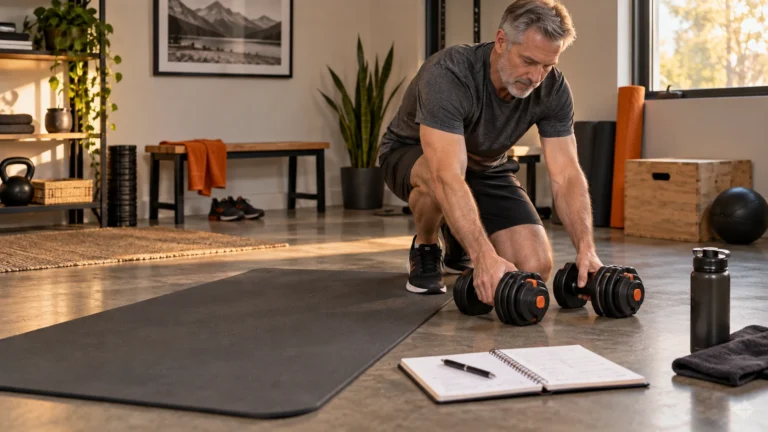
Choose a dumbbell chest workout for your floor or bench setup. Follow complete sessions, handling checks, progression examples and a free training log.
- The floor and bench provide different available ranges.
- Handling the weights is part of choosing a load.
- Count your other pressing before adding more sets.
Bottom line Choose one press you can set up and finish under control, then log its load, repetitions and depth.
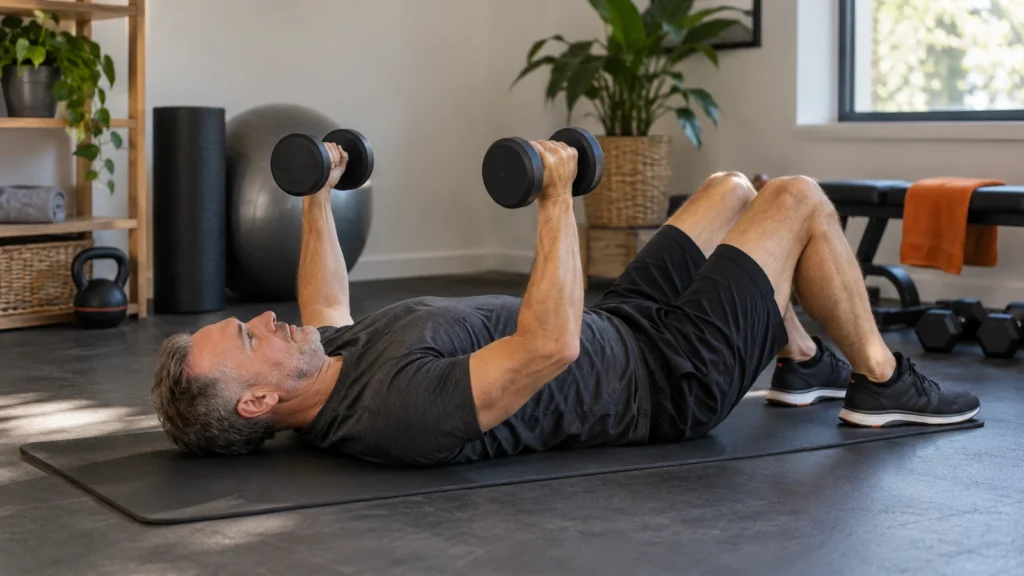
A dumbbell chest workout needs a press you can set up, control and finish safely. The floor is a practical option when you do not have a bench, while a bench changes the available movement range. Choose the position first, then the load and amount of work.
Quick Summary: Dumbbell Chest Workout
- The floor and bench provide different available ranges.
- Handling the weights is part of choosing a load.
- Count your other pressing before adding more sets.
The Prime Perspective
The difficult part of a home press may happen before the first repetition: getting the dumbbells into position and returning them to the floor. A weight you can press several times can still be too awkward to handle alone. Choose the starting load with entry and exit in mind.
These examples are focused pressing sessions, not a complete weekly program. Use them within the dumbbell-only home plan or full-body routine, replacing similar pressing instead of adding every version together.
Floor press or bench press?
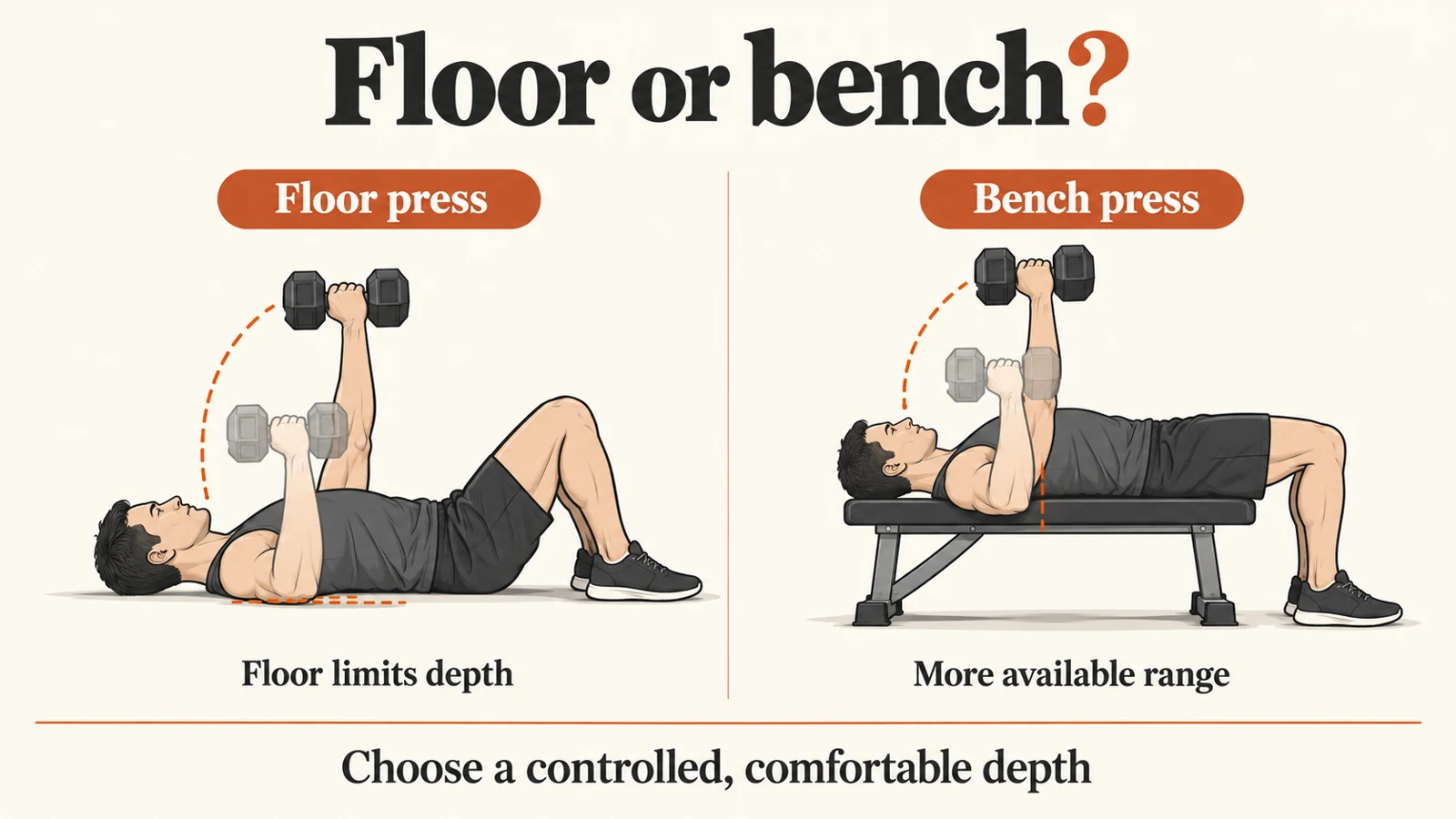
In a floor press, the floor limits how far the upper arm can travel downward. A bench leaves more clearance below the torso. That extra available range is an option to control, not a requirement to lower as far as possible. Your comfortable depth and ability to manage the weights still determine the movement.
A floor press requires a comfortable way to get down and stand up. A bench press requires a stable purpose-built bench with its adjustments locked and enough room beside it. Neither surface makes the exercise universally suitable for sore shoulders or recent injuries.
| Option | What it provides | What to check |
|---|---|---|
| Dumbbell floor press | A floor-limited lowering range; no bench purchase | Floor transfers, firm surface, hand clearance and a controlled exit. |
| Flat dumbbell bench press | Clearance for a deeper lowering position | Bench stability and manual, feet supported, manageable weight handoff. |
| Incline dumbbell press | A changed pressing angle | A suitable locked bench; use as an alternative primary press before adding it as extra work. |
| Wall push-up | A standing pressing alternative without weights | Stable wall, footing and a comfortable range; it is not identical loading to a dumbbell press. |
Optional equipment for this setup
Use the equipment you already have when it meets the plan. We have not hands-on tested these models. The current catalog and product images were checked on October 7, 2026; specifications and variants can change.
As an Amazon Associate, PrimeForMen earns from qualifying purchases. The links below are affiliate links. Check the selected variant and current instructions before buying.

PowerBlock Elite EXP Stage 1 pair
A selectable pair for recording the same load on repeated sessions.
- The catalog lists two dumbbells with 5–50 lb settings per hand.
- Check the exact edition and selector instructions before handling weights.
- Compare the minimum load and increments with your lightest exercise.
Skip it: Keep your current dumbbells if their load and increments already suit the movements.

YOLEO adjustable bench
An optional support for the bench-based variations in this guide.
- Read the exact manual for permitted positions, locks and loading.
- Check stability, floor contact and space around the moving weight.
- A catalog load headline does not establish suitability for every supported exercise.
Skip it: Skip a bench purchase when the floor, standing or suitable existing support option meets your plan.

Gorilla Mats exercise mat
A defined floor area for the floor-press option.
- Check the selected size; the listing contains several dimensions.
- Confirm the surface stays flat and does not slide during setup.
- A mat does not make dropping dumbbells or an awkward transfer safe.
Skip it: Skip it if your existing firm, nonslip surface already works for floor transfers.

Ultimate Workout Journal
A paper record for loads, repetitions and the setup that produced them.
- Record the exact movement and load unit rather than a vague workout score.
- Keep left and right results separate when the movement is unilateral.
- Use a new page to compare repeated conditions and planned changes.
Skip it: An ordinary notebook or the free worksheet below does the same recording job.
Choose one primary session
The following are editorial examples for adults already comfortable with the chosen movement. Begin with about five minutes of easy movement and light pressing rehearsal. The work sets come after the rehearsal. Start with one or two primary sets when returning after a break; the extra push-up is optional.
Leave about two or three controlled repetitions available at the end of a work set. Rest longer if breathing or positioning the dumbbells makes the next set rushed. Allow roughly 25–35 minutes with a prepared setup, while treating the clock as an estimate rather than an instruction to hurry.
| Session | Primary work | Optional additional pressing |
|---|---|---|
| A: without a bench | Floor press: 3 × 8–12; rest 90–120 seconds | Wall push-up: 2 × 6–12; rest 60–90 seconds. |
| B: with a suitable bench | Flat bench press: 3 × 8–12; rest 90–120 seconds | Wall push-up: 2 × 6–12 if the weekly workload supports it. |
| Incline alternative | Replace the primary flat press with a familiar incline press: 3 × 8–12 | Do not also add all three primary press prescriptions. |
Set up the floor press before adding effort
Place the weights within controlled reach, with a clear route for your feet. Use a firm surface that allows your upper arms to meet it gently. Rehearse getting into and out of position with very light weights or without a load. Do not balance a heavy adjustable dumbbell on a removable plate or improvise a grip the manufacturer does not allow.
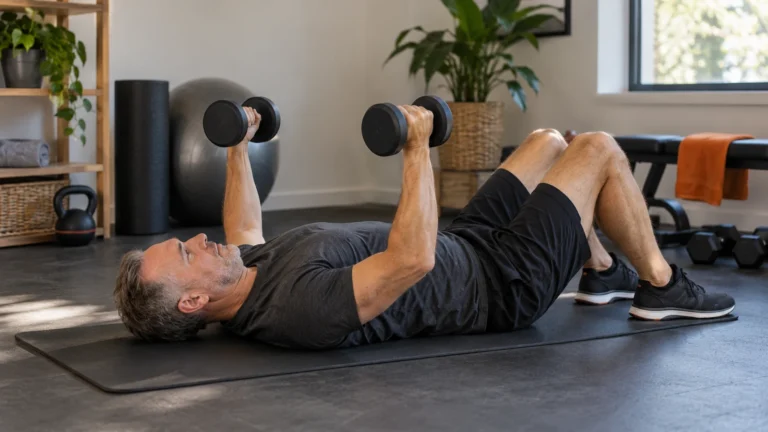
Lie with your knees bent and feet planted. Hold each handle securely, keep your wrist aligned with the forearm and lower until the upper arm meets the floor gently. Avoid bouncing the elbow against it. Press back along a comfortable path. At the end, lower and set the weights down under control; do not throw them sideways.
If getting onto the floor or managing two dumbbells is the obstacle, choose wall pressing or get qualified help with another setup. The floor restriction does not make a heavy self-handoff safe. Use the dumbbell setup guide after 50 when standing options and transfers are the main decision.
Set up a bench press with a controlled finish
Inspect the bench, select the intended position and confirm the manual permits the combined user-and-weight load. Keep the bench on a stable surface and clear objects from the lowering and exit areas. Place both feet securely; do not raise them onto the bench just to copy a harder-looking variation.
Use a load you can bring into position without twisting or losing your grip. A qualified spotter can help with an appropriate handoff, but simply having another person nearby is not a spotting plan. Lower under control to a comfortable depth, then press without forcing an excessive back arch. End the set before you lose the ability to return the weights safely.
The ACE chest press instructions describe a supported bench position and controlled movement. The exact routine here is our editorial example, not an ACE-prescribed workout.
Floor press and bench press
A qualitative diagram compares the floor limiting upper-arm travel with the extra available space in a bench press. It does not prescribe a depth.
Silent 8.5-second schematic. Motion pauses outside the viewport. Reduced-motion settings keep manual playback. Open the MP4 directly.
Do you need upper-chest and lower-chest exercises?
A change in bench angle changes the pressing task. You can use a familiar incline press when it fits your goal and setup, but a beginner does not need a separate session for every chest region. Learn one primary press and progress it before collecting several overlapping versions.
A fly is a different movement with a longer lever. It is not necessary for the starting examples, and heavier pressing weights should not automatically become fly weights. A squeezing sensation, pump or soreness does not measure which chest fibers grew. Keep choices tied to a repeatable movement and a log.
Use a progression record with the same depth
An illustrative press record might be 10, 9 and 8 repetitions with the same pair. Repeat that setting and aim for more controlled repetitions within the range. If your next record is 11, 10 and 9, note whether the depth, pauses and rest were also comparable.
Once all selected sets reach the upper end with consistent technique and planned remaining effort on repeated sessions, consider a small increase. A jump that you can only manage by lifting your hips or shortening every repetition is too large for this version. Review the available dumbbell increments before buying a set solely for its maximum load.
Record load per hand with its unit. Two 20 lb dumbbells are 20 lb per hand, not 40 lb per dumbbell. The helper below records your choices; it does not estimate a one-repetition maximum or determine a safe personal load.
Place pressing inside the whole week
For example, if Monday and Friday already include a floor press, use Session A in those slots instead of creating two extra chest days. If Wednesday also contains push-ups or overhead pressing, keep those sets in your workload record. The triceps and shoulders are involved in several of these exercises.
You do not need to turn every session into a chest specialization plan. Maintain pulling and lower-body work through the home strength plan. Use the focused row routine when you need pulling detail, and the recovery guide when performance across the week starts to decline.
Technique demonstration: NASM two-arm dumbbell chest press
NASM demonstrates a bench press. Watch the supported position and controlled lowering. It does not demonstrate the floor variation or certify your chosen load.
When pressing needs a different plan
Stop for sharp or increasing shoulder, chest or arm pain, loss of control or symptoms that alter the movement. New chest pressure, fainting or severe breathlessness needs urgent medical attention, not a lighter dumbbell selected online. Persistent or injury-related pain warrants qualified assessment.
For an equipment-free alternative, the no-equipment plan includes progressive pushing choices. Use a version you can perform comfortably and record it as a different exercise rather than pretending it is an equal replacement for the same dumbbell load.
Press setup record
This helper organizes your choices; it cannot assess technique, symptoms, equipment safety or personal suitability. Entries stay in this page’s memory and are not saved or sent. Print the current record before leaving.
Record your selected setup, loads, repetitions, rest and other work in a notebook or the blank PDF below. For unilateral work, three sets of eight on each side means 24 left and 24 right repetitions. Keep unknown attachment or handling details unresolved until checked.
The helper printout includes current choices and notes. The downloadable PDF is a separate blank fillable record and does not import your entries.
Download the fillable training record
The one-page PDF has eight editable fields for your setup, work and next session. It starts blank; it does not receive the helper entries. Save a copy after filling it in a PDF reader, or print it and write by hand.
What a workout table cannot decide
The repetitions describe an example session. They cannot establish whether a movement, load or attachment suits you. Record the unresolved detail, reduce the task when needed and get qualified help for persistent symptoms or an unfamiliar setup.
Your next session
Use this dumbbell chest workout guide to choose a repeatable setup and a manageable amount of work. Choose one press you can set up and finish under control, then log its load, repetitions and depth.
The 2026 ACSM resistance-training overview supports regular work across the major muscle groups and gradual progression. The detailed sessions on this page are editorial examples; they are not ACSM protocols or individually prescribed plans.
Frequently asked questions
Can dumbbells train the chest without a bench?
A floor press is one option when floor transfers and weight handling are comfortable. Wall push-ups provide a standing alternative. Neither requires buying a bench.
Is the floor press safer than a bench press?
The floor limits available lowering depth. That does not establish personal safety: weight handling, symptoms, control and the chosen load still matter.
Do I need flyes for this workout?
No. The starting examples use a primary press with optional wall pressing. A fly is another movement with its own lever and load choice, not a required addition.
How heavy should my dumbbells be?
Choose a load you can position, press through a comfortable range and set down under control. Learn with light rehearsal sets. This page does not supply a personal starting weight.
Can I do the chest session after my full-body workout?
First check the pressing already included. Usually it is clearer to replace that block with the chosen session than to stack another complete pressing routine on top.
General fitness education for adults, not a diagnosis, rehabilitation plan or medical clearance. Follow any restrictions from your clinician. Stop for sharp or worsening pain, dizziness, unusual breathlessness or loss of control. Seek urgent care for severe or sudden symptoms.