
I walked into a commercial gym last week and saw something that made my joints ache just watching it. A high school linebacker was standing on a Bosu ball, holding a pair of 15-pound dumbbells, doing single-leg curls while his “coach” threw a tennis ball at his face.
When I asked what the hell they were doing, the kid panted and said, “It’s a football-specific workout. It simulates the instability of being blocked while tracking the ball.”
No, it doesn’t. It simulates being an idiot in a circus act.
📋 TL;DR: The 2026 Gridiron Blueprint
- Stop Mimicking: Weight room exercises shouldn’t look like football plays. The gym is for building force; the field is for applying it.
- Chase Power, Not Just Strength: Moving heavy weight is good. Moving heavy weight fast is mandatory. Rate of Force Development (RFD) is your golden ticket.
- Bulletproof the Posterior Chain: Your glutes, hamstrings, and erectors are your engine. Ignore them, and you will tear a hamstring during a dead sprint.
- Train Unilaterally: Football is played almost entirely on one leg at a time. Bilateral strength (squats) builds the base; unilateral strength (split squats) builds the player.
- Manage the CNS: Your Central Nervous System dictates your speed. Stop training to failure every single session.
If there is one massive lie that the fitness industry has sold to athletes over the last decade, it’s that to get better at a sport, your time in the weight room needs to visually mimic the sport itself. We see guys shadow-blocking with cables or doing agility ladder tap-dances for hours, thinking it’s going to translate to gridiron dominance.
Here is the hard truth for 2026: Strength is general. Skill is specific.
You don’t get better at shedding blocks by doing cable chest presses on one foot. You get better at shedding blocks by building massive levels of absolute strength, optimizing your Rate of Force Development (RFD), and then going out onto the field to practice shedding actual blocks.
If you are following a traditional 3×10 bodybuilding “bro-split” of chest on Monday, back on Tuesday, and legs on Wednesday, you are building a slow, aesthetic engine for a sport that demands violent, high-output performance. It’s time to stop training for a mirror selfie and start training to put people on their backs.
The Truth About Football-Specific Workouts in 2026
When we talk about football-specific workouts in 2026, we aren’t talking about gimmicks. We are talking about highly calculated programs designed to meet the exact physiological and biomechanical demands of the sport.
Football is a game of violent, explosive collisions followed by brief periods of rest. An average play lasts 4 to 6 seconds. You have about 30 to 40 seconds of rest before the next snap. This means the sport relies heavily on the ATP-PC (phosphagen) energy system. You don’t need the aerobic capacity of a marathon runner; you need the explosive recovery capacity of a sprinter who also happens to wear armor.
Your foundational goal in the off-season is General Physical Preparedness (GPP). GPP is your engine’s displacement. The bigger the engine, the more horsepower you can eventually produce. You build GPP through heavy compound movements, dragging sleds, and carrying heavy things.
Once your GPP is established, we shift toward Special Physical Preparedness (SPP). This is where we focus on the specific metabolic pathways and fast-twitch muscle fibers (specifically Type IIx) required for football.
🏃♂️ The Prime Perspective
I’ve interviewed dozens of D1 strength coaches, and they all say the same thing: The incoming freshmen who struggle the most aren’t the weakest ones; they are the “gym strong” kids who have only ever trained like bodybuilders. They can bench 315, but they are stiff as a board, their hips are locked up, and they can’t change direction without losing their balance. They have all the show, but none of the go.
Why Bodybuilding Splits Fail Football Players
Bodybuilding is about muscle hypertrophy (size) and isolation. It focuses heavily on the eccentric (lowering) phase of a lift to cause micro-tears and build mass.
While size is important for football—mass equals force, after all—training exclusively for hypertrophy creates non-functional muscle. It builds sarcoplasmic fluid rather than dense, fast-twitch myofibrillar tissue.
This makes you heavy, slow, and highly susceptible to Central Nervous System (CNS) fatigue. Furthermore, isolated bodybuilding completely ignores the stretch-shortening cycle (the elastic energy your tendons store when you jump or cut).
To dominate on the gridiron, you must master the relationship between Eccentric vs. Concentric Contractions, focusing on moving loads with maximum intent and velocity.
Myth vs. Reality: The 2026 Football Training Matrix
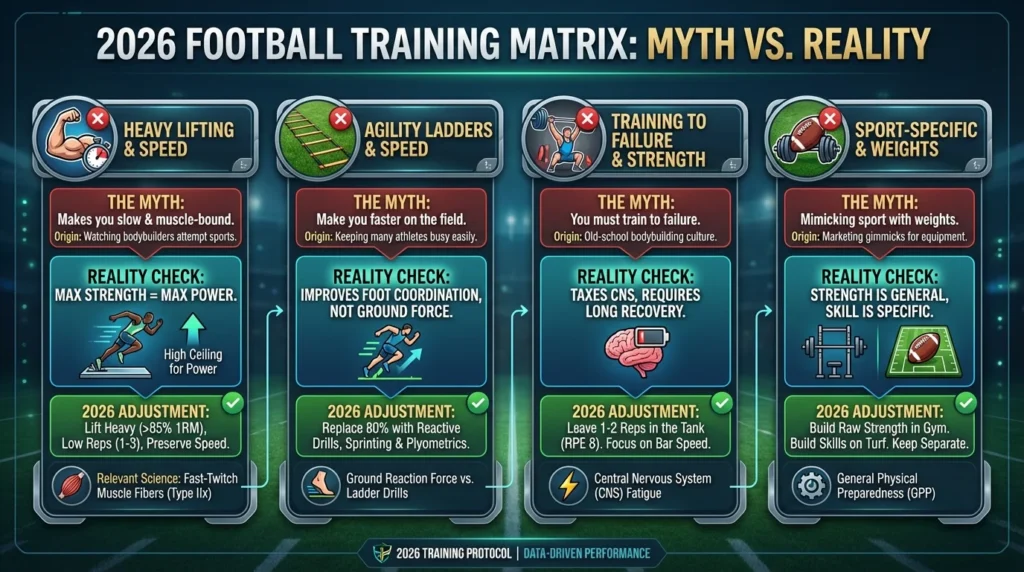
Let’s clear the air on some of the worst advice currently floating around locker rooms.
| The Claim / Myth | The Origin of the Myth | What the Data Actually Says | Practical 2026 Adjustment | Relevant Entity / Science |
| “Heavy lifting makes you slow and muscle-bound.” | Decades of watching bodybuilders who never sprinted or stretched trying to play sports. | Maximal strength increases the ceiling for maximal power. You cannot be explosive if you are weak. | Lift heavy (>85% 1RM) but keep the reps low (1-3) to avoid excessive fatigue and preserve speed. | Fast-Twitch Muscle Fibers (Type IIx) |
| “Agility ladders make you faster on the field.” | Coaches needed a way to keep 50 kids busy at once with minimal equipment. | Ladders improve foot coordination, not the ground reaction forces required for actual speed. | Replace 80% of ladder work with reactive agility drills, sprinting, and plyometrics. | Agility ladder drills vs. Ground Reaction Force |
| “You must train to failure to build real strength.” | Old-school bodybuilding magazines from the 1980s. | Training to failure heavily taxes the CNS, requiring days of recovery and ruining subsequent speed workouts. | Leave 1-2 reps in the tank (RPE 8). Focus on bar speed and intent, not total exhaustion. | Central Nervous System (CNS) Fatigue |
| “Sport-specific means mimicking the sport with weights.” | Marketing gurus trying to sell balance boards, bands, and gimmicky equipment. | Strength is general. Adding a football to a barbell squat doesn’t make it a football squat; it makes it a dangerous squat. | Build raw strength in the gym. Build specific football skills on the turf. Keep them separate. | General Physical Preparedness (GPP) |
The Biomechanics of the Gridiron: What Actually Matters
If you want a football-specific workout in 2026, you have to understand the biomechanics of a football play.
Whether you are a defensive tackle firing off the line or a wide receiver exploding into a route, the power generates from the ground up. The force travels from your feet, through your ankles and knees, is multiplied by your hips, stabilizes through your core, and transfers out through your shoulders and hands.
If there is a weak link in that chain, power leaks.
Rate of Force Development (RFD) vs. Absolute Strength
Absolute strength is the maximum amount of weight you can lift, regardless of how long it takes. Think of a grueling, 5-second, grinding deadlift. That is absolute strength. It’s crucial.
However, in football, you rarely have 5 seconds to apply force. If it takes you 3 seconds to reach your peak power, the opposing lineman has already put you on your back. This is where Rate of Force Development (RFD) comes in.
RFD is how fast you can access your strength. It is the explosive, rapid-fire recruitment of motor units. In 2026, modern strength programs utilize Velocity-Based Training (VBT) to measure bar speed. If the bar isn’t moving at the required meters-per-second, the weight is too heavy for a power adaptation, and the coach pulls plates off the bar.
Bulletproofing the Posterior Chain
The muscles on the back of your body—the calves, hamstrings, glutes, and erector spinae—make up the posterior chain. This is the undisputed engine of athletic performance. It is responsible for sprinting, jumping, tackling, and cutting.
If your workout program consists of bench presses, bicep curls, and leg extensions, you are building a Ferrari with a lawnmower engine. You must prioritize Romanian deadlifts, glute-ham raises, and heavy kettlebell swings.
💡 What Most Guys Miss
The biggest knowledge gap in amateur football training today is the misunderstanding of Central Nervous System (CNS) fatigue. Guys will do heavy, grinding squats on Monday, heavy deadlifts on Wednesday, and then wonder why they feel like they are running in mud during Friday night’s game.
Your muscles might recover in 48 hours, but your CNS—the electrical system that tells your muscles to fire fast—takes up to 72 hours to recover from heavy, high-intensity loading (a one-way ticket to overtraining syndrome). If your CNS is fried, your Type IIx fast-twitch fibers physically cannot activate. You have literally trained yourself to be slow.
Designing Your Football-Specific Workout Program
To build a program that translates to the field, we heavily borrow from The Conjugate Method. Popularized by Westside Barbell, this method rotates exercises frequently to prevent accommodation and relies on two main days: Max Effort (heavy weight, low reps) and Dynamic Effort (lighter weight, maximum speed).
Here is how we structure the ultimate football performance protocol.
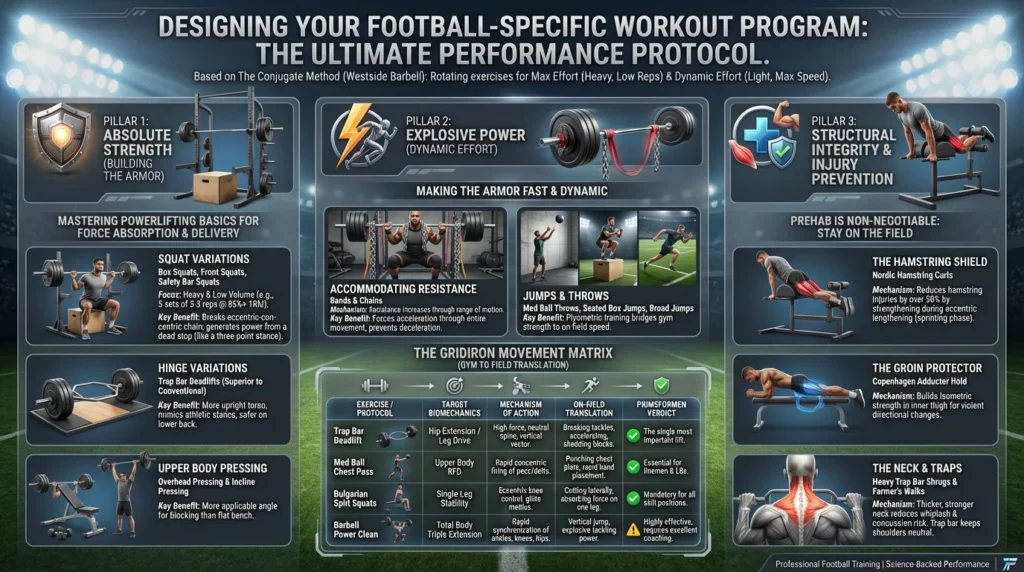
Pillar 1: Absolute Strength (Building the Armor)
You need to be strong enough to absorb and deliver force without breaking. This requires mastering powerlifting basics.
- Squat Variations: Box squats, front squats, and safety bar squats. For absolute strength, keep it heavy and low-volume (e.g., 5 sets of 2-3 reps at 85%+ 1RM). We use box squats to break the eccentric-concentric chain, forcing the athlete to generate power from a dead stop (exactly like firing out of a three-point stance).
- Hinge Variations: Trap bar deadlifts are superior to conventional deadlifts for football players. They allow for a more upright torso, mimic the athletic stance, and are safer on the lower back.
- Upper Body Pressing: Heavy bench press is fine, but overhead pressing and incline pressing are more applicable to the angle of blocking.
Pillar 2: Explosive Power (Dynamic Effort)
Once the armor is built, we have to make it fast.
- Accommodating Resistance: We use bands and chains on the barbell. As you lift the weight, the bands pull harder. This forces you to accelerate through the entire range of motion, rather than decelerating at the top.
- Jumps and Throws: Medicine ball scoop throws, seated box jumps, and broad jumps. Incorporating plyometric training bridges the gap between the weight room and the turf.
The Gridiron Movement Matrix
How exactly do gym movements translate to the field? Let’s break it down.
| Exercise / Protocol | Target Biomechanics | Mechanism of Action | On-Field Translation | PrimeForMen Verdict |
| Trap Bar Deadlift | Hip Extension / Leg Drive | High force production with a neutral spine; vertical force vector. | Breaking tackles, accelerating from a standstill, shedding blocks. | The single most important lift for football players. |
| Med Ball Chest Pass | Upper Body RFD | Rapid concentric firing of the pectorals and anterior deltoids. | Punching a defender’s chest plate; rapid hand placement. | Essential for linemen and linebackers. |
| Bulgarian Split Squats | Single-Leg Stability | Eccentric control of the knee; glute medius stabilization. | Cutting laterally without knee valgus; absorbing force on one leg. | Mandatory for all skill positions (DBs, WRs, RBs). |
| Barbell Power Clean | Total Body Triple Extension | Rapid, explosive synchronization of ankles, knees, and hips. | Vertical jump for a catch; explosive tackling power. | Highly effective, but requires excellent coaching to avoid wrist/shoulder injury. |
Pillar 3: Structural Integrity & Injury Prevention
You can be the strongest guy on the team, but if you tear a hamstring in week two, you are useless. 2026 programming puts a massive premium on prehab.
The Hamstring Shield: Sprinting causes hamstring tears during the eccentric phase (when the leg is reaching forward and the muscle is lengthening while contracting). To prevent this, you must do Nordic Hamstring Curls. Studies published in the British Journal of Sports Medicine have repeatedly shown that incorporating Nordics can reduce hamstring injury rates by over 50%.
The Groin Protector: Groin pulls end seasons. Enter the Copenhagen Adductor Hold. This isometric exercise builds incredible strength in the inner thigh, directly translating to your ability to change direction violently without tearing a muscle.
The Neck and Traps: Concussion mitigation starts in the weight room. A thicker, stronger neck reduces the whiplash effect during a collision. Heavy farmer’s walks and shrugs are non-negotiable. And when it comes to trap bar shrug vs barbell shrug, the trap bar is vastly superior for keeping the shoulders neutral and allowing heavier loads safely.
Why You Must Train Unilaterally
Football is not played with both feet perfectly planted, shoulder-width apart. You sprint on one leg, you cut off one leg, and you hit off one leg.
Therefore, unilateral training—training one limb at a time—must make up at least 40% of your lower body volume. Exercises like Bulgarian split squats, single-leg RDLs, and weighted step-ups expose side-to-side imbalances and strengthen the stabilizing muscles (like the gluteus medius) that a bilateral barbell squat ignores.
Speed, Agility, and High-Speed Running (HSR)
If you are just doing heavy squats and ignoring sprint mechanics, you are building a tractor, not a sports car.
Modern football periodization relies heavily on High-Speed Running (HSR) metrics. HSR is generally defined as running at velocities greater than 15 mph. You must consistently expose your hamstrings to max-velocity sprinting during the week so they are inoculated against the stress of game day.
Stop spending 45 minutes doing fancy footwork drills. Instead, focus on true acceleration.
- 10-Yard Sprints: Get off the treadmill and onto the turf. Start from various positions (kneeling, push-up position, three-point stance) wearing your actual cleats. Accelerate fully. Rest for at least 60 seconds between reps to ensure your ATP stores replenish—if you are breathing heavy, wait longer.
- Reactive Agility: Put down the cones. Real agility involves visual processing. Have a partner point left or right right before you sprint, forcing you to plant, cut, and react on the fly.
If you want to be fast, you have to run fast. Period.
✅ Your 24-Hour Action Plan
- Step 1: Ditch the bro-split. Sit down today and restructure your weekly program into an Upper/Lower split focusing on heavy compound movements and dynamic speed work.
- Step 2: In tomorrow’s lower body session, swap your standard barbell back squats for box squats, and add 3 sets of 5 Nordic Hamstring Curls at the end of the workout.
- Step 3: Begin a long-term habit of timing your sprints. If your 10-yard dash time starts dropping, your CNS is fatigued. Rest.
Final Whistle
The game of football is evolving, and the athletes are bigger, faster, and stronger than ever before. If your workouts still look like an Arnold Schwarzenegger routine from 1978, you are going to get left in the dust—or worse, carried off the field.
Stop seeking out “football-specific” gimmicks that have you juggling on balance boards. Build a massive base of General Physical Preparedness. Master the Trap Bar Deadlift. Treat your CNS like gold, train unilaterally to fix your leaks, and sprint with maximum intent.
Build the armor. Sharpen the weapon. Go to work.
Frequently Asked Questions About Football-Specific Workouts in 2026
What is the most important exercise for a football-specific workout in 2026?
The Trap Bar Deadlift is arguably the most critical lift. It builds immense lower body power, strengthens the posterior chain, and perfectly mimics the biomechanical demands of driving through an opponent, all while placing significantly less shear stress on the lower back compared to a straight bar.
Should football players run long distances to build endurance?
No. Football is an alactic-aerobic sport, meaning it requires short bursts of maximal output followed by brief recovery. Long-distance jogging trains slow-twitch muscle fibers, which will actually make you slower and less explosive. Focus on high-intensity interval sprints and High-Speed Running (HSR) to build field-specific conditioning.
How many days a week should I lift during the football season?
In-season training is about maintenance and injury prevention, not hitting new PRs. You should lift 2 days a week in-season. Keep the volume low and the intensity relatively high (80-85% 1RM) for 2-3 reps per set. The goal is to stimulate the nervous system without causing muscle soreness.
Do I need to do Olympic lifts like power cleans for football?
While power cleans are fantastic for building triple-extension explosiveness, they are highly technical. If you don’t have a qualified coach to teach you, the risk of wrist, elbow, and shoulder injury is high. You can achieve similar Rate of Force Development (RFD) adaptations using heavy kettlebell swings, weighted jumps, and medicine ball throws.
Why are my hamstrings always tight during the season?
Tight hamstrings are often weak hamstrings. Your body tightens the muscle as a protective mechanism because it senses it lacks the strength to handle high-velocity eccentric loads. Incorporating Nordic Hamstring Curls and Romanian Deadlifts (RDLs) builds eccentric strength and will actually “loosen” your hamstrings better than static stretching.
Disclaimer: The information provided in this article is for educational purposes only and is not intended as a substitute for advice from your physician or other health care professional. Always consult with a qualified strength and conditioning coach and a medical professional before beginning any high-intensity athletic training program.
The Ultimate Guide to Sport-Specific Training
Stop guessing your workouts. Discover the specific protocols elite athletes use to dominate their field, court, or track.
Get the Free Guide