
Compare powerlifting and bodybuilding after 40 with complete sessions, rest times, progression examples and a practical training-choice helper.
- Choose the result you want to track: lift performance or muscle development.
- Compare complete sessions, including work sets and rest.
- Use a repeatable log before adding more weight or work.
Bottom line Choose one training priority, try an appropriate familiar session and record the result before changing the dose.

Powerlifting vs bodybuilding in your 40s comes down to the result you want to track. Powerlifting makes performance in the squat, bench press and deadlift the priority. Bodybuilding organizes training around muscle development, with more freedom to change exercises. Both can improve strength and muscle size; choosing an emphasis helps you decide what deserves the first part of a session and what can be adjusted.
Use the comparisons and session examples below to make that choice. They are editorial starting structures for people familiar with the movements, not individualized programs, rehabilitation plans or instructions to test a maximum.
Quick Summary: Powerlifting vs Bodybuilding in Your 40s
- Choose powerlifting when improving the three competition lifts matters most.
- Choose a bodybuilding emphasis when muscle development and exercise flexibility matter most.
- Keep a hybrid plan selective: prioritize one result and give the other enough useful work.
- Record load, repetitions, rest and estimated effort. A harder session is not automatically a better progression.
- Experience, setup and individual restrictions matter more than an age-based training label.
The Prime Perspective
A man with several years of consistent lifting and a man returning after a long break need different starting points, even if both are 45. Before choosing a split, ask what you can already perform comfortably, what equipment you can use reliably and how many sessions you actually complete.
For a return to training, the next useful step may be learning familiar movement patterns with manageable loads. Our strength-training basics cover that foundation. The examples here become useful once exercise setup and ordinary work sets are familiar.
What changes when you choose a training emphasis?
In competition, powerlifting is a rules-based sport. The current IPF technical rules define the squat, bench press and deadlift, judging requirements and permitted equipment. Practicing those standards matters if you intend to compete. You can also train for strength without entering a meet.
Recreational bodybuilding means training for muscle development; it does not require stage preparation. Choose exercises that train the intended muscles with a setup and range you can repeat. A dumbbell press or machine press can be useful even when it does not resemble a competition bench press.
| Decision | Powerlifting emphasis | Bodybuilding emphasis |
|---|---|---|
| Main result | Performance in the three competition lifts | Muscle development across chosen muscle groups |
| Exercise selection | Keep enough specific lift practice; use accessories to support it | Choose effective, repeatable exercises; substitute when useful |
| First exercise | The lift or skill that needs the freshest practice | The muscle group or movement given priority in that session |
| Useful log | Load, reps, effort, technique and competition-standard practice | Load, reps, effort and consistent range/setup for each exercise |
| Typical adjustment | Keep the specific lift but change its dose or add a relevant variation | Change dose or exercise while retaining the intended muscle work |
| What neither guarantees | Freedom from pain, a personal best or superior general health | Freedom from pain, a particular physique or faster recovery |
Repetition ranges overlap
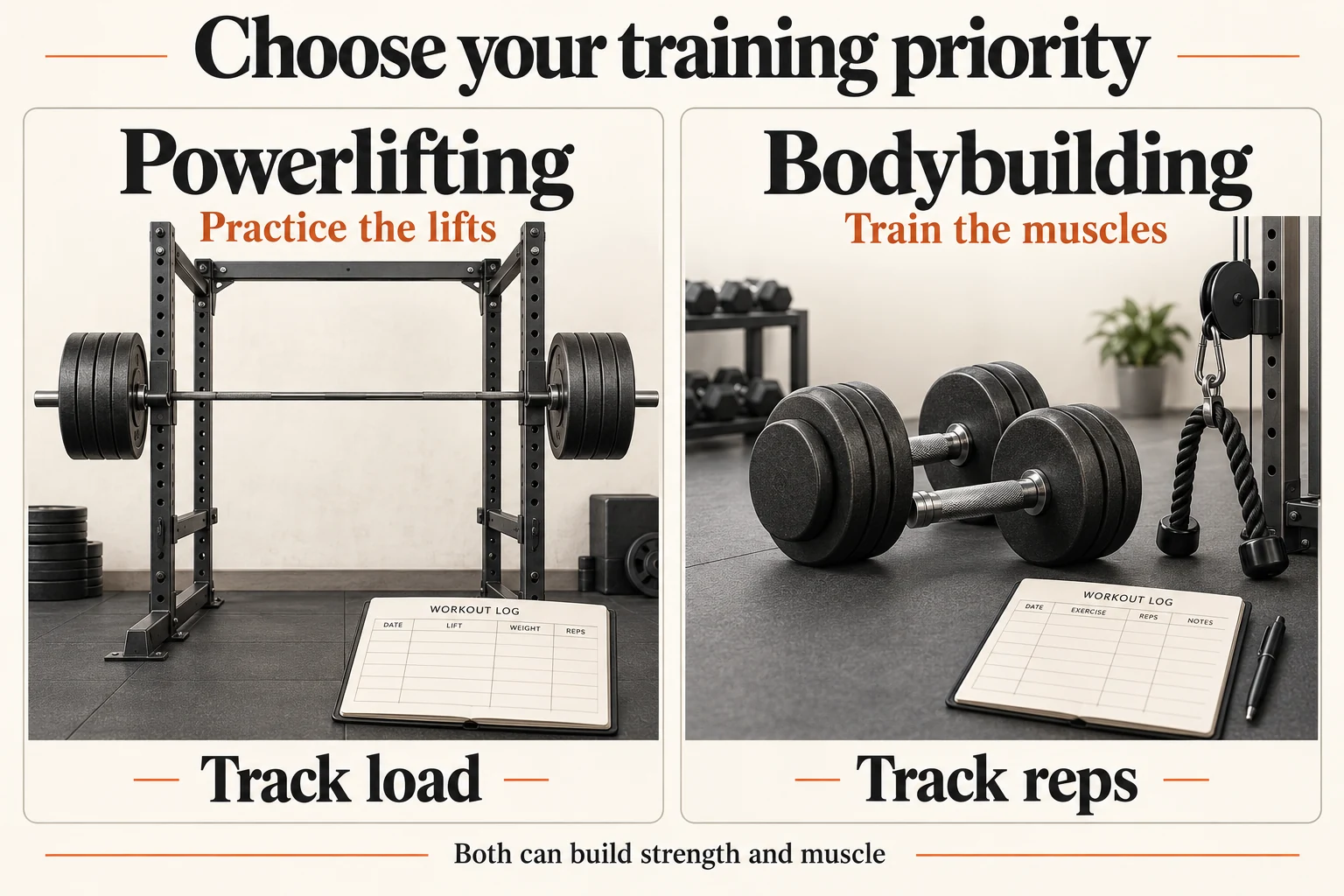
Low repetitions are not exclusive to powerlifting, and sets of 8–12 are not exclusive to bodybuilding. What matters is the combined choice of load, effort, exercise, weekly work and practice. A powerlifter may use rows and leg curls for muscle work. Someone training for muscle can keep a barbell lift because they enjoy it and can perform it well.
The ACSM’s 2026 resistance-training guidance distinguishes goal-specific load and volume: heavier loading favors maximal strength, while greater weekly volume supports hypertrophy. It also emphasizes regular training and individualization. Its healthy-adult evidence is not a head-to-head trial of these exact sample sessions in men aged 40–49, and it does not make training to failure compulsory.
Choose an emphasis and prepare your session log
This helper organizes your stated goals and access. It does not assess technique, fitness or medical suitability, and it does not calculate a working weight.
Without the helper: choose lift performance, muscle development or a hybrid priority from the comparison. New movements need instruction; symptoms or restrictions need individual guidance. Use only an appropriate familiar example with a suitable setup, and record load, reps, effort and rest.
Two complete sessions: see what the choice changes
These examples assume familiar exercises, suitable equipment and no unresolved reason to seek individualized guidance. Sets below are working sets; warm-up sets are separate. Start at the lower end if the dose is appropriate for you, and do less when needed. Neither example is a complete competition program or a promise of muscle growth.
Before the first lift, use comfortable general movement, rehearse the exercise and build up through lighter sets without tiring yourself out. Check rack safeties and the spotter arrangement for barbell squats and bench presses. If you do not know how to set them, get instruction before using the barbell example.
Session A: squat-focused powerlifting practice
The squat receives the freshest work. Bench practice stays in the session, while the final two exercises add back and hamstring work. Rest long enough to keep the next work set controlled; the listed intervals are starting examples, not a reason to hurry a difficult setup.
| Exercise | Sets × reps | Rest between sets | Effort and purpose |
|---|---|---|---|
| Familiar back squat | 3 × 3–5 | 3–4 minutes | About 2–3 reps in reserve; repeat the setup and lift standard |
| Familiar barbell bench press | 3 × 4–6 | 2–3 minutes | About 2–3 reps in reserve; controlled bench practice with the proper safety arrangement |
| Chest-supported row | 2 × 8–12 | 90–120 seconds | About 2 reps in reserve; upper-back work without adding another unsupported hinge |
| Leg curl | 2 × 10–15 | 60–90 seconds | About 2 reps in reserve; hamstring work with a familiar machine setup |
If competing is your goal, a coach can help match squat depth, bench commands and technique to your federation. A lift that moves more weight but changes the standard cannot be compared directly with your previous logged lift.
Session B: full-body muscle-development emphasis
This example distributes work across more exercises and uses a wider range of repetitions. The goblet squat keeps the squat pattern without requiring competition-specific barbell practice. A leg press can replace it when the selected machine, positioning and range suit you; neither choice is automatically suitable for every joint or condition.
| Exercise | Sets × reps | Rest between sets | Effort and purpose |
|---|---|---|---|
| Goblet squat or familiar leg press | 3 × 8–12 | 2–3 minutes | About 2–3 reps in reserve; consistent knee/hip movement and range |
| Dumbbell or familiar machine chest press | 3 × 8–12 | 2 minutes | About 2 reps in reserve; repeatable pressing range and setup |
| Chest-supported row | 3 × 8–12 | 90–120 seconds | About 2 reps in reserve; back work without turning every rep into a body swing |
| Familiar dumbbell Romanian deadlift | 2 × 8–10 | 2 minutes | About 2–3 reps in reserve; controlled hinge within a comfortable range |
| Lateral raise | 2 × 12–15 | 60–90 seconds | About 2 reps in reserve; shoulder work without forcing the range |
When goblet loading is limited by holding the dumbbell rather than the intended leg work, choose an appropriate alternative instead of assuming the squat has stopped being useful. The unilateral-training guide explains other ways to train one side at a time. For a split-squat option, learn the setup in our Bulgarian split squat guide before adding it to a hard session.
Count the work without inventing a winner
Widths share a scale of 0–13 working sets and summarize only the two tables above. They do not measure fatigue, weekly muscle-group volume, time, safety or expected results. Three more sets do not establish a better session.
Track progress for your goal
The two log cards show different training priorities. They do not compare measured strength, muscle growth or recovery.
Silent, 8.5 seconds. Open the animation directly. Playback pauses offscreen; reduced-motion preferences keep playback manual. The comparison remains in the readable table above.
Choose a load without testing your maximum
Reps in reserve (RIR) means your estimate of how many more repetitions you could complete with the intended technique. Two RIR means you think roughly two more controlled reps were available. It is a judgment, not a measured safety margin. Beginners often need feedback to learn it; pain or uncertain technique is a reason to stop or change the task, not a RIR calculation.
For these examples, choose a familiar manageable load, complete the lower end of the range and review the set. If you cannot keep the setup or expect the next rep to become uncontrolled, stop. If the set was much easier than intended, you can use that information for a later set or session without making a sudden large jump. Leaving 2–3 RIR is an editorial way to keep these examples submaximal, not a universal requirement for every program.
Keep the rest interval reasonably consistent when comparing sessions. Shortening three minutes to thirty seconds changes the task and may reduce repeatable reps. A logged decrease in reps under those conditions does not prove that you lost strength.
Watch a deadlift setup before making it a priority lift
Alan Thrall, coach and owner of Untamed Strength, demonstrates his five-step conventional deadlift setup in this 2022 tutorial. The embed starts at the setup chapter, 3:10; the complete video runs about 14 minutes. Watch how stance, grip and positioning are organized before the pull. It is technique education, not a demonstration of our sample program or medical clearance.
Watch the deadlift setup on YouTube if the embed does not play. A coach can help you apply the setup to your body and equipment; do not copy the demonstration load.
Fit the emphasis into two or three weekly sessions
Use days you can reliably attend, with recovery time between demanding sessions. Monday/Thursday or Monday/Wednesday/Friday are scheduling examples, not medically required intervals. The ACSM guidance encourages training major muscle groups at least twice weekly; the examples here still need review against your actual week, exercise overlap and tolerance.
| Schedule | Strength priority | Muscle priority |
|---|---|---|
| Two days | Use squat-focused Session A on one day. On the other, a familiar deadlift 2 × 3–5, bench 3 × 6–8, supported row 2 × 8–12 and leg press 2 × 8–12 illustrate a second session. | Repeat Session B if appropriate, keeping setup consistent. Alternatively use a familiar leg press, machine press or cable row in the same corresponding slots and log each separately. |
| Third day, if appropriate | Add lighter specific practice rather than another maximum: familiar squat 2 × 5–6, bench 2 × 6–8, supported row 2 × 8–12 and leg curl 2 × 10–15. | Add a shorter full-body session: goblet squat 2 × 8–12, familiar chest press 2 × 8–12, supported row 2 × 8–12 and familiar RDL 2 × 8–10. |
| Rest and effort | Use 3–4 minutes for the deadlift, 2–3 for squat/bench/leg press, 90–120 seconds for rows and 60–90 for curls. Keep about 2–3 RIR. | Use 2–3 minutes for squat/leg press, 2 for chest press/RDL and 90–120 seconds for rows. Keep about 2–3 RIR. |
The extra day adds work; it is not automatically an improvement. If two days are productive and a third compromises recovery or attendance, keep two. When you have less time, retain the main practice and one or two useful accessories, or reduce sets. Do not squeeze the same work into the slot by removing necessary rest.
A hybrid needs a priority too
Powerbuilding can use the structure of Session A while keeping accessory progression important. For example, track the squat first, then bench practice and rep-range progress in the row and curl. If muscle development is the priority, use Session B and keep a familiar barbell press in the chest-press slot when appropriate. Choose the useful parts of each approach; do not stack both complete sessions together.
A small home setup may support productive muscle and general strength work without supporting competition-specific barbell practice. Our strength training at home guide covers those alternatives. Equipment limits should change the plan before they force improvised safety arrangements.
Progress one exercise with a clear rule
Record the exercise version, load, reps per set, rest and estimated RIR. Record weight per dumbbell when using a pair; for a barbell, record total loaded weight including the bar. Those different conventions can otherwise make the next log entry ambiguous.
Example 1: progress repetitions before load
Suppose a familiar row is prescribed as 3 × 8–12. At the same load and setup, your entries might be 10/9/8, then 10/10/9, then 11/10/10. You do not need to increase weight after every session. Once all three sets reach the top of the range with the intended effort and control on repeatable sessions, consider the smallest suitable increase and return toward the lower end.
This example uses double progression. Do not force the top number by shortening the range, swinging or changing the exercise. After switching from a cable row to a machine row, start a separate record; the two displayed loads are not interchangeable.
Example 2: a small barbell increase
For a 3 × 3–5 squat example, keep the current load while building controlled reps within that range. When 5/5/5 is repeatable at the intended effort and setup, a small increase may be appropriate. Adding one 1.25 lb plate to each side adds 2.5 lb to the barbell total: 135 lb becomes 137.5 lb. It does not add 1.25 lb overall.
The arithmetic shows how micro-loading works; it does not establish the right increase for your lift. Available plates, the exercise and your previous response decide whether to add load, hold it or reduce it. You can make progress by improving repeatability without changing the weight that day.
When the planned increase does not fit
If the first set becomes an unexpected grind, do not treat every remaining set as a test. Reduce the load or number of sets, check the setup and review what changed. A single difficult day is not proof that the whole method has failed. Repeated difficulty under comparable conditions needs a closer review; the fitness-plateau guide provides a wider troubleshooting framework.
Manage recovery and know when to stop
Compare your log with sleep, other demanding activity and the previous session. A missed night, a long physical workday or unfamiliar exercises can change how much work fits. Use the rest and recovery guide to organize those observations. Neither a powerlifting nor bodybuilding label supplies a universal recovery interval for every man in his 40s.
| What you notice | What to do with that information |
|---|---|
| A familiar load feels harder, without pain | Keep the session submaximal; consider fewer sets or less load. Record the change and compare again. |
| Setup or technique becomes inconsistent | End the set; use a manageable version and get instruction if the cause is unclear. |
| An exercise repeatedly causes discomfort | Stop forcing that version. Seek guidance about the cause and appropriate alternatives. |
| Performance keeps declining despite adjustments | Review total training and recovery with a qualified coach; unresolved symptoms need clinical assessment. |
Stop exercise for sharp pain, feeling unwell or an unusual symptom. Chest pain, fainting, severe breathlessness or sudden neurological symptoms can require emergency help. Persistent pain, unexplained weakness or exercise restrictions need professional guidance. This article does not decide which symptoms are harmless or clear you to train.
Do not use a belt, straps or a different rep range to override those concerns. If you need individual advice about breathing or blood-pressure restrictions, follow that advice rather than a generic bracing instruction from a video.
Take a training log to your next session
The one-page training choice and session log (fillable PDF) has eight fields for your goal, setup, actual work and next review. Save it after filling, or print and write by hand. The helper print button creates a separate record of your current choices, notes and checkmarks.
Optional gear for specific training tasks
These three products support smaller load changes, familiar belt use or accessory pulling. Use existing gear when it fits; none is required to choose a training emphasis. We have not independently tested these products.
* As an Amazon Associate, PrimeForMen earns from qualifying purchases. Confirm the selected pack, size, compatibility and current instructions before ordering.
Best for: For an appropriate smaller barbell increase when the usual plates make too large a jump. Skip if you do not use a compatible barbell or do not need smaller increments. Current Amazon listing: Micro Gainz Olympic Fractional Weight Plates, 2-Piece, 1.25LB Black Best for: For experienced lifters who already understand their bracing and belt fit. Skip if you need technique instruction or individual advice about bracing. Current Amazon listing: Gymreapers Weight Lifting Belt - 7MM Heavy Duty Pro Leather Belt with Adjustable Buckle - Stabilizing Lower Back Support 4 Inches Wide For Weightlifting, Bodybuilding, Cross Training (Black, Large) Best for: For familiar accessory pulls when grip limits the intended muscle work. Skip if the exercise is unfamiliar or you need to practice an unassisted competition grip. Current Amazon listing: Gymreapers Olympic Lifting Straps for Weightlifting, Snatch, Clean, Powerlifting, Strongman, Deadlifts - Durable Cotton with Reinforced Stitching (Pair) (Black) * As an Amazon Associate, PrimeForMen earns from qualifying purchases.Recommended Products

Micro Gainz 1.25 lb Olympic fractional plates, pair
View on Amazon

Gymreapers 7 mm leather lifting belt, Large
View on Amazon

Gymreapers cotton lifting straps, pair
View on Amazon
Conclusion
Choose powerlifting if improving the competition lifts is the result you most want to track. Choose a bodybuilding emphasis if muscle development and exercise flexibility matter more. For a hybrid, make one the priority and select the supporting work deliberately.
Start with an appropriate familiar session, record what you actually did and change one variable after reviewing the result. More exercises, a harder final rep or a new purchase does not replace that process.
Build the rest of your training plan
The advanced fitness techniques hub connects progression, exercise methods and recovery. Our editorial policy explains how we separate source evidence, editorial examples and commercial recommendations.
Frequently asked questions
Is powerlifting or bodybuilding better in your 40s?
The better fit depends on your goal, experience, equipment and individual context. Powerlifting prioritizes the competition lifts; bodybuilding prioritizes muscle development. Neither label guarantees safety, joint comfort or results.
Can powerlifting build muscle?
Yes. Strength-focused training can support muscle growth, and powerlifters often include accessory work. The amount and distribution of useful work matter; improving a single maximum does not tell you how every muscle group is developing.
Do I need to lift to failure for bodybuilding?
No. The ACSM review does not make momentary failure necessary for the average healthy adult. These examples keep estimated repetitions in reserve. Effort still matters, and the estimate needs practice; it is not a guarantee that a set is appropriate.
Should I test my one-rep maximum before starting?
You do not need a maximum test to use these editorial examples. Learn the movements and choose manageable familiar loads. Competition testing and peaking need a more specific plan and appropriate instruction and safety arrangements.
Can I combine powerlifting and bodybuilding?
Yes, but choose a priority and budget the supporting work. Keep specific lift practice when strength is the priority; retain sufficient muscle work when size matters. Combining methods does not mean adding both full sessions to the same day.
Medical note: Educational information only, not medical advice, diagnosis, treatment or exercise clearance. Seek qualified guidance for symptoms, conditions or restrictions before changing training.