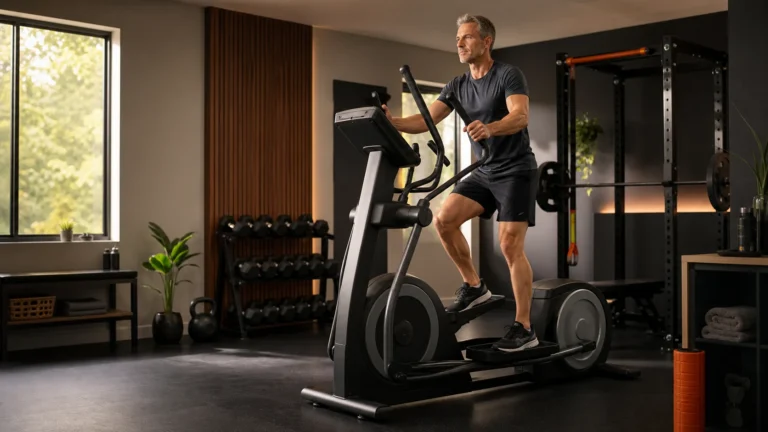
Compare home ellipticals by stride length, room size, step-up height, resistance, warranty and low-impact training fit.
- Fit stride length, pedal path, and ceiling clearance before comparing screens.
- Choose by use case: tall users, compact rooms, smart classes, or no-subscription cardio.
- Low impact does not mean knee-proof; start easy and track symptoms.
Bottom line The right elliptical is the one that fits your stride and room so well you still use it after the first month.
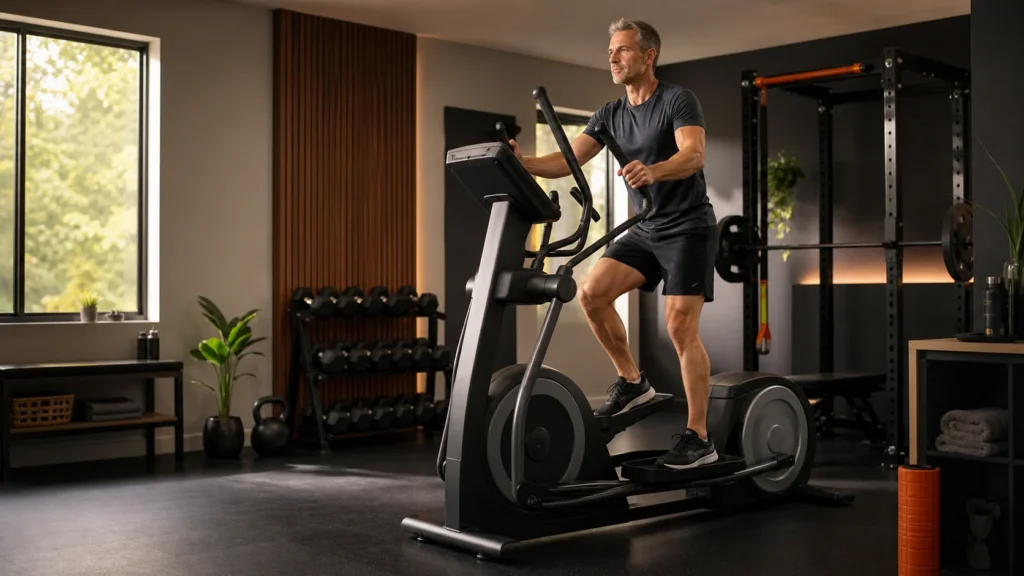
The best elliptical machine for home use is not the one with the biggest screen. It is the model that fits your stride, room, joints, and the way you will train three months from now. Full-size ellipticals usually provide the smoothest fit; compact machines trade some stride freedom for a smaller footprint.
Quick Summary: Best Elliptical Machine for Home
- Check stride length, step-up height, footprint, weight capacity, and warranty before console features.
- Most men should compare full-size ellipticals, compact ellipticals, smart incline models, bikes, treadmills, and rowers before buying.
- Low impact means less pounding than running, not automatic knee-proof training.
- Build time first, then resistance or intervals; do not make every session hard.
- Use Amazon product cards as a shortlist, not a substitute for measuring your room and checking return logistics.
The Prime Perspective
An elliptical trainer solves a specific problem: you want repeatable cardio with less impact than running, more whole-body rhythm than many bikes, and less technique demand than rowing. That does not make it the best machine for every man.
The buying decision should start with fit. If the stride is too short, the pedals feel awkward, the step-up height hits your ceiling clearance, or the warranty is weak, the entertainment screen will not save the purchase. This guide uses the same decision logic we apply across fitness gear and equipment: buy the tool that removes your real training friction.
How we chose these elliptical recommendations
This is an editorial buying guide, not a fake lab test. The shortlist below is based on visible product fit, use case, Amazon availability, brand/entity relevance, image verification, warranty and ownership considerations, and how the machine fits a realistic home-cardio plan.
Body fit
Stride length, pedal path, handle position, and max user weight come before screen size.
Room fit
Footprint, step-up height, mat size, delivery path, and storage matter more than spec-sheet hype.
Training fit
Zone 2, intervals, incline, resistance smoothness, and data should match how you will actually train.
For editorial standards, PrimeForMen follows a transparent research and review process described in our editorial policy. We do not invent ratings or claim hands-on testing where we did not perform it.
Amazon.com picks
Elliptical Trainer Shortlist by Use Case
These are direct product CTAs, not generic category links. Use them as a quality shortlist after you have checked stride length, room fit, warranty, and whether you want a smart-app ecosystem.
Disclosure: This section includes affiliate links. If you buy through them, PrimeForMen may earn a commission at no extra cost to you. Recommendations are based on fit, use case, specs, ownership friction, and training value.

Premium no-nonsense elliptical
SOLE Fitness Elliptical Line
Best when durability, stride comfort, and a stronger frame matter more than a flashy app ecosystem.
- Strong fit for men who want a serious home cardio machine with a longer-use mindset.
- Compare E25, E35, E95, and E95S by stride, incline, console, and warranty before buying.
- Best when you prefer machine quality and repeatable training over entertainment features.

Smart incline elliptical
NordicTrack AirGlide 14i
Best when guided workouts, incline variety, and a connected screen are the reason you will train more consistently.
- Useful if coaching, routes, and programmed sessions help you stay on schedule.
- Check subscription cost, delivery, ceiling clearance, and incline comfort before committing.
- Skip it if you want a simple no-screen elliptical with lower ownership complexity.

Value pick for longer stride
Niceday 20-Inch Stride Elliptical
Best when you want a longer-stride home elliptical without moving straight into premium pricing.
- The 20-inch stride target helps reduce the short, choppy feel many taller men dislike.
- Magnetic resistance and a simple console keep the setup less app-dependent.
- Verify footprint, max user weight, and return logistics before ordering a large box.

Midrange home-gym option
Reebok FR30 Cross Trainer
Best when you want a branded cross trainer with resistance levels and a cleaner home-gym footprint.
- Good comparison point for buyers who do not want the largest premium machine.
- Check stride feel and handle position if you are tall or have long legs.
- Works best for steady cardio, intervals, and basic home conditioning blocks.

Training data upgrade
Polar H10 Heart Rate Monitor
Best when you already have the elliptical decision mostly made and want cleaner heart-rate data for Zone 2 and intervals.
- A chest strap is usually more reliable for intervals than wrist-only readings.
- Makes easy days, Zone 2 work, and hard intervals easier to separate.
- Buy after you know you will train, not as a substitute for a realistic plan.

Floor, noise, and sweat control
SuperMats Equipment Mat
Best when the machine will sit on hard flooring, apartment flooring, or any surface you want to protect.
- Helps define the machine footprint before you commit the room layout.
- Useful for sweat, vibration, and floor protection under a heavy cardio machine.
- Measure the elliptical base and step-up area before choosing mat size.
* As an Amazon Associate, PrimeForMen earns from qualifying purchases.
Best elliptical trainers by use case
Do not buy an elliptical as a generic cardio object. Buy it for a job. The same machine can be excellent for one man and wrong for another if the stride, footprint, app model, or joint feel is wrong.
| Use case | What to prioritize | What to avoid | Best next check |
|---|---|---|---|
| Best overall home cardio | Stable frame, smooth resistance, 18-20+ inch stride, useful console | Light frames that wobble at moderate pace | Machine weight, user weight capacity, warranty |
| Best for tall men | 20+ inch stride, natural handle reach, wide stable pedals | Short compact stride that feels like stepping in place | Stride length by height and return policy |
| Best compact elliptical | Footprint, transport wheels, ceiling clearance, short session comfort | Buying only by small size and ignoring stride feel | Room measurement plus step-up height |
| Best smart elliptical | Guided programming, incline, screen value, app motivation | Subscription cost that becomes the reason you quit | Monthly cost after trial |
| Best knee-friendly starting point | Low incline, moderate stride, stable posture, easy resistance | Assuming low impact means symptom-proof | 10-minute easy test and 24-hour symptom response |
| Best no-subscription setup | Simple programs, HR monitor pairing, durable frame, clear controls | Machines that depend on apps for basic use | Console function without membership |
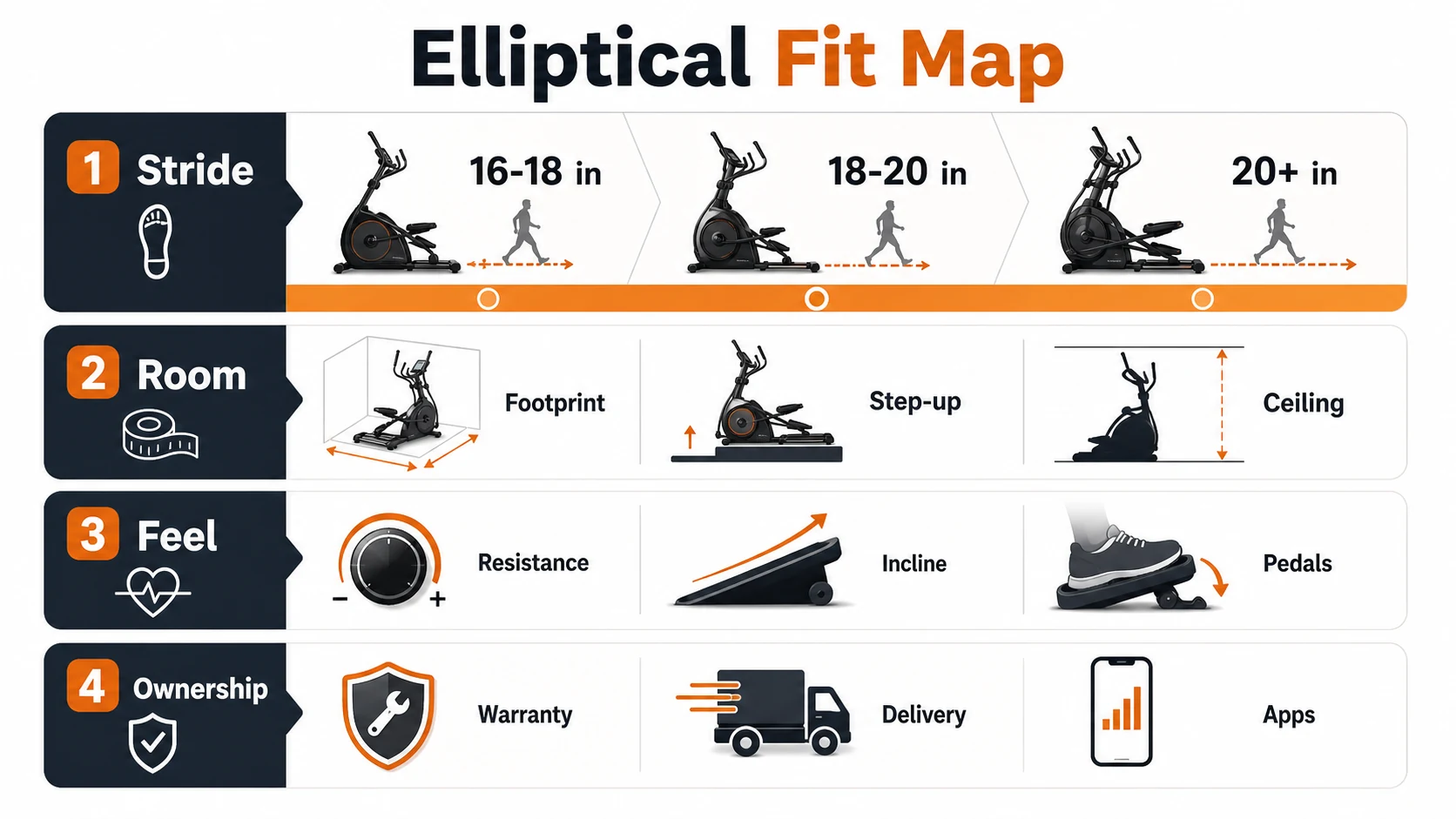
Stride length by height: the number most buyers skip
Stride length is not just a spec. It shapes whether the elliptical feels natural or clipped. Garage Gym Reviews notes that 16 to 20 inches is a common industry range and that taller users often need at least 20 inches. Treat that as a starting point, then check your actual movement comfort.
| Height range | Stride target | What it should feel like | Buying note |
|---|---|---|---|
| Under 5’7" | 16-18 inches | Controlled and not overreaching | Compact models may work if stable |
| 5’7"-6’0" | 18-20 inches | Smooth, repeatable, no hip rocking | This is the safest standard range for many homes |
| Over 6’0" | 20+ inches | Long enough that cadence does not feel chopped | Short machines can feel cheap even when the console is good |
| Multiple users | Adjustable or generous stride | Works for both shorter and taller users | Prioritize return policy if fit is uncertain |
Elliptical vs treadmill vs bike vs rower
If you are still deciding which home cardio machine belongs in your room, compare the movement first. An elliptical is not a universal upgrade over treadmills, exercise bikes, or rowing machines.
| Machine | Best for | Watch out for | Choose it when |
|---|---|---|---|
| Elliptical | Low-impact whole-body rhythm, steady cardio, joint-conscious home training | Forced pedal path, balance issues, short stride | Running feels too hard but biking feels too passive |
| Treadmill | Walking, running, gait-specific conditioning | Higher impact when running, more noise | Walking or running is the main goal |
| Bike | Very low-impact cardio, smaller footprint, controlled knee tracking | Seat comfort, hip angle, less upright loading | Knees prefer cycling over elliptical pedal path |
| Rower | Full-body conditioning, posterior chain work, measurable intervals | Technique errors, back irritation, higher learning curve | You want conditioning plus skill and power output |
For a broader machine comparison, use our guide to the best cardio machine for home and then return to this page for elliptical-specific buying checks.
Are ellipticals good for knee and hip comfort?
Ellipticals are often described as low impact because your feet remain on the pedals. Harvard Health frames them as a joint-friendlier option for many people, and the Arthritis Foundation discusses ellipticals as one possible option for people managing arthritis. That is useful context, not a guarantee.
Low impact does not mean knee-proof. Incline, pedal spacing, reverse pedaling, stride length, resistance, and session length can all change how your knees, hips, ankles, and back respond.
Start easier
Use low incline, low resistance, and 10-15 minutes before increasing training load.
Track 24 hours
If symptoms rise during or after use, reduce load or compare a stationary bike.
Keep strength work
Pair cardio with strength, mobility, and recovery rather than asking one machine to fix everything.
If joint irritation is recurring, pair cardio choices with the recovery principles in rest and recovery and consider professional guidance before pushing intensity.
Beginner elliptical workouts that actually progress
The CDC adult activity guideline gives a useful floor: adults should build toward regular moderate-intensity activity and include muscle-strengthening work. On an elliptical, that means you need a weekly rhythm, not random hard sessions.
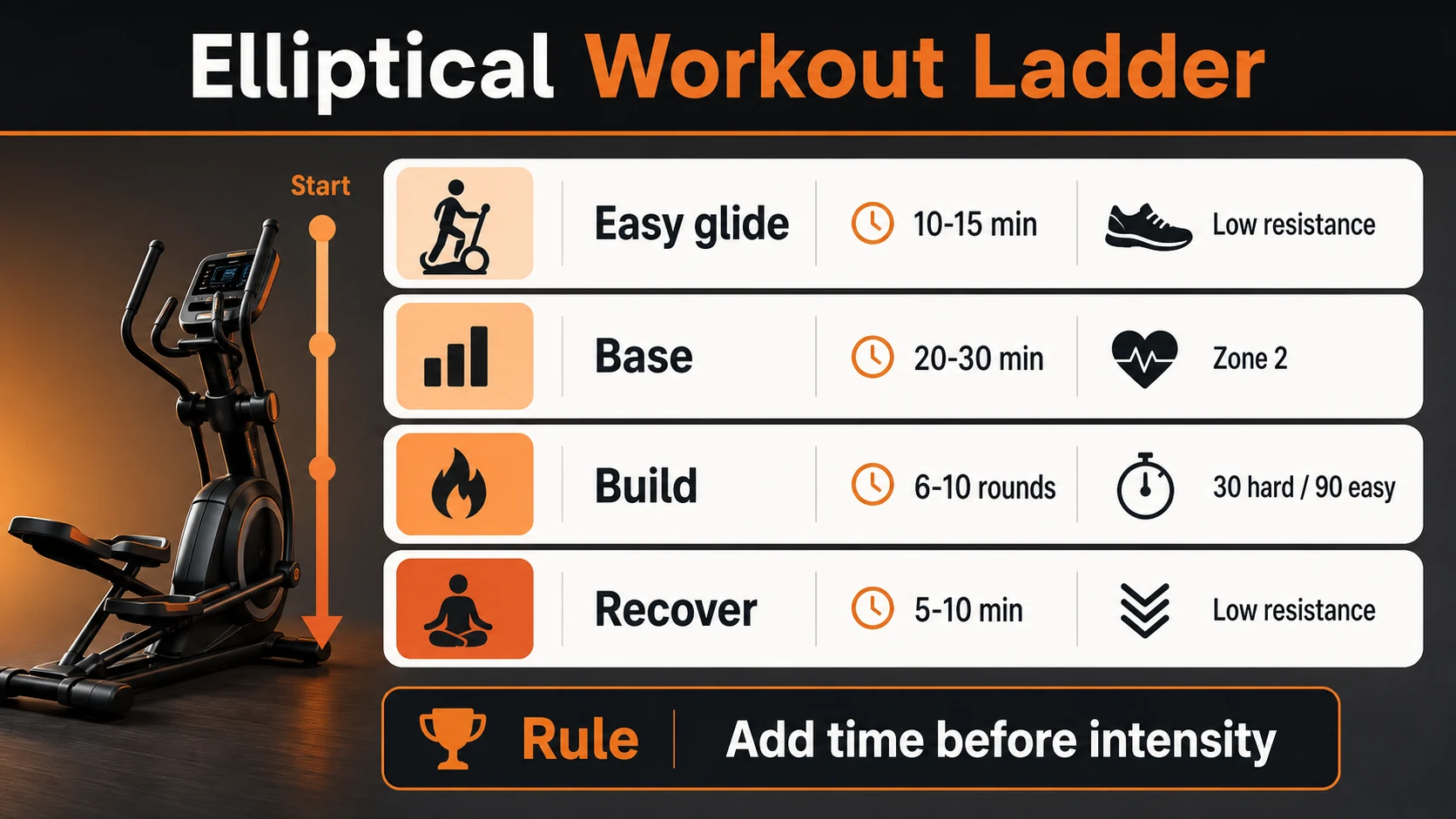
| Goal | Workout | Progression | Use a heart-rate monitor for |
|---|---|---|---|
| Beginner baseline | 10-20 minutes, easy resistance, RPE 4-5 | Add 5 minutes before adding resistance | Keeping easy days honest |
| Zone 2 cardio | 25-40 minutes at steady conversational effort | Increase duration first, then cadence or resistance | Staying out of accidental tempo work |
| Intervals | 6-10 rounds: 30 seconds hard, 90 seconds easy | Add rounds before making hard reps harder | Separating work and recovery |
| Knee-friendly test | 10 minutes, low incline, low resistance | Repeat only if the next day feels normal | Spotting intensity drift |
For cleaner training data, compare a heart rate monitor for elliptical workouts. For budget constraints, compare fitness on a budget before buying a large machine.
Large cardio machines create ownership friction. Before ordering, check delivery path, box size, assembly requirements, return window, restocking fees, labor warranty, parts warranty, frame warranty, and whether the console becomes much less useful after a trial subscription ends.
Warranty
Frame warranty is not the same as parts and labor. Read the split before comparing prices.
Assembly
Heavy machines may need two people, scheduled delivery, or paid assembly. Plan that before checkout.
Subscription
Smart classes can be useful, but basic cardio should not become unusable without a monthly fee.
If you are building a broader space, start with home gym equipment and then decide whether an elliptical, bike, treadmill, or rower deserves the floor space.
Conclusion: buy the machine that removes friction
The best elliptical trainer is not necessarily the most expensive model. It is the machine that fits your stride, your ceiling, your floor, your budget, your knees, and your weekly schedule.
If you are tall, start with stride length. If space is tight, start with footprint and step-up height. If motivation is the problem, a smart elliptical may be worth the subscription. If comfort is the blocker, compare the elliptical against a bike before forcing the purchase.
FAQ
What stride length is best for an elliptical trainer?
Many home users fit best around 18 to 20 inches, while taller men often feel better with 20 inches or more. Shorter users may be fine with 16 to 18 inches. The key is not the number alone; it is whether your hips, knees, and ankles move smoothly without a choppy step.
Is an elliptical better than a treadmill for knees?
An elliptical usually has less impact than running because your feet stay on the pedals, but it is not automatically better for every knee. Pedal path, incline, resistance, and your individual joint mechanics still matter. If symptoms increase, reduce intensity or compare a bike, walking plan, or clinician-guided approach.
Should I buy a compact elliptical for a small apartment?
A compact elliptical can work if the frame is stable, the stride does not feel cramped, and the ceiling clearance is realistic. Do not buy only by footprint. Also check step-up height, machine weight, transport wheels, mat size, and whether the short stride will annoy you after two weeks.
Do I need a smart elliptical subscription?
No. A subscription can help if coaching and classes make you train more often. It is a poor deal if you only need steady Zone 2 cardio or simple intervals. Compare the machine without the app first: stride, resistance, frame, warranty, and comfort still matter most.
How many elliptical workouts should beginners do each week?
Start with two to three easy sessions per week, often 10 to 20 minutes each. Build time before resistance or intensity. Add strength training on at least two days per week if your recovery allows, because cardio equipment should support a full training system, not replace strength work.
Medical Disclaimer: This article is educational and does not replace medical advice. If you have chest pain, dizziness, numbness, worsening joint pain, recent surgery, balance problems, or a medical condition, speak with a qualified professional before changing your cardio routine.
Affiliate Disclosure: This article contains Amazon affiliate links. PrimeForMen may earn from qualifying purchases. Product recommendations are editorial and should be checked against your body, room, budget, warranty expectations, and current availability.