
Understand overtraining syndrome, record symptoms and training changes, and learn when to seek help. No symptom score or fixed recovery deadline.
- A symptom checklist cannot diagnose OTS.
- Dated observations help a professional assessment.
- Recovery and activity advice depend on the individual.
Bottom line Bring the change in familiar activity and daily life to a clinician; ask which activity is appropriate while the cause is assessed.

Overtraining syndrome involves a prolonged loss of performance that requires clinical evaluation. A difficult workout, soreness or a tired week cannot establish that diagnosis. If your usual activity has become unusually difficult, avoid adding harder sessions to test yourself. Record what changed and seek professional advice when symptoms persist, worsen or affect daily life.
Men over 50 may have several explanations for declining exercise tolerance. Training load belongs in the conversation alongside health conditions, medicines, food intake, sleep and life demands. Age alone does not explain new symptoms.
Quick Summary: Overtraining Syndrome
- Functional overreaching, nonfunctional overreaching and overtraining syndrome describe different outcomes; a symptom count cannot separate them.
- A dated training record helps explain the change. It cannot diagnose the cause or clear you to resume exercise.
- Persistent underperformance deserves evaluation for other causes, including illness, nutritional problems and mood disorders.
- There is no universal seven-day reset or percentage reduction that treats suspected OTS.
- Acute chest pain, fainting or severe breathing difficulty needs emergency help, not a workout adjustment.
The Prime Perspective
A missed workout can feel costly when training anchors your week. An extra session to prove you are still fit adds another demand when performance has declined unexpectedly and may obscure what is happening. Existing observations are more useful for the first conversation: what you normally do, what became harder and when the change started.
Our approach separates clinical decisions from training records. The clinician investigates the symptoms; your coach can help reconstruct the program and adjust it within the advice you receive. The strength-training guide for men over 50 explains routine progression once exercise is appropriate. It does not provide a recovery plan for unexplained symptoms.
Fatigue, overreaching and OTS: useful distinctions
The joint ECSS/ACSM consensus statement describes functional overreaching as a temporary performance decline followed by improvement after recovery. Nonfunctional overreaching does not produce the intended improvement and takes longer to resolve. OTS involves prolonged maladaptation. The distinction between nonfunctional overreaching and OTS depends on the course of recovery and excluding other explanations, not a simple symptom checklist.
| Term | What it describes | What it cannot tell you at home |
|---|---|---|
| Ordinary training fatigue | A temporary response to effort, interpreted against your usual experience and circumstances. | Feeling tired does not explain new chest symptoms, fainting or persistent impairment. |
| Functional overreaching | A short performance dip after overload, with later recovery and improvement. | You cannot label a current slump productive before seeing its outcome. |
| Nonfunctional overreaching | Underperformance with a longer recovery and no intended training benefit. | A calendar or watch cannot reliably distinguish it from OTS or another illness. |
| Overtraining syndrome | Prolonged performance impairment assessed clinically after other causes are considered. | Symptom severity alone does not establish the diagnosis or recovery date. |
The NSCA explanation of overtraining emphasizes individual differences in response to training and recovery. A workload one person tolerates can exceed another person’s current capacity. Even your own familiar schedule may become harder to manage when circumstances change.
Notice the pattern without giving it a diagnosis
HSS lists training, lifestyle and health changes that can accompany inadequate recovery: declining performance, unusual ongoing soreness, fatigue, sleep problems and changes in mood or motivation. These observations also occur for reasons other than OTS. Having several together is a reason to describe them clearly and seek advice, not to award yourself a higher likelihood score.
Performance
Write what changed in a familiar task: fewer repetitions with the same load, a usual route becoming harder, or needing longer breaks. Include the conditions. Different equipment, heat or a shorter rest interval can make two sessions difficult to compare.
Daily life
Note whether fatigue affects work, stairs, shopping or ordinary social activities. Describe its onset and course. A record limited to your gym performance can miss the effect on the rest of your day.
Sleep and mood
Record the change in plain language, such as waking repeatedly or losing interest in activities you normally enjoy. Major mood changes deserve professional attention in their own right.
Pain and illness
Identify the location and circumstances of pain and note recent illness. Do not keep repeating a painful movement to obtain a more complete data set.
When to seek help
Emergency symptoms
Stop exercise and seek emergency help for acute chest pain or pressure, fainting, or severe breathing difficulty. Call 911 in the US or your local emergency number. Do not wait for a diary entry, a normal wearable reading or an easier workout to decide whether help is needed.
The American Heart Association and American Red Cross first-aid guidelines recommend activating emergency services for acute chest pain. New symptoms should not be attributed to overtraining without evaluation.
Contact a healthcare professional for persistent or worsening fatigue, a continuing unexplained performance drop, recurrent illness, unexpected weight change or pain that does not settle. Seek advice sooner when symptoms are severe or unusual for you. There is no requirement to wait a fixed number of weeks to qualify for care.
Depression, anxiety and loss of enjoyment should not be dismissed as a discipline problem. If you have thoughts of suicide or urges to harm yourself, get immediate support. In the US, call or text 988; call 911 for immediate life-threatening danger. The National Institute of Mental Health lists crisis support options.
What a clinical evaluation may involve
Cleveland Clinic describes an evaluation that considers training history, symptoms, sleep, nutrition, mental health and other aspects of health. Examination and tests depend on the individual presentation. You do not need to purchase a particular panel before making an appointment.
The clinical education review by Kreher discusses other explanations for underperformance, including infection, iron deficiency, thyroid disease, asthma and mood disorders. This list explains why assessment matters; it is not a menu of conditions to diagnose yourself. Food restriction and insufficient intake also deserve attention. Tell the clinician about changes in meals, appetite, weight and training.
Bring the names and amounts of medicines, supplements and stimulants you use, including recent changes. Do not change prescribed medicines because a performance graph looks different. A clinician decides which possibilities require testing and how the results fit your history.
Why a watch or hormone result is insufficient
A resting heart-rate change, HRV reading or commercial readiness number cannot establish OTS. The 2022 diagnostic scoping review mapped proposed biomarkers and tools across 39 eligible studies. It reported no gold-standard diagnostic test and a need for further validation. Mapping possible markers is different from validating a consumer test for this reader.
If you already collect wearable data, keep the device, timing and conditions with the entry. A missing reading is acceptable. Do not start repeated exercise tests or purchase a sensor to complete this record. Normal readings do not cancel concerning symptoms, and isolated unusual readings need context.
Build a useful observation record
A concise record gives the appointment a clearer starting point. Use dates, actual activities and your own words. Leave unknown details blank or write “not recorded”. Reconstruct recent changes from existing notes where possible; do not turn recordkeeping into another performance demand.
Keep dated observations together
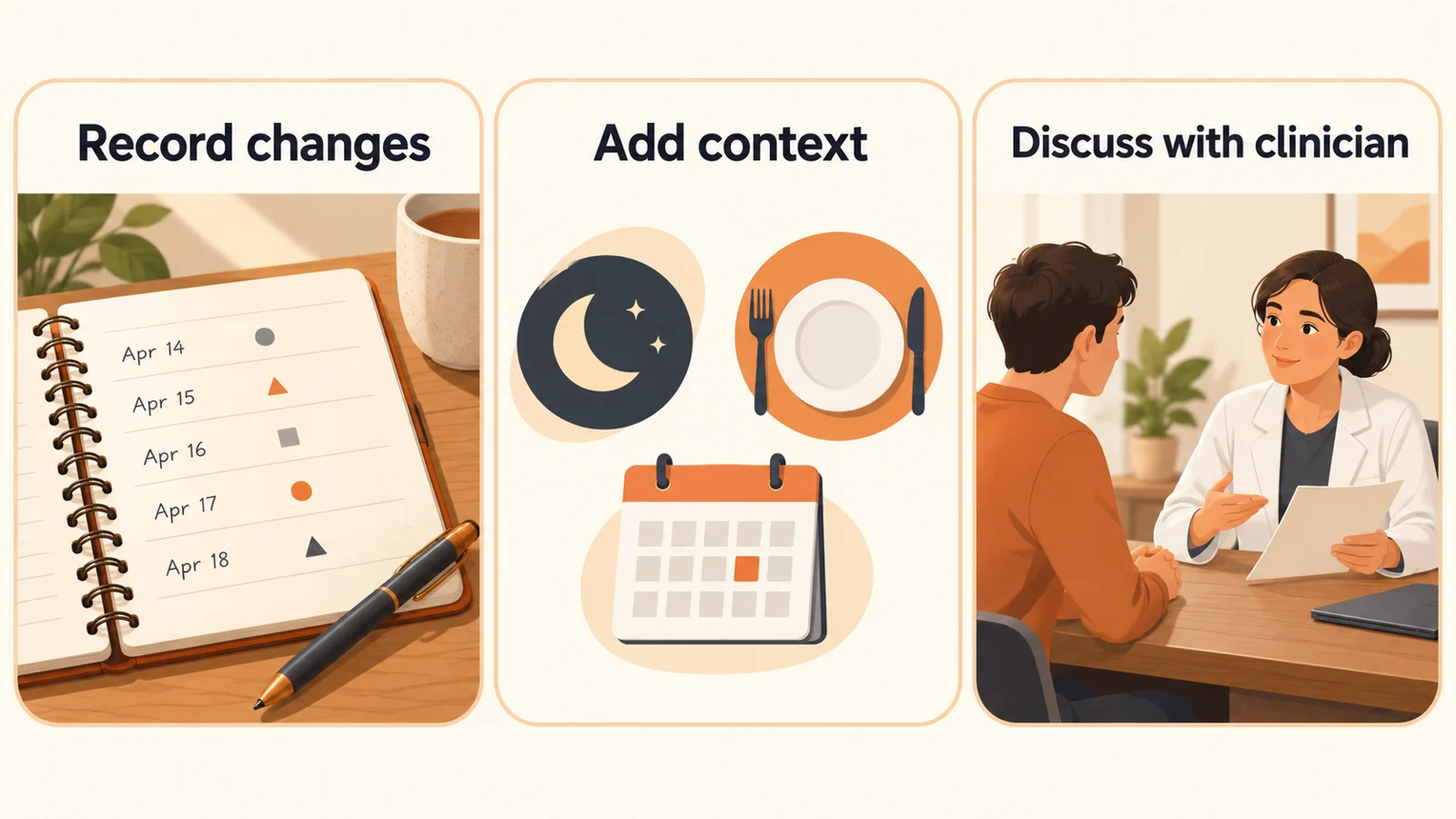
The animation adds changes and context to a record for discussion. It shows no diagnosis, recovery deadline or clearance. Open the silent animation.
| Entry | Useful detail | Avoid |
|---|---|---|
| Training change | Two additional sessions, a new exercise, more sets, shorter breaks or a recent event. | Only writing “I trained too hard”. |
| Performance observation | The familiar task, existing result and relevant conditions. | Testing to exhaustion to prove the decline. |
| Sleep and life context | Interrupted nights, travel, shift work or an unusually demanding period. | Assuming one disrupted night explains everything. |
| Meals and appetite | Missed meals, changed portions, appetite changes and dieting. | Adding a supplement as an assumed treatment. |
| Symptoms | When they started, where they occur and their effect outside training. | Assigning a diagnostic score. |
| Questions | What activity is appropriate now, what needs assessment and when to follow up. | Using a better diary day as automatic clearance. |
A fictional example of a clear entry
“October 6: Over the last two weeks I added Tuesday intervals to Monday and Thursday lifting. I also changed to early work shifts. My existing log shows fewer repetitions in two familiar sessions; I did not repeat them as a test. I have been waking during the night and stairs at work feel more tiring. I have an appointment on October 8 to discuss the change and what activity is appropriate meanwhile.”
This fictional entry identifies sequence and daily impact. It does not establish whether training, sleep, illness or another cause explains the change. No conclusion follows from the number of symptoms. A note such as “waking less often today” can be added later without changing that boundary.
Prepare your observation record
Choose how you will use the notes and enter only what you know. This helper produces a record, not a diagnosis or an exercise recommendation. Entries stay in this page’s memory; the helper does not save or send them. Printing creates a copy of your current entries. The downloadable PDF is a separate blank sheet.
Do not delay urgent or professional care to fill in a form.
Without the helper, write the date, training changes, existing performance observations, sleep and life context, meals, symptoms, health context and questions. Keep uncertainty in your notes. The PDF below has the same eight fields.
A record cannot diagnose OTS or clear you to exercise. Do not delay care to complete it.
A record you can take to an appointment
The one-page PDF has eight editable fields for training, symptoms, context and questions. Type into a compatible PDF viewer, save your own copy and reopen it to check the entries. You can also print it and write by hand. Keep medical details somewhere you trust.
Download the observation record PDF
Completing the sheet is optional and should never delay care.
What to change while you arrange advice
When exercise is bringing on concerning symptoms or performance has fallen unexpectedly, avoid adding demanding sessions or max-effort tests. Ask a clinician what activity is appropriate now, including whether complete rest is needed. Walking, cycling or an “active recovery” workout still counts as activity; none is automatically suitable for someone with unexplained symptoms.
A seven-day calendar and a universal reduction such as half your normal training volume cannot determine recovery from suspected OTS. The appropriate change depends on the cause, the symptoms and professional assessment. Someone who needs complete rest would not be protected by doing a smaller version of the same demanding workout.
Keep regular food and fluid intake within your existing medical advice and avoid aggressive dieting while unexplained fatigue is being assessed. If intake is difficult or restricted, bring that up with the clinician or a registered dietitian. Our creatine and protein after 50 guide explains food and supplement decisions in their own context; neither supplement is a treatment for suspected OTS.
The rest and recovery guide can help you review routine scheduling. Use the active recovery examples only when that activity fits your situation and the guidance you receive.
Listen to a sports-medicine conversation
Cleveland Clinic London: training load and clinical context
Sport and exercise medicine consultants Dr. Phil Batty and Dr. Charlotte Cowie discuss individual training demands, the value of a clinical history and using existing observations to prompt medical review. Their conversation covers broader exercise and injury care. It does not teach a home OTS test or prescribe a recovery schedule for this article.
This is an audio episode. Start it when you want to listen; playback pauses when you leave this section. Open the official episode and full transcript.
Returning to a routine requires an individual plan
After evaluation, ask what “return” means for you: which activities, how much work, what effort, which restrictions and what would prompt another review. A plan can specify a follow-up or a symptom-related stop instruction without promising a completion date. Feeling better for one morning does not answer all those questions.
Share the advice with the person helping with your training. Write down the permitted changes instead of adding an automatic extra set every week. You may need to address a food-intake problem, illness or other condition alongside the program. The recovery and performance consensus includes nontraining demands in the stress and recovery picture.
For ordinary programming once you can exercise, the workout plan for men over 50 provides worked session options. Choosing one should follow the individual advice you received. The observation sheet remains a record of actual experience; it never produces a green light.
Optional paper recording
The free PDF or a notebook you already own is enough. A structured journal may suit readers who prefer keeping exercise entries in one place. We have not tested this product, and it cannot diagnose or treat OTS.
* As an Amazon Associate, PrimeForMen earns from qualifying purchases.

Ultimate Workout Journal
For a reader who wants a separate paper training record. Skip it if the free sheet or your existing notes are easier to maintain.
- Keep dated exercise entries alongside notes on changed circumstances.
- Record completed work, including sessions you stopped or skipped.
- Bring relevant notes to a professional conversation without treating them as a diagnostic score.
Conclusion
Record the change in your familiar activity, its effect on ordinary life and recent circumstances. Seek professional advice for persistent or concerning symptoms and ask which activity is appropriate while the cause is assessed. Keep the record brief enough that you can bring it with you; completing every field is unnecessary.
Questions about overtraining syndrome
Can I tell whether I have OTS from a symptom checklist?
No. Symptoms overlap with other conditions and ordinary training fatigue. OTS requires clinical evaluation, consideration of other causes and the course of recovery. This page’s record helper only organizes notes.
How long does overtraining syndrome take to resolve?
Recovery varies. Clinical sources describe cases taking weeks to months or longer. That is not a timetable for an individual reader. Seek advice based on your symptoms without waiting for a duration threshold.
Should I reduce my workout by half for a week?
A fixed percentage and deadline cannot determine what is appropriate for unexplained symptoms. Some people need complete rest or investigation for another condition. Ask a clinician about activity while you arrange evaluation.
Can lifting weights contribute to inadequate recovery?
Resistance training can exceed a person’s current capacity, as can endurance work or a combination. That possibility does not establish OTS. Include all training and relevant life demands in your record.
Can HRV, testosterone or a recovery supplement confirm or fix OTS?
A consumer reading or single hormone result cannot confirm OTS. A supplement is not an established treatment for it. A clinician can investigate other explanations and decide whether testing or a nutrition referral is appropriate.
Medical disclaimer: This article is educational and does not replace medical advice, diagnosis or treatment. PrimeForMen does not diagnose OTS or clear readers to exercise. Seek professional help for persistent, worsening or unusual symptoms and emergency help for acute chest pain, fainting or severe breathing difficulty.
Affiliate disclosure: The optional Amazon link can earn PrimeForMen a commission. Purchasing the journal is unnecessary to use the observation record or obtain care.
Read our editorial policy for how we handle evidence and commercial links.