Use two practical core workouts after 50 with bracing, anti-rotation, carries, progressions and back-aware exercise options.
- Train bracing, anti-rotation, lateral stability, and carries.
- Use two short sessions instead of one exhausting ab day.
- Progress leverage and control before adding load or fatigue.
Bottom line A useful core transfers force and controls motion; it does not need endless crunches to become stronger.
Core workouts for men over 50 should train the trunk to brace, resist unwanted movement, carry load, and move with control. Two focused sessions per week are enough for most men when the exercises progress from stable positions to harder leverage, longer holds, or modest external load.
Quick Summary: Core Workouts for Men Over 50
- Train anti-extension, anti-rotation, lateral stability, and loaded carries.
- Start with positions you can control while breathing normally.
- Use two to three sets and stop when posture changes.
- Progress one variable at a time: leverage, range, time, reps, or load.
- Sharp pain, radiating symptoms, new weakness, or numbness are not training signals to push through.
The Prime Perspective
A stronger core is not a six-pack contest. It is the ability to transfer force between your hips and shoulders without losing position. That matters when you lift, carry, rotate, walk on uneven ground, or catch yourself after a bad step.
Place this work inside the complete fitness for men over 50 system so core volume supports strength, conditioning, mobility, and recovery.
What Your Core Actually Needs to Do
Your core includes more than the visible rectus abdominis. The obliques, deeper abdominal wall, spinal extensors, multifidus, diaphragm, pelvic floor, glutes, and hip muscles cooperate to manage pressure and motion. A good program trains that system in several directions rather than repeating one flexion exercise.
The general PrimeForMen core workout guide explains the full training category. This page applies it specifically to men over 50 by emphasizing recoverable volume, stable exercise choices, balance transfer, and clear regressions.
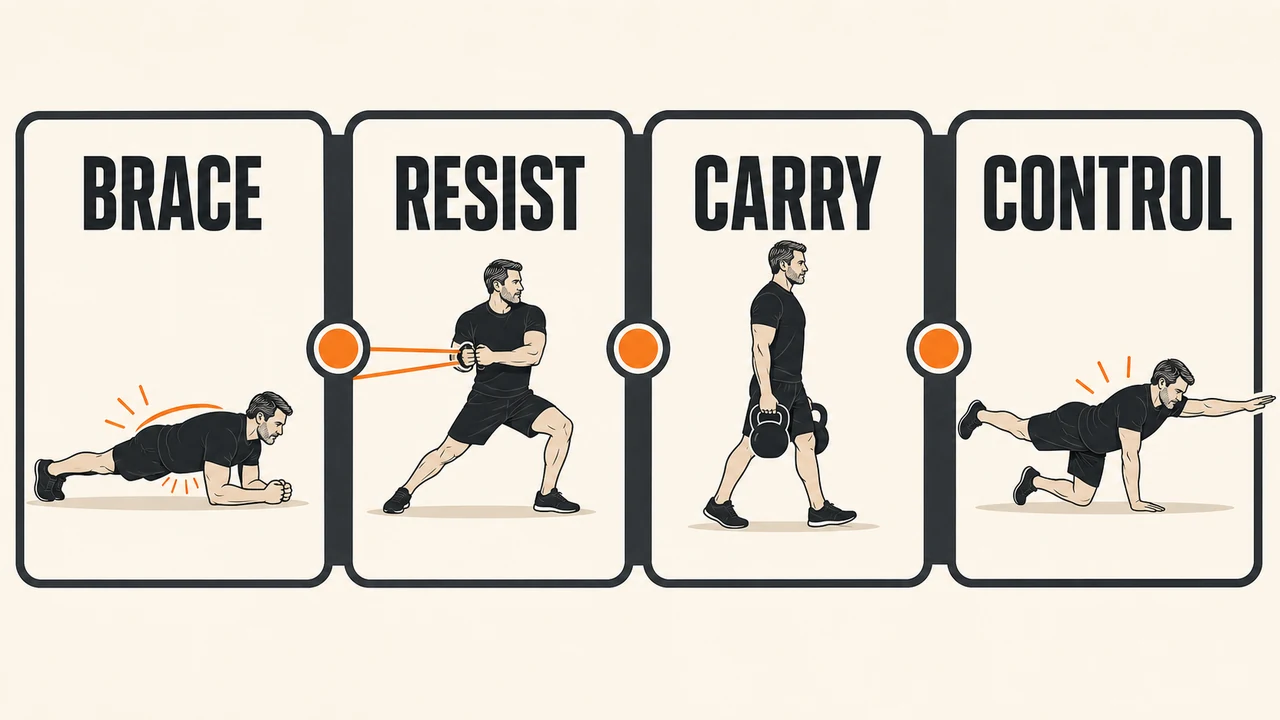
The Four Core Functions Worth Training
| Function | Good starting exercise | Progression | What to avoid |
|---|---|---|---|
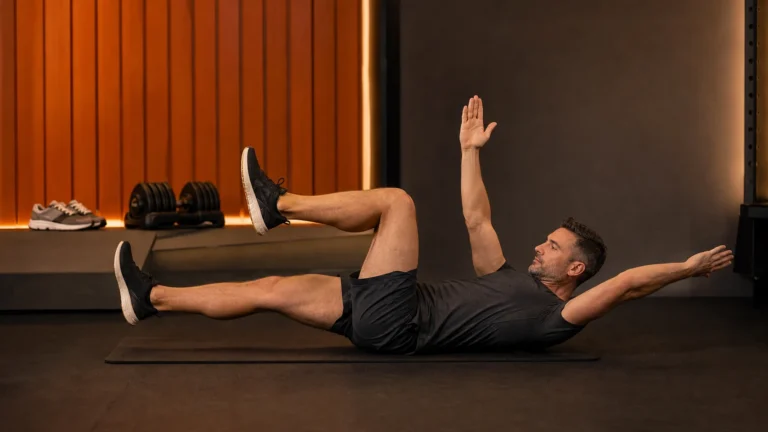
| Anti-extension | Dead bug | Longer lever or stability-ball dead bug | Low back lifting away from the floor |
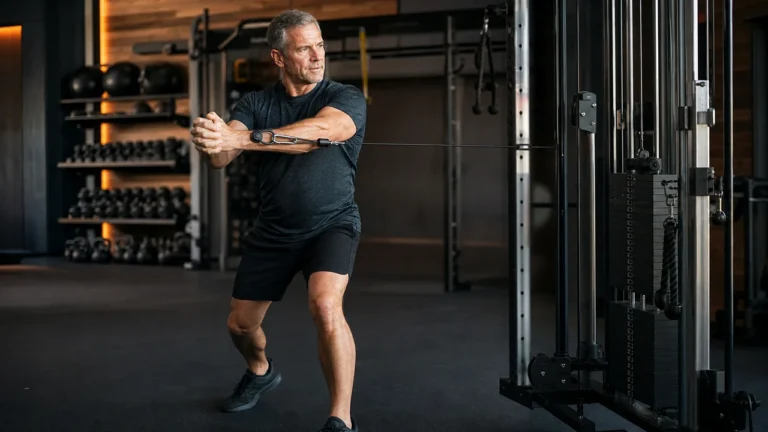
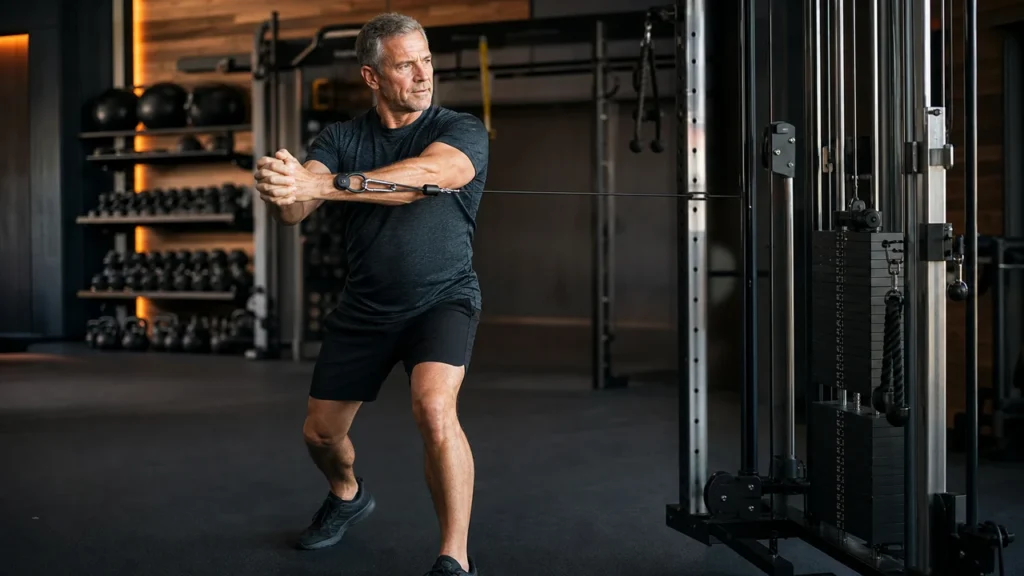
| Anti-rotation | Half-kneeling Pallof press | Standing press or controlled steps | Torso turning toward the cable |
| Lateral stability | Short-lever side plank | Full side plank or suitcase carry | Shoulder shrugging and hips sagging |
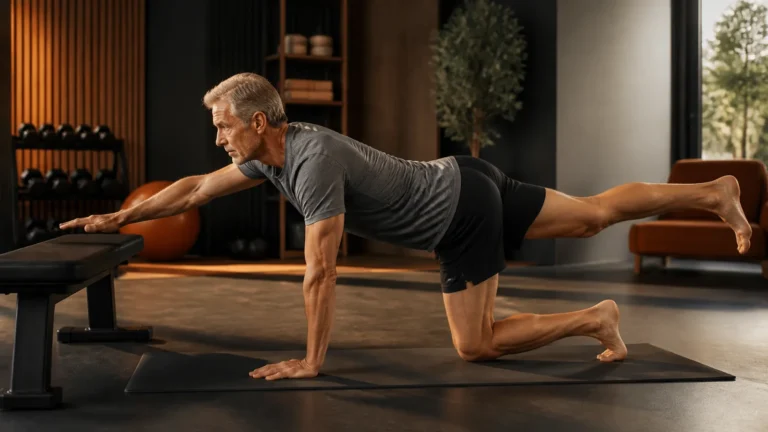
| Controlled movement | Bird dog | Slow crawl or cable chop | Speed that hides lost position |
Technique Cues That Make the Exercises Work
Dead Bug
Set the ribs over the pelvis, exhale before the limb moves, and stop the range before the low back lifts. A smaller clean motion is the correct starting point.
Bird Dog
Reach long rather than high. Keep both front hip bones facing the floor and pause without shifting weight toward the support hand.
Pallof Press
Use a stance you can own. Press straight out without letting the cable rotate the shoulders or pull the hips sideways.
Side Plank
Stack the shoulder, ribs, and pelvis. Shorten the lever by bending the knees before accepting a sagging full-leg version.
Suitcase Carry
Walk normally with the bell beside you. Do not lean away from it or rush the steps to finish the distance.
Cable Chop
Move through a controlled diagonal while the hips and trunk contribute together. Avoid yanking the handle with the arms.
Choose the Right Starting Level
Beginner or Restarting
Use dead bugs, bird dogs, short-lever side planks, and supported carries. Work for clean sets of 6-8 reps or 15-20 seconds.
Regular Lifter
Use Pallof presses, full side planks, suitcase carries, rollouts from a limited range, and controlled chops.
Back-Sensitive Today
Choose stable, symptom-free positions and reduce range. Do not assume one exercise is universally “back safe.” Tolerance is individual.
If you need a broader restart, first use the three-day workout plan for men over 50. Core training should support the main program, not replace lower- and upper-body strength work.
Two Core Workouts for Men Over 50
| Session | Exercise | Dose | Primary job |
|---|---|---|---|
| Workout A | Dead bug | 2-3 x 6-8 each side | Anti-extension |
| Half-kneeling Pallof press | 2-3 x 8-10 each side | Anti-rotation | |
| Short-lever side plank | 2 x 15-30 sec each | Lateral stability | |
| Farmer carry | 3 x 30-45 sec | Bracing under load | |
| Workout B | Bird dog with pause | 2-3 x 6 each side | Cross-body control |
| Supported cable chop | 2-3 x 8 each side | Controlled rotation | |
| Suitcase carry | 3 x 20-30 sec each | Anti-lateral flexion | |
| Incline plank shoulder tap | 2 x 6-10 each | Anti-rotation |
Place Workout A after the first strength day and Workout B after the third. If the main session already includes heavy carries, do only the first three movements. The core stability exercise guide provides additional substitutions.
What Most Ab Workouts Miss
Fatigue is not the same as control. Once you hold your breath, arch hard, twist to finish a rep, or lose shoulder and hip position, the set has stopped training the intended pattern. End it there. A clean 20-second side plank is more useful than a 60-second survival hold.
How to Brace Without Holding Your Breath
- Exhale gently until your ribs settle over your pelvis.
- Inhale through the nose into the sides and back of your lower rib cage.
- Create firm abdominal pressure as if preparing for a controlled bump.
- Keep breathing behind that pressure while the limbs move.
This is a skill, not one permanent maximal squeeze. Use enough tension for the task. The randomized trial indexed by PubMed on trunk training in older adults supports including trunk strengthening and motor-control work inside a broader program rather than treating it as cosmetic exercise.
The Four-Step Progression Rule
- Own the starting position and breathe normally.
- Reach the top of the rep or hold range without compensation.
- Increase leverage or range slightly.
- Add modest load only after the harder position stays controlled.
Progress every one to two weeks, not every set. For a complete load-management framework, use strength training for men over 50. If stiffness limits your setup, build a short pre-session routine with the mobility and warm-up builder.
A Four-Week Core Progression
| Week | Change | Success check |
|---|---|---|
| 1 | Two sets at the lowest listed dose | Normal breathing and consistent position |
| 2 | Add one or two reps or five seconds | No extra movement from the spine or pelvis |
| 3 | Add a third set to two exercises | Main strength sessions remain unaffected |
| 4 | Repeat or use one slightly harder leverage | Harder variation looks as clean as week one |
Do not progress every exercise at once. If the core work begins to reduce squat, hinge, or carry performance, remove a set before adding difficulty.
Your First Week
- Monday: Workout A after strength training.
- Thursday or Friday: Workout B after strength training.
- Keep two clean reps or several clean seconds in reserve.
- Record which exercise, side, and variation you used.
- Repeat the same choices next week before progressing.
Conclusion
Core workouts for men over 50 should make lifting, carrying, balance, and movement more reliable. Train several trunk functions twice per week, stop before posture collapses, and progress control before load. That approach builds capacity without turning every session into an ab endurance test.
Build the Complete 50+ System
Core work is one piece of the week. Use the Fitness for Men Over 50 pillar to connect strength, cardio, mobility, nutrition, and recovery.
Frequently Asked Questions About Core Workouts for Men Over 50
How often should men over 50 train their core?
Two focused sessions per week work well for most men. Main lifts, carries, and sports may add indirect core work, so more is not automatically better.
Are crunches bad after 50?
Not automatically. Controlled spinal flexion can be appropriate for some men, but it should not be the entire program. Choose movements that match your tolerance and goals.
What is the safest core exercise for a sensitive back?
There is no universal safest exercise. Dead bugs, bird dogs, and supported Pallof presses are adjustable starting options, but symptoms and history matter.
Can core training reduce belly fat?
Core training strengthens the muscles underneath, but it cannot selectively remove abdominal fat. Energy balance and total activity determine fat loss.
Should I train my core before or after weights?
Usually after the main lifts so fatigue does not reduce bracing during squats, hinges, presses, or rows. A low-fatigue activation drill can be used in the warm-up.
Medical Disclaimer: This article provides general education, not diagnosis or individualized medical care. Stop training and seek qualified guidance for sharp or worsening pain, pain radiating into a limb, new weakness or numbness, loss of balance, or symptoms that do not settle.