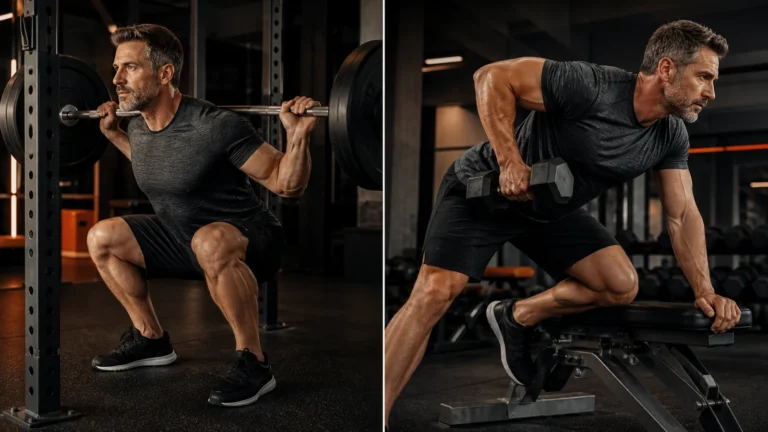

Use practical HIIT workouts after 50 with readiness checks, low-impact options, work-to-rest ratios and recovery rules.
- Build an aerobic base before adding maximal-feeling intervals.
- Choose a mode that stays stable when fatigue rises.
- Start with one HIIT session and protect lower-body recovery.
Bottom line The right HIIT dose improves conditioning without making the next strength session worse.

HIIT workouts for men over 50 can improve conditioning, but the useful dose is smaller than many circuits suggest. Start with one weekly session, choose a stable low-impact mode, work near RPE 7-9 rather than chasing an estimated maximum heart rate, and use recovery intervals long enough to repeat quality efforts.
Quick Summary: HIIT Workouts for Men Over 50
- Earn HIIT with several weeks of repeatable moderate cardio.
- Bike, incline walking, and controlled rowing are strong starting modes.
- Use one to two minutes of recovery for every hard minute at first.
- Keep HIIT away from demanding lower-body lifting when possible.
- Chest pressure, fainting, unusual breathlessness, or new rhythm symptoms require medical evaluation.
The Prime Perspective
HIIT is a dose, not an identity. If every interval becomes an all-out test, the session stops being repeatable conditioning and becomes a recovery problem. The goal is consistent hard work with enough control to complete the planned set.
Fit intervals into the complete fitness for men over 50 system so conditioning does not crowd out strength, mobility, or recovery.
Who Should Start With Easier Cardio First?
Build an aerobic base before HIIT if you have been inactive, cannot complete 20-30 minutes of moderate activity, or need several days to recover from ordinary training. The best cardio for men over 50 comparison can help you select a lower-cost starting mode.
Men with known cardiovascular disease, uncontrolled blood pressure, recent surgery, significant balance limitations, or concerning exercise symptoms should obtain individualized guidance before vigorous training. Medication can also alter heart-rate response, which is why talk test and RPE remain useful alongside—not beneath—a monitor.
HIIT, Intervals, and Hard Circuits Are Not the Same
Intervals simply alternate harder and easier work. HIIT uses repeated vigorous efforts intended to challenge cardiorespiratory capacity. A circuit can feel brutal because local muscles fatigue, even when the heart and lungs are not receiving a consistent interval stimulus.
For men restarting after 50, controlled intervals are often the better first label and first dose. You do not earn extra benefit by calling a session HIIT. You earn benefit by choosing a mode and intensity you can repeat long enough to adapt.
| Format | Main limiter | Useful starting point |
|---|---|---|
| Brisk intervals | Breathing and pace | 30 sec brisk / 90 sec easy |
| Traditional HIIT | Cardiorespiratory effort | 45-60 sec hard / 75-120 sec easy |
| Bodyweight circuit | Often local muscle and technique | Use only movements already mastered |
| All-out sprint intervals | Power, technique, and high fatigue | Not the default starting option |
Readiness Scorecard Before the First Session
Green Light
You complete moderate cardio comfortably, strength sessions recover normally, and the chosen mode is technically familiar.
Yellow Light
You are returning after a break, sleep has been inconsistent, or ordinary training creates prolonged soreness. Use brisk intervals instead.
Red Light
You have concerning symptoms, an unstable health condition, recent surgery, or no tolerance for continuous moderate work. Obtain guidance first.
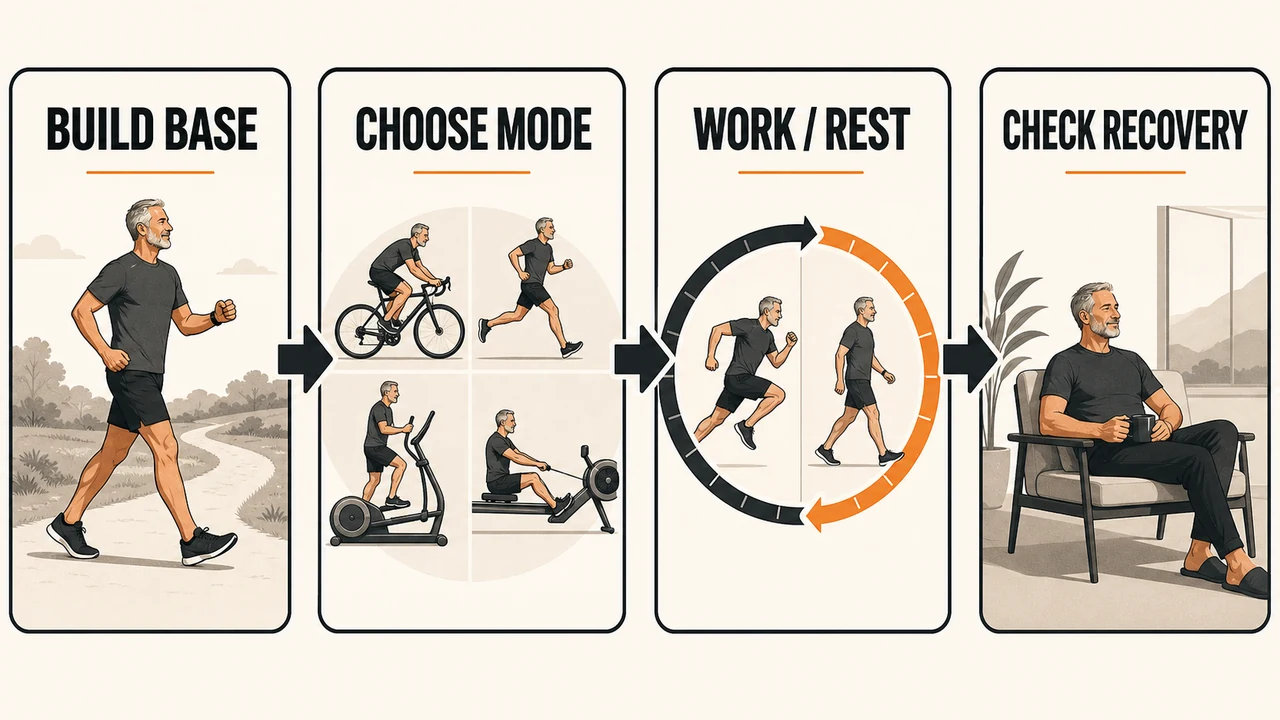
Choose the Lowest-Risk Effective Mode
| Mode | Impact | Skill under fatigue | Best fit |
|---|---|---|---|
| Stationary bike | Low | Low | Most beginners and lifters |
| Incline walk | Low-moderate | Low | Men comfortable on a treadmill |
| Rowing machine | Low impact | Moderate-high | Men with established rowing technique |
| Elliptical | Low | Low-moderate | Whole-body rhythmic work |
| Running sprints | High | High | Experienced runners with specific goals |
| Bodyweight circuits | Variable | High | Conditioned trainees who can preserve form |
The general HIIT at home guide provides additional exercise ideas. This page owns the age-specific readiness and dose decision.
Three HIIT Workouts for Men Over 50
| Level | Warm-up | Main set | Target |
|---|---|---|---|
| Returner | 8 min easy-to-brisk | 6 x 30 sec hard / 90 sec easy | RPE 7-8, brisk walk or bike |
| Intermediate | 10 min with 3 short pickups | 8 x 45 sec hard / 75 sec easy | RPE 8, bike or elliptical |
| Experienced | 10-12 min progressive | 6 x 60 sec hard / 120 sec easy | RPE 8-9, bike or rower |
Finish with five easy minutes. If the final two efforts lose cadence, posture, or power sharply, the set was too aggressive. Do not add intervals and intensity in the same week.
What Most HIIT Articles Miss
Short work intervals are not automatically low cost. A 20-second all-out sprint can create more fatigue and technique breakdown than a controlled one-minute effort. Program intensity by what you can repeat, not by how dramatic the interval looks.
How Hard Should the Work Intervals Feel?
Use RPE 7-9: breathing is forceful, talking is limited to a few words, and you still control the machine or movement. The goal is not a specific age-predicted maximum. If you use a monitor, the heart-rate zone calculator for men over 50 provides an estimate, not a diagnosis or universal prescription.
A 2024 systematic review and meta-analysis of HIIT in older adults reported improvements in cardiorespiratory fitness and several health-related measures, while another meta-analysis on functional movement found HIIT may help compared with no intervention but was not clearly superior to moderate continuous training. That supports HIIT as an option, not a requirement.
Place HIIT Around Strength Training
| Day | Training | Reason |
|---|---|---|
| Monday | Full-body strength | Primary adaptation |
| Tuesday | Easy cardio or walking | Low recovery cost |
| Wednesday | Full-body strength | Keep quality high |
| Thursday | HIIT | Separated from hardest lower-body day |
| Friday | Rest or mobility | Absorb interval fatigue |
| Saturday | Full-body strength | Adjust if Thursday still lingers |
| Sunday | Easy aerobic work | Build the base |
If you use the three-day workout plan for men over 50, begin with only one HIIT day. Add a second only after several weeks of stable sleep, performance, soreness, and joint feedback.
Stop Rules and Warning Signs
Stop the session for chest pressure, fainting, severe dizziness, a new irregular heartbeat sensation, unusual shortness of breath that does not settle, loss of coordination, or sharp escalating pain. Seek urgent care for severe or persistent symptoms. Ordinary hard breathing should recover progressively during the easy interval.
Build the warm-up around the selected mode with the mobility and warm-up builder. Avoid turning mobility drills themselves into a fatigue circuit.
Your First Four Weeks
- Week 1: one session of 6 x 30/90.
- Week 2: repeat the same session and improve consistency.
- Week 3: add one interval only if recovery is normal.
- Week 4: repeat or reduce volume; do not test yourself.
Conclusion
HIIT workouts for men over 50 should improve conditioning without damaging the rest of the week. Build a base, choose a stable mode, start with one short session, and keep the hard efforts repeatable. Moderate cardio remains valuable even when HIIT works well.
Put HIIT Inside the Complete 50+ System
Use the Fitness for Men Over 50 pillar to balance intervals with strength, mobility, nutrition, and recovery.
Frequently Asked Questions About HIIT Workouts for Men Over 50
How often should men over 50 do HIIT?
Start with one session per week. Some well-conditioned men can recover from two, but more is not automatically better.
Is HIIT safe after 50?
It can be appropriate for many healthy, conditioned men when the mode and dose match their capacity. Health conditions and concerning symptoms require individualized guidance.
What is the best HIIT exercise for bad knees?
A stationary bike is often easier to control than running or jumping, but no mode is universally pain-free. Adjust range and resistance and seek guidance for persistent symptoms.
Do I need to reach 90 percent of maximum heart rate?
No. Age formulas are estimates. RPE, talk test, cadence, and repeatability can guide the session, especially when medication changes heart-rate response.
Can HIIT replace steady cardio?
It should not replace every easy session. Moderate continuous work builds aerobic volume with a lower recovery cost and complements intervals.
Medical Disclaimer: This article is general education and is not a substitute for medical advice, diagnosis, exercise testing, or treatment. Obtain individualized guidance when cardiovascular, metabolic, neurological, balance, or recent surgical considerations may change vigorous-exercise safety.