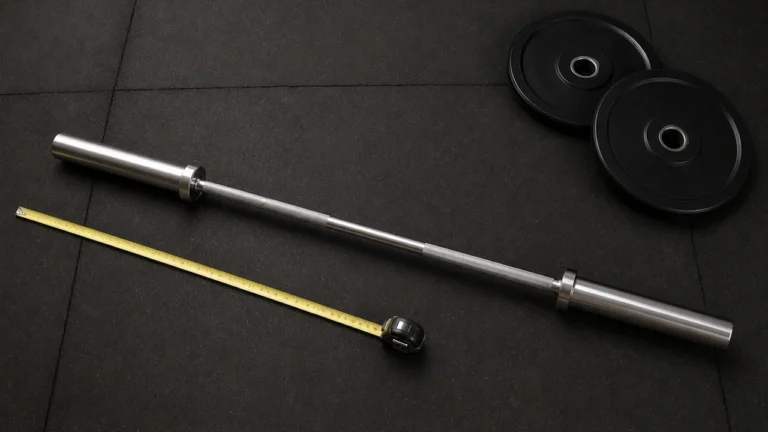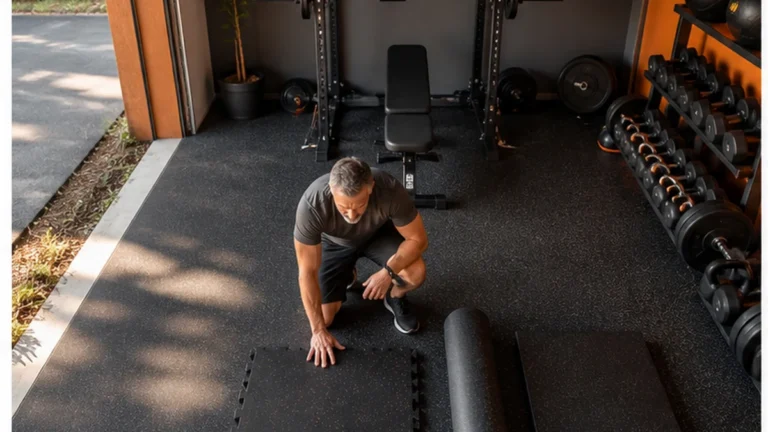
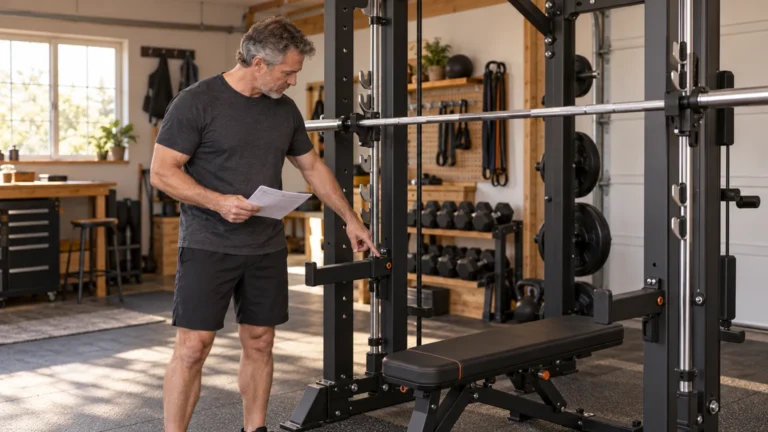
Compare Smith machine formats, model-specific bar weights, physical stops and bench fit. Use the setup helper and free buying worksheet.
- Confirm the exact unloaded starting resistance.
- Check physical stops and bench position for each lift.
- A guided bar does not make every exercise safe.
Bottom line Take your planned lifts to a demonstration and resolve bar resistance, protective stops and full operating space before ordering.
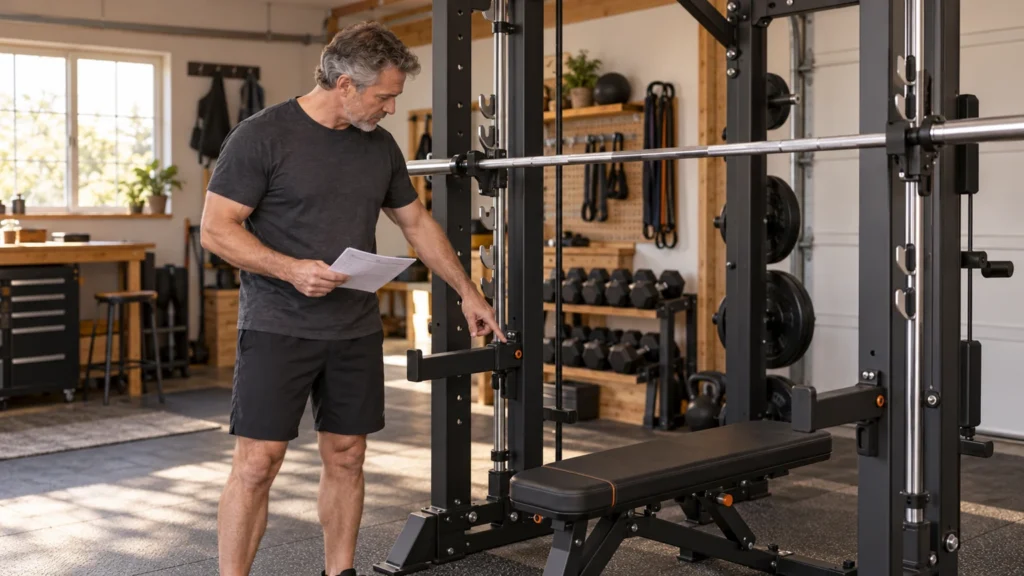
A Smith machine home gym is worth considering when you want guided bar work and can set up each lift comfortably inside its fixed path. Choose the machine around the exercises you will use, its unloaded resistance, the physical stops and your bench position. A bar that travels on rails can still pin you, force an awkward movement or exceed what you can control.
For guided lifts alone, start with a simple Smith frame. Add a free-bar rack if you also want an unconstrained barbell path. Pay for an integrated cable system when cable exercises are part of your weekly routine. Confirm the exact model and package before transferring specifications from a review or another seller.
Quick Summary: Smith Machine Home Gym
- Check the unloaded bar or carriage specification. A counterbalanced bar can have a different starting resistance from its physical weight.
- Racking hooks and lower physical stops do different jobs. Learn both mechanisms using the current manual.
- Rehearse bench placement, movement and reracking without added plates. “Unloaded” can still mean substantial resistance.
- Measure operating space, plate-loading access and ceiling clearance, then compare complete delivered quotes.
The Prime Perspective
A man returning to lifting after a long break may value a repeatable setup more than a long attachment list. That only works if the machine’s starting load is manageable and its stops suit the intended movement. A well-equipped combo can still be a poor fit if you cannot position the bench, reach the hooks or use the guided path comfortably.
We compare manufacturer specifications and current listing identities. We have not personally load-tested these machines or assessed your room or body. Our editorial policy explains that distinction. Use the demonstration to check movement fit and the written quote to confirm the equipment included.
Choose the format before the attachment bundle
| Format | Consider it for | Check before buying | Reason to skip |
|---|---|---|---|
| Smith-focused frame | Guided presses, squats and other supported movements; existing separate equipment | Unloaded resistance, lower stops, racking reach, bench fit and included plate sleeves | You need free-bar lifts or adjustable cable work in the same frame |
| Smith plus free-weight rack | Guided work and conventional barbell lifts | Separate Smith stops and free-bar safeties, compatible bar length and rack working area | You would use only the Smith function |
| Smith/rack/cable combination | A permanent room with a program using all three stations | Every station’s loading, cable ratios, bench access, attachments and parts support | You want portability, easy moves or little assembly |
| Free-bar power rack | Lifts where you want to control the bar path | Correctly set safeties, bar and plate compatibility, ceiling and loading access | Your chosen movements specifically require a guided Smith station |
A Smith bar is attached to its guided carriage. Free-bar lifting on a hybrid uses a separate bar and the rack’s own catches. Buying both functions does not make their safety hardware interchangeable. Use the power-rack buying guide when conventional squats and presses are your priority. For broader integrated-system choices, see the all-in-one home gym comparison.
Model specifications that change the decision
Model names, finishes and bundled attachments change. The following are manufacturer-stated figures checked October 5, 2026. Dimensions are frame dimensions in width × depth × height, not required exercise clearance. A stated bar weight, carriage weight and effective starting resistance are different kinds of information; ask which one the seller is quoting.
| Model / format | Published unloaded figure | Frame W × D × H | Decision-changing check |
|---|---|---|---|
| BFSM250B Smith-focused |
Numeric starting resistance not established in checked current sources | 66 × 50 × 79 | 20 racking points; lat add-on increases depth/height; confirm Amazon family revision |
| PSM200 Smith / half rack |
25 lb carriage mass | 66 × 47 × 79 | 7-degree reverse pitch, separate J-cups and 13-inch free-bar safeties |
| GS348B Series 7 Smith / free-weight rack |
25 lb stated starting weight | 70 × 56 × 83 | 7-degree path; base and full package differ; linked manual uses older Q name |
| Force USA G3 Smith / rack / plate cables |
35 lb stated Smith bar | 78 × 60.5 × 87 | 2:1 cable ratio does not apply to Smith plates; confirm exact generation |
| Force USA G15 Counterbalanced Smith / rack / stack cables |
Counterbalance confirmed; numeric residual starting load unresolved | 79.5 × 53 × 87.5 | Smith still uses plates; cable stacks are separate; request current starting-load figure |
| Marcy SM-4033 Smith / cable cage / bench |
Approximately 36 lb stated bar mass | 67.8 × 83.5 × 86.2 cage | Bench working area extra; no stack; Olympic plates not included |
Best Fitness BFSM250 family: guided lifting without a full combo
The current BFSM250B manufacturer page lists 20 racking points, adjustable safeties and two-inch plate sleeves. Its frame is 66 inches wide, 50 deep and 79 high. The September 2025 data sheet shows a larger 59-inch depth and 82-inch height with the optional lat attachment, so an add-on can change the fit decision.
Investigate it when you want a focused Smith station and already have a suitable bench and plates. Skip it when a free-bar rack or adjustable cable towers are essential. The checked current page and data sheet do not establish a numeric unloaded starting load. “Slides without resistance” in promotional copy is not a calibrated zero-pound specification.
Amazon describes the BFSM250 family without always carrying the current B suffix. Obtain the exact unit’s manual and starting-load information before using the current B model’s dimensions or ordering parts. Check the BFSM250B manufacturer page and its September 2025 data sheet.
Powerline PSM200: Smith and free-bar half rack
Body-Solid specifies a seven-degree reverse pitch, a 25 lb bar carriage, 12 Smith racking points, separate J-cups and 13-inch free-bar safety arms. The base frame is 66 inches wide, 47 deep and 79 high. It accepts two-inch Olympic plates; a bench, free bar and optional lat station need their own inclusion and compatibility checks.
This format suits someone who wants guided and free-bar work without buying a complete cable crossover. Skip it if the working height or stop positions fail your demonstration. The published 25 lb carriage figure is useful for identifying the unloaded assembly, but it is not our measurement of force through the full stroke.
A PSM200 frame and a PSM200 package with lat attachment and bench occupy different spaces and include different equipment. Compare the seller’s exact package with the base model. Check PSM200 specifications and the manufacturer manual.
Body-Solid Series 7 GS348B: an angled Smith/rack platform
The current GS348B page specifies a seven-degree path, a 25 lb starting weight, 20 Smith lockout positions and a separate free-weight gunrack with 17-inch safety arms. Published base dimensions are 70 inches wide, 56 deep and 83 high. The Smith and free-weight rack have separate stated load limits; a high rack rating does not increase the Smith bar’s limit.
Investigate it for a permanent Smith/rack setup with optional compatible stations. Skip a full package when you would leave its bench or lat attachment unused. The base frame and the GS348BP4 complete package are different purchases.
The current page links a manual named GS348Q, and older sources use GS348Q or different dimensions. Ask for the drawing and revision corresponding to the delivered B model; do not combine a legacy package drawing with current base-frame measurements. Check the current Series 7 page.
Force USA G3: plate-loaded Smith, rack and cables
The current G3 page states a 35 lb Smith bar and a frame 78 inches wide, 60.5 deep and 87 high. Its cable station uses a 2:1 ratio. That ratio describes the cable path; it does not halve plates loaded onto the Smith bar.
Investigate it if you want all three stations and accept moving plates between them. Skip it when pin-selected cable changes or a lighter confirmed unloaded Smith load are essential. Loose weights, a bench and a separate free bar need to be included in the complete quote where the base package omits them.
The 35 lb figure is the current maker’s bar statement, not a claim that every G3 generation has identical resistance. Ask about the exact generation, counterbalance status and intended safety components. Check the current G3 configuration and linked G3 V2 manual.
Force USA G15: counterbalanced Smith with selectorized cables
The current G15 page describes a counterbalanced Smith station, two 289 lb cable stacks and selectable 2:1 or 4:1 cable ratios. Its exterior is 79.5 inches wide, 53 deep and 87.5 high. The linked November 2024 manual identifies Smith counterbalance components.
Investigate this format when pin-selected cables and a counterbalanced guided station both matter. A counterbalance supports some of the bar assembly’s weight. It does not establish a zero-pound starting resistance, remove friction or cancel plates added to the Smith sleeves.
The checked current sources do not settle a numeric residual starting load for the exact configuration. Request it before deciding whether the bar is light enough for your planned lifts. The machine still needs Smith plates; selectorized cables do not make the guided bar selectorized. Check the current G15 page and linked G15 manual.
Marcy SM-4033: Smith/cable cage with a bench
The SM-4033 listing combines a Smith cage, cable stations and an adjustable bench. Marcy’s usage article states an approximately 36 lb Smith bar for this model. The cage is 67.8 inches wide, 83.5 deep and 86.2 high; the separately positioned bench changes the working area.
Investigate it when you want that particular bench-and-station bundle and accept plate-loaded resistance. Skip it when pin-selected cable stacks or minimal assembly are priorities. The maker explicitly states that this unit has no weight stack and does not include Olympic plates. Use that explicit specification when checking package contents, even if an image caption suggests a stack.
Marcy lists distinct limits for the Smith bar, catches, trolley and bench. Its bench capacity includes the user and weights, rather than being a spare machine-wide allowance. Confirm the exact package, current manual and delivery-to-room plan. Check SM-4033 configuration and manuals; the maker’s model-specific bar-weight article explains why Marcy bars are not all the same weight.
Starting load: what to record before adding plates
The unloaded guided assembly can include a bar, sleeves and carriage components. A counterweight or cable mechanism may support part of that assembly. Ask the seller for the effective unloaded starting resistance, the units, whether counterbalance is fitted and the exact model revision. If only physical bar mass is published, record it under that label.
Do not assume a Smith bar weighs the same as your free bar. Do not subtract a counterweight you cannot identify or apply a cable pulley ratio to the Smith station. When the maker supplies a usable starting-resistance figure, a simple nominal training log is:
Nominal log entry = stated starting resistance + plates on both sides
If the confirmed starting figure is 25 lb and you add 10 lb per side, the nominal entry is 45 lb. With a 35 lb starting figure and the same plates, it is 55 lb. These are arithmetic examples, not measured force or a recommended training load.
Record the machine, stance or bench setting and range of motion alongside the load. A 55 lb entry on one guided machine is not automatically equivalent to 55 lb on a free bar or another Smith machine. Rail angle, carriage behavior and setup differ. Progress your own repeatable movement rather than chasing a number imported from another machine.
Record your Smith setup and nominal load
Build a purchase checklist and an arithmetic load entry. Your answers stay in this browser. The result does not assess your body, floor, movement or safe lifting capacity.
Without the interactive helper, choose the format using the comparison above and record the exact starting-resistance statement in the worksheet. If that figure is unknown, log plates separately instead of inventing a total.
Choose all purchase answers to build your record.
Your purchase and setup record
Recorded checks are your own statements, not independent approval. A nominal load entry is not a recommended load, capacity check or free-bar equivalent.
Bar path: vertical and angled rails need a rehearsal
A fixed path means you position your body relative to the rails. On an angled model, that relationship also changes through the stroke. A seven-degree specification describes geometry; it is not proof that the path is natural or suitable for everyone.
Before purchasing, rehearse the lifts you plan with no added plates, provided the unloaded bar is manageable. Confirm which direction the manufacturer intends the machine to face and how the hook mechanism engages. Do not reverse the setup because an unrelated video uses another brand’s rail angle.
For a press, the bar’s travel and your shoulder position must work together while the hooks remain reachable. For a squat or split squat, check that you can move without being pushed into an uncomfortable stance and that the stops can protect the intended bottom position. A coach familiar with the exact equipment can help judge movement fit. If the rehearsal causes pain or you cannot control or rerack the unloaded bar, choose a different setup.
Racking hooks and physical stops do different jobs
Racking hooks hold the Smith bar after the specified rotation or engagement motion. Lower stops limit downward carriage travel if the hooks are not engaged. A free-bar safety arm on a hybrid may protect only the free-bar station. Identify each part in the manual instead of treating every orange handle or metal catch as the same safeguard.
- Confirm the assembly, fasteners and condition first. A loose or damaged machine is not ready for a rehearsal.
- Set the physical stops for the particular exercise and user using the maker’s instructions. Confirm matching left/right settings and full engagement where the design uses paired stops.
- Check the intended movement with no added plates, without putting yourself beneath an unverified catch. Stops must allow the chosen range while limiting dangerous downward travel.
- Practice the specified rerack movement while the unloaded resistance is manageable. Confirm that the hooks fully engage before releasing control.
- If the available stop positions, hooks or clearance cannot protect the intended movement, skip that exercise on the machine. Do not remove or bypass safeties to gain range.
“Below the bottom of the rep” alone is an incomplete stop-setting rule. With a bench, consider where the bar would meet the torso or neck if position changes. A generic photo cannot select a safe stop height for your body. Do not test a failure with a loaded bar or assume rails replace suitable supervision and instruction.
Check the setup before adding plates
The diagram separates the racking hook from the lower physical stop and shows a bench moving into position. Rehearse the approved movement without added plates only when the unloaded bar is manageable. This conceptual side view does not set a safe bench position, stop height or range of motion.
Silent, 8.5 seconds. Open the animation directly. Playback pauses offscreen; reduced-motion preferences keep playback manual.
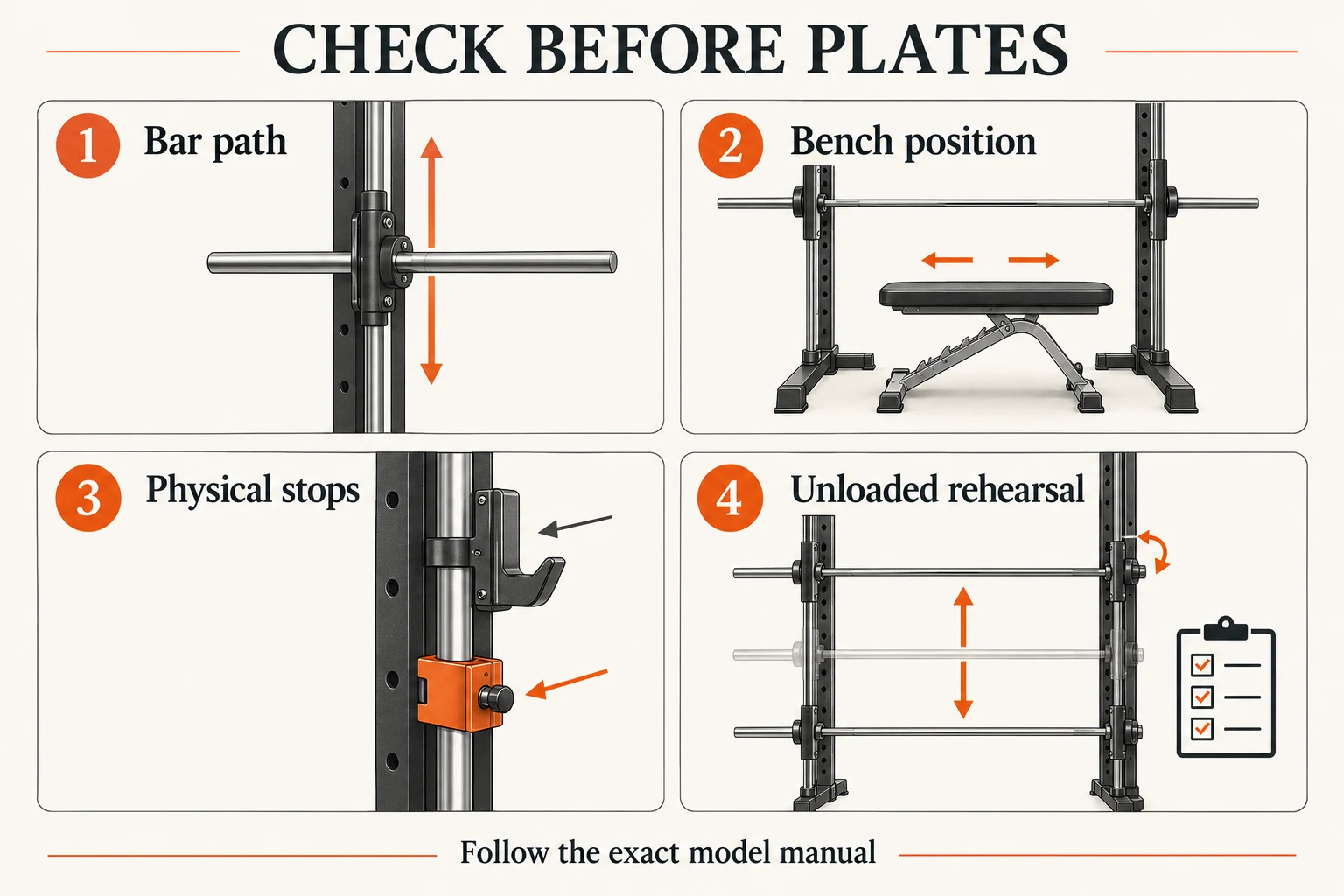
Bench position: check the whole movement
A bench must fit between the uprights without its feet, frame or adjustment handles striking the machine. It also needs a stable, permitted surface and a usable path to move it into and out of position. An included bench is not evidence that every backrest angle works with every station.
- Choose the intended bench angle and lock its adjustments according to its manual. Confirm the bench’s combined user-plus-load limit and the machine’s separate limits.
- Position the bench so you can take control of the bar, complete the planned movement and reach the reracking points without twisting or sliding to find them.
- Check the lower physical stops again. Changing bench angle or position changes the relationship between the bar, stops and your body.
- Rehearse with no added plates if the starting resistance is manageable. Adjust or abandon the setup if travel, clearance or reracking is uncomfortable.
- Record repeatable bench and stop settings for that lift. Recheck them each session and whenever another person uses the machine.
There is no universal distance from the bench to the front upright. A narrow frame, steep backrest or high bench can leave too little usable bar travel even when the bench fits on the floor. The adjustable weight-bench guide helps with bench choices; the Smith demonstration still decides compatibility.
Map your exercises before ordering
| Planned movement | Demonstrate before purchase | Reason to change the plan |
|---|---|---|
| Flat or incline pressing | Bench access, shoulder/bar relationship, hook reach and protective stops at the chosen angle | The bench cannot align or stops cannot protect the setup |
| Squat or split squat | Manageable unloaded bar, comfortable stance, lower travel and rerack reach | The rail path forces discomfort or the necessary stop setting is unavailable |
| Row or hinge variation | Approved use, bottom travel, clearance and controlled body position | You must bypass stops or force an uncomfortable range |
| Standing press | Overhead room, actual bar travel and head/hand clearance | Ceiling clearance or carriage travel limits the movement |
| Free-bar training | Separate bar, J-cups, correctly set rack safeties and loading access | A Smith-only station cannot provide the required free path |
Use these questions for the buying demonstration. They do not prescribe a workout or establish that every manufacturer approves each listed exercise. Leave specialized inverted presses, foot-driven bar movements and heavy failure demonstrations out of a general buying test. Begin your training program with the strength training over 50 guide if you are rebuilding consistency, and obtain individual instruction when setup is unfamiliar.
Room, delivery and the complete quote
Mark the full frame on the floor, then add the bench’s working positions, both plate sleeves and room to carry plates without squeezing past another station. Check doors, garage tracks, lights and the highest pull-up or cable position. Measure the actual room with its door open, not only the empty wall-to-wall rectangle.
The frame must stand on a surface permitted by the current manual. Confirm floor suitability, leveling and any anchoring requirements before ordering. Mats do not establish structural capacity or permission to avoid bolting. The home gym layout guide and flooring guide cover those planning tasks.
Ask whether freight delivery ends at the curb, threshold or training room. Request the largest packaged dimension, lifting/assembly arrangements and a route through stairs or tight turns. Record who handles packaging if a return is needed and which freight or restocking charges apply.
Compare the complete quote: exact frame, bench, Smith plates, separate free bar, compatible collars, rack safeties, handles, optional stations, delivery, tax and installation. A displayed bench or stack may be optional. Use the home gym cost guide for budget planning rather than comparing base prices against complete bundles.
Take the buying and setup worksheet to a demonstration
The two-page worksheet records exact model details, starting-load sources, counterbalance questions, room and quote information. Use the second page for one demonstrated lift and user; keep separate records for different setups.
Download the fillable Smith worksheet (PDF)
Sixteen editable fields; also suitable for paper notes. Print the helper’s current answers for a separate personalized purchase record.
Inspection and parts support belong in the buying decision
Ask for the current maintenance instructions and part numbers for the guide rods, bushings or bearings, hooks, stops and any counterbalance or cable system. Confirm whether the seller can supply those parts for the exact generation. A large frame warranty does not establish coverage for every wear component or the freight involved in repair.
Before each use, inspect the unit as the maker directs. Stop using it if movement binds, hardware is loose, stops are damaged, hooks do not engage or cables show damage. Do not force a stuck carriage or add a lubricant copied from an online comment. Use the specified cleaning, lubrication and adjustment procedure; contact the maker when the cause is unclear.
Record a few repeatable setup details after an approved demonstration: lift, bench angle/position, stop setting, hook position and how the starting resistance is labeled. Keeping these notes helps when you switch between Smith, free-bar and cable stations. For cable-specific loading questions, see the home cable-machine guide.
Compare three verified Amazon machine options
These three options cover a focused Smith frame, a Smith/half-rack hybrid and a Smith/cable/bench bundle. Check the exact seller and current package. The Series 7 and Force USA models have manufacturer links above; choose them only after the same fit and setup checks.
As an Amazon Associate, PrimeForMen earns from qualifying purchases. Prices, seller terms and package contents can change.
Recommended Products

Best Fitness BFSM250 Smith Frame
Best for: Focused guided lifting with a separately chosen bench and plates. Skip it when a free-bar rack or cable crossover is essential.
Current Amazon listing: Body-Solid Best Fitness BFSM250 Smith Machine Without LAT Attachment for Home Gym - Strength Training with Safety Bars, Adjustable Safeties, and Attachments for Squats, Bench Presses, Rows
- The current catalog names BFSM250; confirm the exact revision before applying BFSM250B dimensions or parts.
- Request the unloaded starting resistance; do not treat marketing about smooth sliding as a zero-load figure.
- Demonstrate bench fit, adjustable stops and rerack reach for your intended lifts.

Powerline PSM200 Smith and Half Rack
Best for: Guided work and separate free-bar lifts in one basic frame. Skip it if you need included adjustable cable towers or a complete bench bundle.
Current Amazon listing: Body-Solid (PSM200) Smith Machine for Home Gym - Strength Training Equipment with Safety Catches, Squat Rack Cage, Half Rack, and Weight Plate Storage
- Confirm PSM200 on the quote and check whether it covers the base frame or an accessory package.
- Manufacturer specifies a 25 lb carriage, seven-degree path and separate free-bar catches; confirm the delivered configuration.
- Quote a compatible bench, free bar and Olympic plates separately if the current package omits them.

Marcy SM-4033 Smith Cage and Bench System
Best for: A planned Smith, cable and bench setup in a permanent training room. Skip it when pin-selected cable stacks or minimal assembly are priorities.
Current Amazon listing: Marcy Smith Machine Cage System Home Gym Multifunction Rack, Customizable Training Station SM-4033, Red
- Verify SM-4033 bundle contents, matching manual and bench configuration before ordering.
- Marcy states that this unit has no weight stack and Olympic plates are not included.
- Measure the cage plus every bench position, loading access and delivery route; a cage footprint alone is insufficient.
* As an Amazon Associate, PrimeForMen earns from qualifying purchases.
See a Smith frame’s mechanisms in the manufacturer demonstration
Body-Solid’s short BFSM250 demonstration shows the guided bar and locking arrangement on that model. Compare those components with the manual and the actual unit you are considering. This is a manufacturer product demonstration, not an independent safety test or a full exercise tutorial.
Watch Body-Solid’s BFSM250 demonstration on YouTube. Source: Body-Solid; linked from its current BFSM250B page. The video uses BFSM250 naming, so verify the delivered revision. Availability checked October 5, 2026.
Before you order
Choose a Smith frame only after confirming that its starting resistance, rail path, bench positions and physical stops suit your intended lifts. Add a free rack or cable system when you need those functions and have checked their separate loading and safety arrangements.
Take a short exercise list and the worksheet to a showroom, request the exact current manual and resolve unanswered specifications before ordering. A guided bar does not make every exercise safe. If the equipment cannot support a comfortable, controlled rehearsal with appropriate protective stops, choose another format.
Frequently asked questions
How much does a Smith machine bar weigh?
It depends on the exact model and counterbalance. The current GS348B page states a 25 lb starting weight; PSM200 specifies a 25 lb carriage; Force USA G3 lists a 35 lb Smith bar; Marcy states approximately 36 lb for SM-4033. These labels are not interchangeable measurements. Ask for effective unloaded resistance and the current model revision.
Does a counterbalanced Smith machine start at zero pounds?
Do not assume it does. Counterbalance supports some of the assembly’s weight, but a remaining starting resistance and friction can still exist. The current G15 sources checked here confirm counterbalance without settling a numeric residual load for the exact configuration.
Is a Smith machine automatically safer than a power rack?
No. Guided travel and reachable hooks can help with setup, but the stops, equipment condition, load and movement fit still matter. A free rack uses its own correctly positioned safeties. Neither format guarantees protection from a poor setup or uncontrolled lift.
Where should the bench and safety stops go?
Use the current machine and bench manuals, your intended movement and individual fit. Confirm stable bench placement, manageable bar travel, rerack reach and stops that protect the setup without bypassing them. Recheck after changing bench angle or user. A universal distance or an unrelated product photo cannot establish those settings.
Can I compare my Smith weight with a free-bar bench or squat?
Record progress on the same machine and repeatable setup. A nominal starting figure plus plates is useful for a log, but it does not measure force through the stroke or establish equivalent difficulty on a free bar or another Smith model.
Manufacturer sources and specification limits
Specifications and listing identities were checked October 5, 2026. Current manufacturer pages and linked manuals are cited beside each model. Older product names and manual filenames are flagged where they affect compatibility or dimensions. Ask the seller to confirm the delivered unit’s drawing, starting resistance, station limits and package contents in writing.