Use a progressive two-day kettlebell workout after 50 with start weights, skill gates, exercise substitutions and conditioning rules.
- Build the hinge with deadlifts before earning the swing.
- Use two weekly sessions and progress one variable at a time.
- Choose the bell by the exercise you can control—not age alone.
Bottom line Master deadlifts, squats, rows, presses, and carries first; ballistic work is a progression, not the entry ticket.
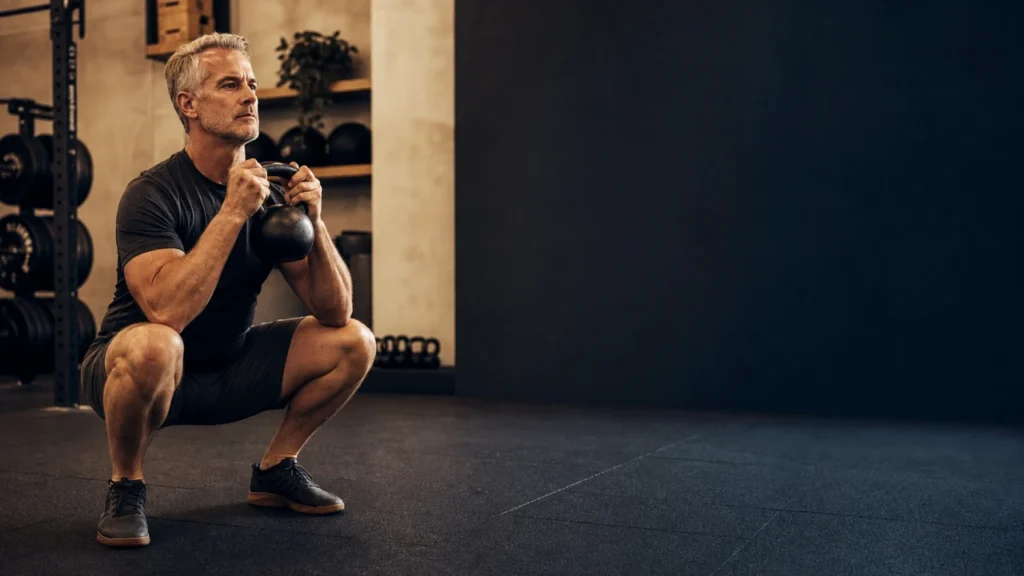
A kettlebell workout for men over 50 should begin with controllable strength movements—deadlifts, goblet squats, rows, presses, and carries—before adding swings or complexes. Train twice per week, keep two to three clean reps available, and progress only one variable at a time.
Quick Summary: Kettlebell Workout for Men Over 50
- Choose a start weight by movement quality, not a universal age chart.
- Learn the deadlift and hinge before performing high-rep swings.
- Use two non-consecutive full-body sessions.
- Progress reps, sets, density, load, or complexity—never all at once.
- Stop ballistic work when timing, grip, back position, or breathing becomes uncontrolled.
The Prime Perspective
The kettlebell is not magic and the swing is not mandatory. Its value is that one compact implement can train strength, grip, carries, and conditioning. You earn the faster skills by first owning the slower ones.
Use kettlebells inside the broader fitness for men over 50 system so the tool serves the week instead of dictating it.
Choose the Bell by the Exercise
There is no single correct starting weight for every man over 50. A bell you can deadlift comfortably may be too heavy to press. Many beginners test an 8-12 kg bell for presses and a 12-16 kg bell for deadlifts or goblet squats, but those are trial ranges—not prescriptions.
The existing PrimeForMen kettlebell buyer guide covers handle shape, fixed versus adjustable bells, and starting-weight decisions in detail. This page assumes you have access to a suitable bell and need a program.
Three Practical Kettlebell Setup Choices
The first purchase should solve load selection or floor protection. It should not push you toward movements you have not learned.

REP Fitness Cast Iron Kettlebell
Best when one dependable fixed bell will cover deadlifts, squats, rows, and carries.
- Fixed load keeps progression simple to track.
- Wide handle supports two-hand hinge work.
- Multiple sizes let you match the main movement.

REP Fitness Adjustable Kettlebell
Best when several loads are needed but storage space is limited.
- Multiple settings support presses and heavier lower-body work.
- Compact option for small home gyms.
- Useful when gradual loading matters more than a fixed-bell collection.

ProsourceFit Home Gym Floor Tiles
Best when starts, storage, and floor protection are the real home-training constraint.
- Creates a defined lifting and storage zone.
- Helps protect finished floors during controlled starts.
- Modular tiles fit compact spaces.
* As an Amazon Associate, PrimeForMen earns from qualifying purchases. Availability, sizing, and product details can change.
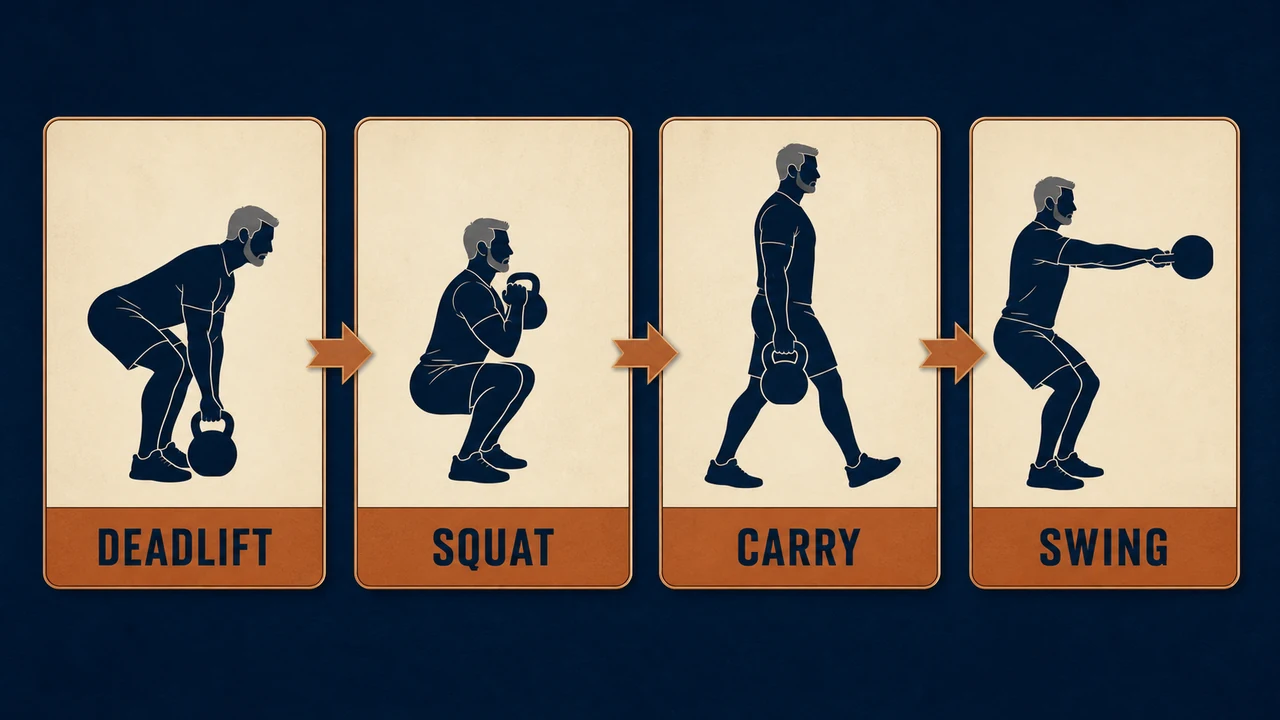
The Movement Skill Ladder
| Level | Movements | Advance when |
|---|---|---|
| Foundation | Elevated deadlift, goblet squat, supported row, farmer carry | Setup and posture stay consistent across every rep |
| Strength | Floor deadlift, press, reverse lunge, suitcase carry | You control the bell without leaning, twisting, or rushing |
| Power | Two-hand swing, clean to rack | The hinge is automatic and the bell floats without arm lifting |
| Complexity | Single-arm swing, clean and press, complexes | Grip, breathing, and timing remain stable under fatigue |
A Practical Start-Weight Test
- Perform five deadlifts from an elevated position. The bell should leave the floor without jerking or changing your back position.
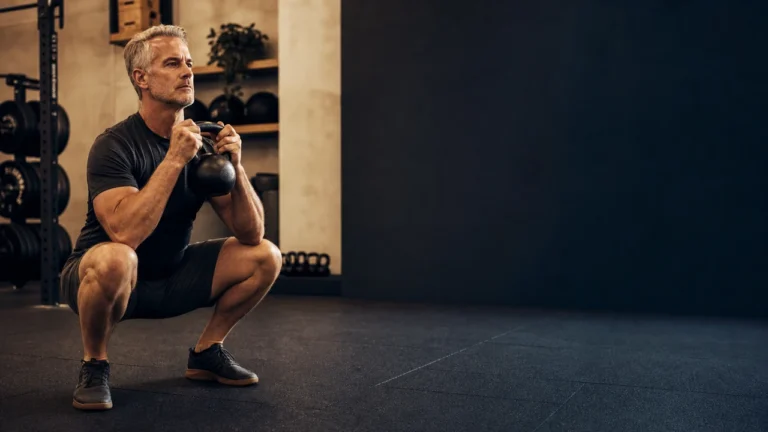
- Hold the bell in the goblet position for 20 seconds. You should breathe and keep the ribs stacked over the pelvis.
- Perform five goblet squats to a comfortable depth. The final rep should look like the first.
- Try a half-kneeling press only with a lighter bell. Stop if you lean or twist to finish.
If one bell is correct for deadlifts but too heavy for presses, that is normal. Use two bell sizes, an adjustable model, or a dumbbell for the lighter movement. Do not force every exercise to fit one load.
Common Technique Problems and Their Fixes
| Problem | Likely cause | First adjustment |
|---|---|---|
| Squatting the swing | Hinge pattern is not established | Return to wall-touch hinges and deadlifts |
| Bell pulls the shoulder forward | Load or rack position is not controlled | Use a lighter bell and slower clean practice |
| Low back fatigues before hips | Bell too far away or brace lost | Move the bell closer and shorten the set |
| Forearms get bruised | Bell flips over the hand during cleans | Practice a close path with a lighter load |
| Grip fails early | Too much density or excessive squeezing | Use longer rest and relaxed hook grip where appropriate |
The Two-Day Kettlebell Workout
| Session | Exercise | Sets x reps | Focus |
|---|---|---|---|
| Day A | Goblet squat | 3 x 6-10 | Full-foot pressure |
| One-arm supported row | 3 x 8-12 each | Square torso | |
| Kettlebell deadlift | 3 x 6-10 | Hinge and brace | |
| Half-kneeling press | 2 x 6-10 each | Ribs stacked | |
| Suitcase carry | 3 x 20-30 sec each | No leaning | |
| Day B | Supported reverse lunge | 3 x 6-8 each | Stable foot |
| Floor press | 3 x 8-12 each | Controlled shoulder | |
| Staggered-stance deadlift | 3 x 6-10 each | Hip control | |
| Two-hand swing or fast deadlift | 6 x 10 / 45-60 sec rest | Crisp speed | |
| Farmer carry | 3 x 30-45 sec | Grip and posture |
If you have not earned the swing, use six sets of five fast but controlled deadlifts. Speed should never outrun position.
What Most Kettlebell Plans Miss
Conditioning density can hide a skill problem. Short rest makes every movement feel harder, but harder is not always better practice. Learn the exercise with full recovery first; reduce rest only after technique is stable.
How to Earn the Swing
- Deadlift from the floor without rounding or squatting the hinge.
- Practice a wall-touch hinge until the hips move back automatically.
- Use hike-pass repetitions with the bell returning safely to the floor.
- Perform sets of 5-10 two-hand swings with full recovery.
- Stop when the bell is lifted by the arms, the back position changes, or the landing becomes noisy.
The kettlebell complexes guide is a later progression, not the starting plan. A pragmatic trial indexed on PubMed found supervised progressive hardstyle kettlebell training feasible in insufficiently active older adults, but supervision and progressive exposure matter when interpreting that result.
Progress One Variable at a Time
Reps
Add one clean rep per set within the listed range.
Sets
Add one set only when the current volume recovers well.
Density
Reduce rest modestly after technique remains stable.
Load
Move to a heavier bell and return to lower reps.
Complexity
Add ballistic or single-arm skills last.
Never All Five
Changing several variables removes your ability to judge the dose.
Use the strength training for men over 50 guide for RIR and deload decisions. The workout plan builder can place these sessions inside a complete week.
When to Reduce the Session
Use only the first three exercises for two sets when sleep, grip, joint feedback, or warm-up speed are clearly worse than normal. Skip swings and density work. Kettlebells combine skill and fatigue; a low-readiness day is the wrong time to test both.
Prepare the hips, shoulders, and hinge pattern with the mobility and warm-up builder for men over 50.
Your First Two Weeks
- Use two non-consecutive sessions.
- Perform two work sets for each movement in week one.
- Add a third set only when soreness and performance are stable.
- Keep swings optional and low volume.
- Record bell weight, reps, RIR, and any technique breakdown.
Conclusion
A kettlebell workout for men over 50 should build control before speed and strength before density. Use two full-body sessions, select the bell by the movement, and progress one variable at a time. That creates a durable training tool instead of a random conditioning challenge.
Build the Rest of the Week
Use the Fitness for Men Over 50 pillar to combine kettlebell strength with cardio, mobility, nutrition, and recovery.
Frequently Asked Questions About Kettlebell Workouts for Men Over 50
What kettlebell weight should a man over 50 start with?
Choose by exercise and current ability. Many men test 8-12 kg for pressing and 12-16 kg for deadlifts or squats, but technique determines the correct start.
Are kettlebell swings safe after 50?
They can be appropriate when the hinge, setup, timing, and load are controlled. They are not mandatory, and men with symptoms or limited skill should use slower strength movements first.
Can kettlebells build muscle after 50?
Yes, when exercises provide enough tension, volume, progression, nutrition, and recovery. Kettlebells are tools; the program drives the adaptation.
How many days per week should I use kettlebells?
Two full-body sessions are a strong starting point. More can work when volume is distributed and recovery remains stable.
Do I need one kettlebell or a pair?
One bell can train the full body and adds useful unilateral work. A pair becomes helpful for heavier squats, carries, and time-efficient bilateral work.
Affiliate Disclosure: PrimeForMen may earn a commission from qualifying Amazon purchases at no additional cost to you. Product availability and fit should be rechecked before purchase.
Medical Disclaimer: This guide is general education and does not replace medical, rehabilitation, or individualized coaching advice. Seek qualified guidance for persistent pain, balance problems, recent surgery, cardiovascular symptoms, or neurological changes.