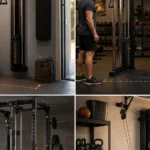
Compare short rackable barbells by collar span, sleeve space and rack fit. Use the measurement checks and plate-stack calculator before buying.
- Compare Philosophy Gym and Bells of Steel; Titan’s 49-inch shaft requires a narrower rack.
- Shorter sleeves can limit plate stacks before the bar reaches its stated load rating.
- A shorter bar saves side clearance, not overhead clearance.
Bottom line Write down your rack, sleeve and plate-stack measurements before choosing a bar model.
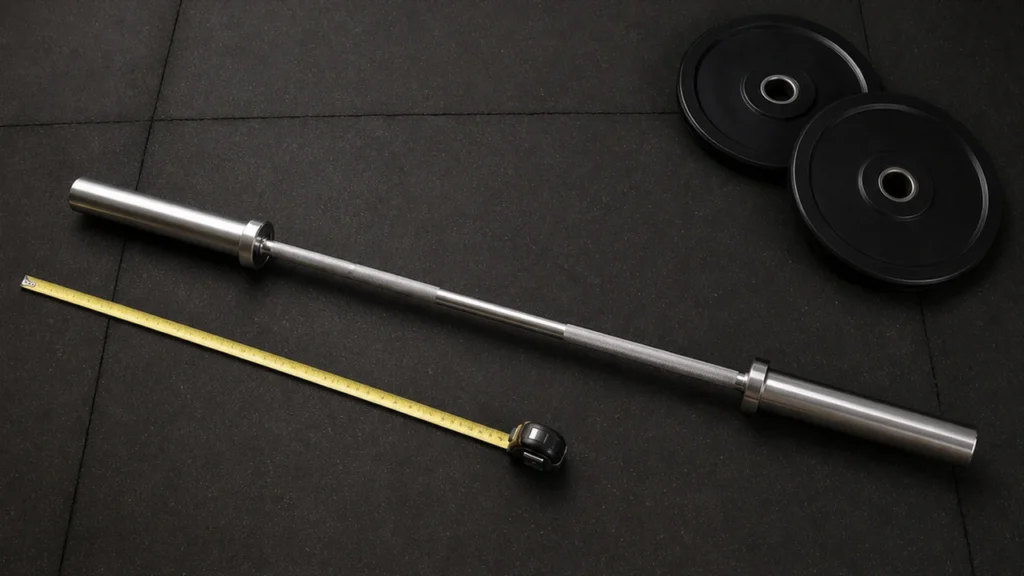
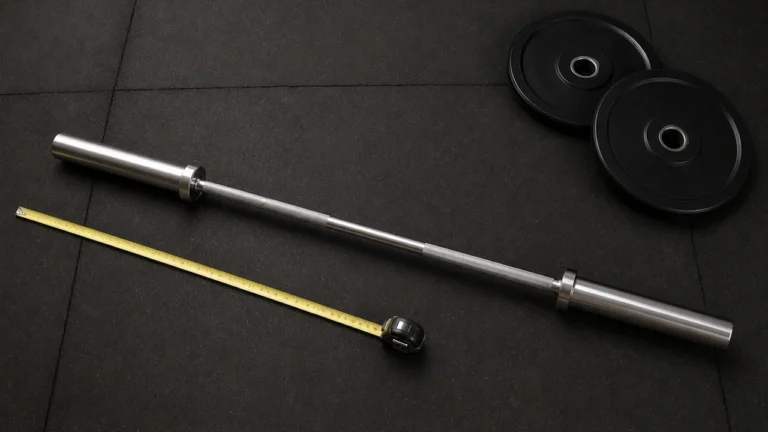
Quick Answer
A short rackable barbell must retain enough clear shaft to rest correctly across your rack while leaving usable sleeve space for plates and collars. Compare overall length, shoulder-to-shoulder span and loadable sleeve length separately. A six-foot label alone does not establish compatibility.
- Check the clear shaft span
- Measure your rack supports
- Count plate thickness
The best short rackable barbells preserve enough shaft length to sit correctly across your rack while reducing the space taken by the sleeves. That is why buying a “six-foot Olympic bar” by overall length alone can go wrong. Some short bars reduce the distance between the collars; others keep a rack-friendly middle and shorten the loading area instead.
Quick Summary: Best Short Rackable Barbells
- Amazon options: compare Philosophy Gym’s 72-inch bar and Bells of Steel’s 69-inch Short Rackable Bar. Titan’s 72-inch technique bar is conditional on a narrower rack because its central span is only 49 inches.
- Other comparison points: Rogue C-70S, REP Colorado Short and Get RX’d Shorty remain direct-manufacturer alternatives.
- Measure three things: overall length, clear distance between the sleeve shoulders and usable sleeve length.
- Check the rack externally: inside upright width alone does not establish whether the thin shaft reaches across the actual supports.
- Count your plates: shorter sleeves may run out of room before you reach the weight you want.
The Prime Perspective
A short bar can make a narrow garage easier to use. It cannot fix a rack that is too wide for its shaft, a ceiling that is too low for overhead lifting or an unsafe solo-bench setup. Decide which space constraint you are solving before treating “compact” as a universal advantage.
This is a specification-led buying guide, not a hands-on barbell test. We checked current manufacturer information on August 31, 2026. We have not measured whip, sleeve rotation, coating durability or grip comfort. The shortlist uses published dimensions and intended use rather than invented scores. Read our editorial policy for the research boundary.
Short Rackable Barbell Shortlist
Start with the three Amazon-listed models below, then compare the direct-manufacturer alternatives in the same dimension table. They are not interchangeable: a 72-inch total length can come with either a 52-inch or a 49-inch central span. Our inclusion of Titan is conditional on a narrower, compatible rack—not a recommendation for every standard-width power rack.
Three Short-Bar Options on Amazon
Exact Amazon.com listings checked August 31, 2026, using US delivery ZIP 10001. Offers and variants can change. Measure your rack before buying; Titan has the narrowest central span.

Philosophy Gym 72-inch / 15 kg Bar
For buyers seeking a six-foot bar while retaining a published 52-inch central shaft.
- Select the 72-inch, 15 kg variant, not the longer parent-listing options.
- 28 mm grip and approximately 33.1 lb starting weight.
- The listed 9-inch sleeves need a separate usable-length and collar-space check.
Skip if: your rack needs more shaft clearance or the confirmed plate-stack space is insufficient.

Bells of Steel 69-inch Short Rackable Bar
For tighter rooms where the shorter loading sleeves still accommodate your plates.
- Manufacturer drawing shows a 51.6-inch central span and 28.5 mm shaft.
- 7⅞-inch loadable sleeves make plate thickness an important limit.
- Listed 29 lb bar; check the manufacturer’s 49-inch outside J-cup-width guidance.
Skip if: your outside support width exceeds that guidance or thick plates leave too little collar space.

Titan 15KG Olympic Technique Barbell
For a narrower, manufacturer-approved rack setup—not a universal rackable substitute.
- 72-inch overall length with only 49 inches between sleeves.
- 9.75-inch loadable sleeves provide more plate space than the other Amazon options here.
- 28 mm shaft and 15 kg / 33 lb starting weight; follow technique-bar use restrictions.
Skip if: your actual outside support width is 49 inches or more, or the required clearance cannot be confirmed.
*As an Amazon Associate, we earn from qualifying purchases. Buying through these links may earn us a commission at no extra cost to you.
| Bar | Total length | Between sleeve shoulders | Sleeve space per side | Starting weight |
|---|---|---|---|---|
| Philosophy Gym — 72-inch variant | 72 in / 182.9 cm | 52 in / 132.1 cm listed shaft | 9 in / 22.9 cm listed sleeve; confirm usable length | 15 kg / 33.1 lb |
| Bells of Steel Short Rackable | 69 in / 175.3 cm | 51.6 in / 131.1 cm in drawing | 7⅞ in / 20 cm loadable; drawing rounds to 7.9 in | 29 lb / approx. 13 kg |
| Titan 15KG Technique — narrower-rack option | 72 in / 182.9 cm | 49 in / 124.5 cm | 9.75 in / 24.8 cm loadable | 15 kg / approx. 33 lb |
| Rogue C-70S | 72 in / 182.9 cm | 52 in / 132.1 cm | 8.875 in / 22.5 cm loadable | 15 kg specification includes collars |
| REP Colorado Short | 72 in / 182.9 cm | 51.5 in / 130.8 cm | 8.9 in / 22.6 cm loadable | 15 kg / 33.1 lb |
| Get RX’d Shorty | Named 74 in; spec table also says 1,870 mm | 51.57 in / 131 cm in spec table | 9.85 in / 25 cm loadable in spec table | 15 kg / 33.1 lb |
Philosophy Gym: the manufacturer’s multi-length listing includes 72-, 80- and 86-inch variants. The Amazon card identifies the 72-inch, 15 kg version. Its 52-inch shaft is the rack-fit comparison point; its advertised 9-inch sleeve dimension still needs confirmation as usable loading space before entering it in the calculator.
Bells of Steel: its Short Rackable Barbell page includes a drawing showing a 51.6-inch central span. Another gallery image describes a maximum 49-inch J-cup outer-edge width, while the prose uses “inside rack width.” Those are different measurements. Use the outside-support measurement and ask the manufacturer to resolve any close fit; do not assume that 49 inches between the uprights is sufficient evidence.
Titan: the 15KG Olympic Technique Barbell specifications give only 49 inches between sleeves. With supports measuring 49 inches across their outside edges, that leaves zero surplus: skip it. Even a 48-inch outside support width leaves only one inch in total, not an automatic safe-fit approval. Confirm the required lateral clearance, rack geometry and permitted use before choosing this option.
Get RX’d rounds some dimensions differently between its sales description and specification table. Its 74-inch name and 1,870 mm specification are not exact conversions. If your fit is close, obtain the current drawing or a confirmed physical measurement rather than resolving the discrepancy in the bar’s favor.
More Short-Bar Alternatives from Manufacturers
These three alternatives link directly to their manufacturers; compare them with the Amazon options above.
Rogue C-70S
The 72-inch design keeps a published 52-inch span between sleeves. It is the C-70S, not the differently proportioned C-70.
- 28.5 mm shaft and dual grip markings.
- 8.875-inch loading sleeves: check your actual plate stack.
- The listed 15 kg weight includes collars.
Skip if: you need full-length loading sleeves or a center knurl.
REP Colorado Short
The Colorado Short pairs a 51.5-inch span between sleeves with 8.9-inch loadable sleeves. Compare that span with your exact rack support width.
- 28.5 mm shaft and dual grip markings.
- Published 15 kg starting bar weight.
- Composite bushings and no center knurl.
Skip if: your rack requires more usable central span or the sleeve stack fails the fit check.
Get RX’d 74-inch Shorty
The specification table lists 9.85-inch loadable sleeves and a 51.57-inch handle. Rounded figures differ elsewhere on the page, so verify a close fit.
- 28 mm shaft with dual grip markings.
- Listed 15 kg weight and no center knurl.
- Longer overall format trades room width for extra sleeve length.
Skip if: your room cannot accommodate the added length or precise dimensions remain unresolved.
What Makes a Short Barbell Rackable?
A rackable bar has enough clear shaft between its sleeve shoulders to rest correctly on both intended supports, with appropriate lateral clearance. The wider sleeves and shoulders must not be the surfaces resting in the J-cups. Total bar length alone does not answer that compatibility question.
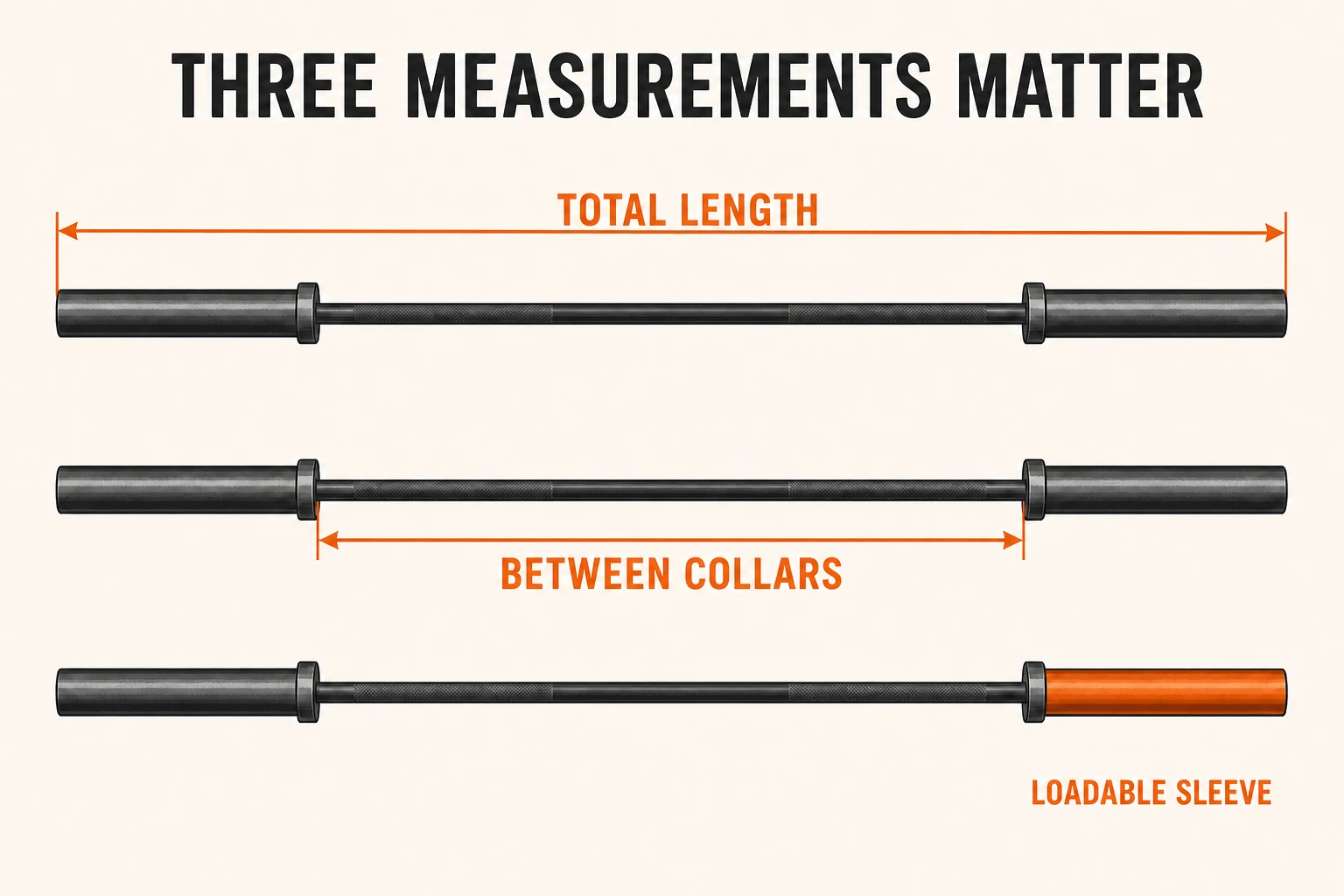
- Measure the bar’s clear shaft span. Use the distance between the inner faces of the two sleeve shoulders, not the distance between grip marks.
- Measure the actual support width. Include the outside geometry of both J-cups or other approved supports at the position where the shaft rests. The space between the uprights is only part of the picture.
- Check the complete setup. Confirm that sleeve shoulders, rack attachments and safeties do not collide through the intended lift and rerack path. Follow the rack and bar manufacturers’ compatibility guidance.
Subtracting the measured support width from the clear shaft span gives the total lateral surplus. A positive result is a screening calculation, not a safety certification: it does not account for every protrusion, movement or manufacturer-required margin. Never plan around a zero-clearance fit.
If you are choosing the rack too, use our power-rack buying guide. A rack and short bar should be selected as a system. Buying each independently because the dimensions sound “standard” invites avoidable mistakes.
Room Clearance: What a Shorter Bar Actually Saves
Consider a hypothetical 96-inch-wide training zone with the bar centered and no other obstructions. A 72-inch bar leaves 24 inches in total, or 12 inches at each end. A full-size 86.75-inch bar leaves 9.25 inches total, or about 4.6 inches per end. Those figures show the potential space saving; they do not establish sufficient space for your lifts.
Illustrative calculation: end clearance = (available room width − total bar length) ÷ 2. It assumes the bar stays centered and the available width is genuinely clear.
Now rehearse a plate change. Can you approach each sleeve, lift a plate into position and slide it fully on? Can you do so without stepping over a bench or twisting between the rack and a wall? Measure around handles, shelves, door tracks and stored equipment, not just the empty room.
There is also the vertical dimension. A short bar still needs enough height for your body, hands and plates during overhead work. Reducing overall bar length does not reduce the diameter of a loaded plate. Our small-space home-gym guide helps separate width, height and storage problems.
Sleeve Space: Count Thickness, Not Just Pounds
A bar’s strength rating does not tell you how many of your plates fit. Thick bumper plates can fill a short sleeve well before the bar approaches its stated static capacity. Conversely, thinner plates may fit more weight, but that never authorizes exceeding any equipment limit.
Measure the usable loading length on one sleeve. Subtract the actual space needed by the fully engaged collar. The remainder is the plate-stack budget for that side. Add the thickness of every plate you intend to use; do not rely on nominal plate weights as a thickness estimate.
Rack and Sleeve Screening Calculator
Enter all measurements in inches. Use your own measurements; the defaults are only an example. This checks geometry, not strength or safe use.
Formula: shaft surplus = clear span − support width. Identical plates per sleeve = floor((sleeve length − collar space) ÷ plate thickness). Use the actual total stack thickness for mixed plates. Positive surplus is not a guaranteed safe fit; allow manufacturer-required clearance.
For example, an 8.875-inch sleeve with a collar occupying 1.5 inches leaves 7.375 inches for plates. Two hypothetical 3-inch-thick plates occupy 6 inches and fit within that length; three occupy 9 inches and do not. This is an invented worked example using real arithmetic, not the measured thickness of a particular plate or collar.
Use our plate-loading calculator to work out weight combinations after checking physical fit. The two calculations answer different questions: one totals load; the other checks whether that load can physically sit on the sleeve.
Optional: Check Collar Fit Too
This accessory is not one of the barbell picks. The example calculator does not use a measured width for this product.

Lock-Jaw Sport 2-inch / 50 mm Collars
Consider only if you need compatible retaining collars; reuse suitable collars you already own.
- Identified as the Sport 2-inch / 50 mm set.
- Lever-style closure provides a clamp alternative to spring clips.
- Measure the actual occupied sleeve width before budgeting plate space.
Skip if: your sleeve diameter or manufacturer requirements do not match.
*As an Amazon Associate, we earn from qualifying purchases. Buying through these links may earn us a commission at no extra cost to you.
Grip, Bar Weight and Loading Tradeoffs
A shorter bar is not necessarily a thinner-grip bar. Bells of Steel, Rogue C-70S and REP Colorado Short list 28.5 mm shafts; Philosophy Gym's 72-inch variant, Titan's 15KG technique bar and Get RX'd list 28 mm. Technique bars can differ in weight, proportions and permitted use. Do not substitute one based on diameter alone.
Starting weight matters if you log sessions or train with a partner. The listed bars are not automatically 45 pounds. Rogue specifically notes that its 15 kg figure includes collars. Use the manufacturer's definition and, where needed, verify the weight of your actual configuration before calculating a working load.
Knurling is another preference, not a simple quality score. Rogue C-70S, REP Colorado Short and Get RX'd Shorty do not list a center knurl. Do not assume the Amazon options share every grip detail: confirm the exact model's current specification. Decide what suits your exercise needs and clothing, especially for back squats. We cannot promise that a particular finish or knurl will feel comfortable to your hands without a trial.
For men returning to lifting after a break, the strength-training guide for men over 50 provides the training context. Buying a lighter bar can make some starting loads easier to assemble; it does not replace suitable technique or progression.
Names, Ratings and Other Expensive Misunderstandings
What most buyers miss: Rogue C-70 and C-70S are different products. The extra letter matters. Likewise, “Olympic” commonly describes a loading format; it does not guarantee that a short bar will fit your rack.
A static load rating and a tensile-strength figure describe different properties and should not be treated as a prescription for dropping a loaded bar. Follow the bar manufacturer's permitted-use instructions. Plate type, floor, repeated impacts and the rest of your setup still matter.
Inspect listings for the selected variant, not only the search-result image. The three barbell cards link to separately verified Amazon product identifiers: B097S5TT5H for Philosophy Gym's 72-inch model, B0GX25Z4BF for Bells of Steel's 69-inch model and B093LV9Y6Y for Titan's 15KG technique bar. They showed US availability at our August 31, 2026 check for ZIP 10001, but delivery, sellers and variants can change. The separate collar card is an optional accessory, not a fourth barbell.
Do not use an image of a long bar to illustrate a short model or assume that a retailer's parent listing has the right child variant selected. Check model name, measurements, finish and included accessories together before checkout.
When a Short Bar Is the Wrong Purchase
- You need more sleeve capacity. If your intended plate stack does not fit, reconsider the bar or plate system rather than leaving collars partly engaged.
- The rack is the mismatch. An incompatible support width cannot be repaired by calling the bar “rackable.”
- The constraint is overhead height. A shorter bar does not solve ceiling clearance.
- You mainly want carries or trap-bar pulls. Compare trap bars as a separate category rather than treating every compact bar as equivalent.
- You cannot train safely in the remaining space. Dumbbells or another appropriate setup may be a better use of the room.
For bench pressing, verify the bench and rack setup and use correctly positioned safeties. No bar length eliminates the risks of a failed solo lift. Keep children, pets and other users out of the loading and lifting area.
Before You Order: Make a Fit Record
Write down the exact bar model, clear shaft span, rack support width, usable sleeve length, collar space and your heaviest planned plate stack. Add delivery cost, warranty terms and the method for returning a long heavy item. Keep the seller's dimensional confirmation if the fit is close.
Then walk through a normal session: carry the empty bar to the rack, load both sides, set the bench or safeties, perform the intended movement path without load and put everything away. A believable day-to-day layout is worth more than an attractive product photo.
Conclusion
For an Amazon purchase, compare Philosophy Gym's 72-inch bar with Bells of Steel's shorter 69-inch design; consider Titan's 15KG bar only when its narrower central span is confirmed compatible with your rack. Rogue C-70S, REP Colorado Short and Get RX'd Shorty provide additional direct-manufacturer comparison points. Eliminate any option that fails your rack-span or plate-stack check. The best short rackable barbell solves a real width constraint without creating a new compatibility or loading problem.
Use our home gym equipment guide to place this purchase alongside the bench, rack, flooring and training space you already need.
Frequently Asked Questions About Short Rackable Barbells
Will every six-foot Olympic barbell fit a power rack?
No. Overall length does not establish the clear distance between the sleeve shoulders. Compare that span with the actual outside support width of your rack and follow both manufacturers' compatibility requirements.
What is the difference between Rogue C-70 and C-70S?
They use different shaft-to-sleeve proportions. The C-70S is the rack-oriented model discussed here, with a published 52-inch span between sleeves. Do not buy the C-70 assuming it has the same geometry.
Can short barbells hold enough weight for serious training?
Some can, but both the product's permitted loading and your plate-stack thickness must work. Short sleeves often become the practical constraint with thick bumper plates. Never confuse physical fit with permission to exceed a load limit.
Do short barbells weigh 45 pounds?
Not necessarily. The models in our comparison are listed at roughly 13–15 kg, or about 29–33 pounds, with an important collar-inclusion note for Rogue. Confirm the actual bar and collar configuration rather than logging every bar as 45 pounds.
Does a short bar make a low-ceiling gym usable for overhead presses?
Not by itself. Overhead clearance depends on your height, reach, movement and plate diameter. A short bar primarily reduces side-to-side space; it does not shrink a loaded plate or raise the ceiling.
Medical Disclaimer: This is general equipment and fitness information, not medical advice or a rehabilitation plan. Follow the product manual and seek qualified guidance for pain, injury, recent surgery or exercise restrictions.
Affiliate Disclosure: As an Amazon Associate, PrimeForMen earns from qualifying purchases. Recommendations are based on documented fit and intended use, not an obligation to buy. Product specifications and offers can change.
Image note: The featured scene and explanatory infographic are AI-generated editorial illustrations, not photographs of our testing or exact representations of the listed products. Amazon card images depict the identified marketplace products.