
Agility Ladder Drills are the fastest way to sharpen your feet, your brain, and your game—if you train them like a coach, not like a TikTok challenge.
If you’ve ever felt a half-step slow—late to a loose ball, sloppy on a cut, heavy-footed in a defensive slide—this guide is built for you. You’ll get:
- A coach-style drill library (beginner → advanced)
- A simple 4-week plan you can plug into your training week
- Progressions (so you actually improve, not just “do more drills”)
- Sport-specific picks (soccer, basketball, tennis, fighters, field sports)
- Common mistakes that keep people stuck
- DIY options if you don’t own a ladder
Quick safety note (YMYL-friendly): This is general fitness information, not medical advice. If you have pain, swelling, dizziness, or a known injury, talk to a qualified clinician or coach before starting. Warm up first. Stop if pain spikes.
Why Most People Don’t Get Faster From a Ladder
Here’s the truth: an agility ladder doesn’t automatically make you “agile.” It’s a tool. A good one. But only when you use it to train the right things.
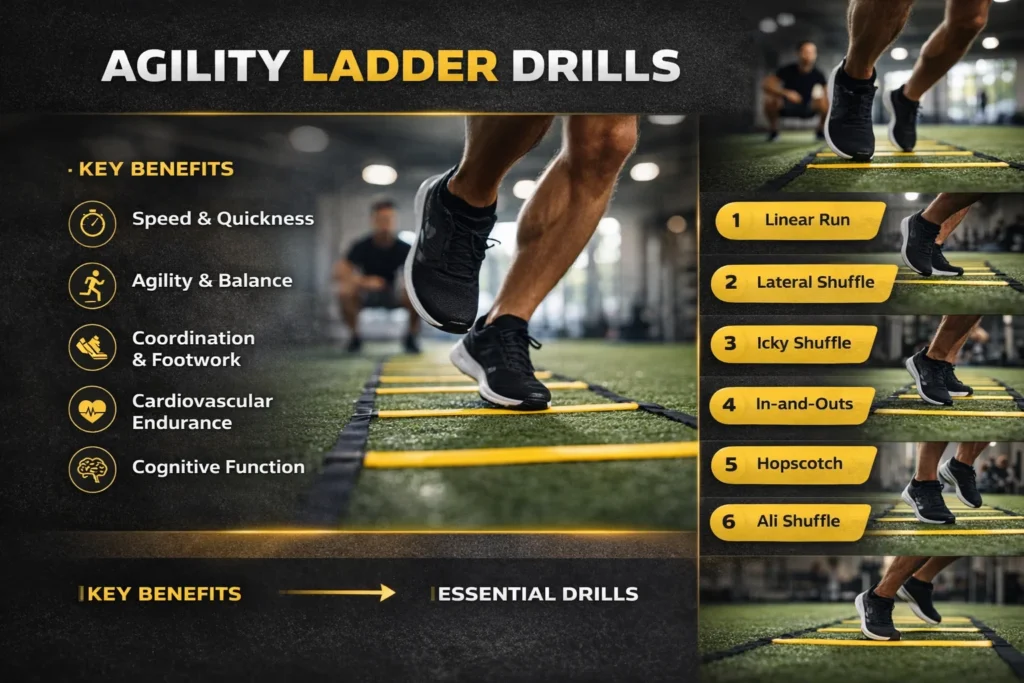
What a ladder is great for
- Foot speed and rhythm (quick contacts with the ground)
- Coordination (hands, feet, and hips working together)
- Body awareness (where you are in space)
- Nervous system prep (a great warm-up for speed, jumping, or lifting)
What a ladder is not great for
- True change-of-direction strength (planting hard and cutting)
- Deceleration (slamming the brakes safely)
- Top-end sprint mechanics (you need actual sprinting for that)
Think of ladder work like a sharpener, not the knife. The knife is your strength, mobility, and sprint/cut technique.
If you want the full picture, pair this guide with these training foundations:
- Build power with Plyometric Training
- Get athletic strength from Functional Fitness Training
- Use smart loading with Progressive Overload
- Avoid digging a recovery hole with Overtraining Syndrome
- Keep your engine healthy with Importance of Rest and Recovery


SKLZ Quick Ladder Pro
The most efficient agility ladder on the market. Hinged rungs ensure it stays flat and folds away in seconds.
- Accordion Fold: Sets up and packs away instantly
- Rigid Sides: Won’t tangle or bunch during drills
- Low Profile: Reduces tripping and catching cleats
- Professional Grade: Built for heavy daily use
Agility Ladder Drills: What They Really Train (and What They Don’t)
Most articles stop at “here are 15 drills.” Cool. But you’re not here to collect drills. You’re here to move better on purpose.
Here’s what’s happening when you do ladder work well:
- Fast brain-to-muscle signals. You’re teaching your nervous system to fire quickly and cleanly.
- Better ground contact. Quick, light steps reduce “wasted time” on the floor.
- Cleaner posture under speed. Hips stable. Trunk quiet. Arms doing their job.
$1### The Hidden Advantage: The Science Behind the Speed
Speed looks like “fast feet,” but the real driver is fast communication between your brain and your muscles.
When you move through a ladder with good form, you’re doing a few powerful things at the same time:
- Neuromuscular efficiency: Your nervous system learns to send clear signals faster. That means fewer “mixed messages” to the ankles, knees, and hips when you’re trying to move quickly.
- Proprioception (body awareness): Your body gets better at sensing where you are in space. That matters when you’re cutting, landing, or reacting.
- Springy ankles: Quick contacts teach you to stay light on the balls of your feet so you don’t feel stuck to the ground.
But you only get these benefits when you practice clean reps.
If you rush patterns you don’t own yet, you teach your brain to move fast and messy. That’s why this guide uses a progression that most drill lists skip:
- Pattern first (smooth)
- Speed next (fast)
- Density after (less rest)
- Game-like last (reactive cues)
And remember: ladder drills are a low-load tool. They don’t replace strength. They polish your movement so it shows up in real play.
If you want an evidence-based overview of agility concepts and training principles, start with the NSCA’s coaching resources on developing agility and quickness.
- External resource: NSCA — Developing Agility and Quickness
Before You Start: Setup, Footwear, and One Simple Rule
Ladder setup
- Put the ladder on a flat surface (turf, gym floor, track apron).
- If you’re indoors, make sure it won’t slide.
- Leave 3–5 meters of space at the end so you can decelerate safely.
Footwear
- A grippy trainer or court shoe works well.
- Avoid thick, squishy soles that make you feel unstable.
The one rule that fixes 80% of form
Be quiet.
If your feet are slapping and stomping, you’re spending too long on the ground. Aim for light, quick contacts.
The Coach’s Programming Rules (The Missing Piece)
Most ladder guides skip the most important question:
“How do I actually use these drills in a week?”
Here’s the simple answer:
- Do ladder work 2–3 times per week
- Keep total ladder time 8–20 minutes
- Place it early in the session (after a warm-up)
- Focus on quality over fatigue
If you do ladder drills when you’re exhausted, you practice sloppy movement. That’s not a win.
Where ladder work fits best
- Before lifting: as a neural warm-up (great before squats, jumps, sprint work)
- On a speed day: as the “skill block” before short sprints
- On conditioning days: as part of a short HIIT circuit (if technique stays clean)
How much is enough?
Use this as a starting point:
| Level | Ladder sessions/week | Time per session |
|---|---|---|
| Beginner | 2 | 8–12 min |
| Intermediate | 2–3 | 12–16 min |
| Advanced | 3 | 16–20 min |
A smarter way to progress
Don’t just “add drills.” Progress in this order:
- Pattern (can you do it smoothly?)
- Speed (can you do it fast without falling apart?)
- Density (same work, less rest)
- Complexity (reactive cues, turns, a ball, a partner)
That’s how athletes actually get better.
The Ultimate Drill Library (With Pro Tips and Common Mistakes)
You don’t need 50 drills. You need the right few, trained well.
Below are 24 drills you can mix and match. Learn them in order. Keep it simple.
Key cues you’ll see again and again
- Quiet feet (light contacts)
- Hips low-ish (athletic stance, not a squat)
- Arms help (don’t run with your hands glued to your sides)
- Eyes up (as soon as you know the pattern)
Beginner Agility Ladder Drills (Foundation)
1) Two-Foot Run (One Square)
How: Two feet in each square. Quick steps. Move forward.
- Pro tip: Think “tap-tap” instead of “step-step.”
- Common mistake: Long steps that land outside the square.
2) Single-Foot Run
How: One foot per square. Run through like a fast march.
- Pro tip: Stay tall and relaxed.
- Common mistake: Overstriding and stomping.
3) In-and-Outs (Two In, Two Out)
How: Two feet in a square → two feet outside the next square → repeat.
- Pro tip: Keep your hips stable—don’t bounce.
- Common mistake: Crossing feet or drifting sideways.
4) Lateral Stepper (Side Shuffle)
How: Face sideways. Step both feet into each square as you move down.
- Pro tip: Keep toes mostly forward, knees soft.
- Common mistake: Clicking heels together.
5) Hopscotch (Two-In → One-In)
How: Two feet in one square, then one foot in the next, alternating.
- Pro tip: Use your arms for balance.
- Common mistake: Landing flat-footed.
6) Forward Hop (Two Feet)
How: Hop both feet into each square.
- Pro tip: “Float” forward; keep contact time short.
- Common mistake: Loud landings.
7) Backward Two-Foot Run
How: Same as drill #1, but moving backward.
- Pro tip: Small steps. Keep your chest proud.
- Common mistake: Looking down the entire time.
8) Lateral In-and-Outs
How: Facing sideways, step both feet into the square, then outside.
- Pro tip: Keep shoulders quiet.
- Common mistake: Turning it into a jump.
Intermediate Agility Ladder Drills (Coordination + Rhythm)
9) Icky Shuffle (Classic)
How: Step in with lead foot → step in with trail foot → step out to the side → repeat.
- Pro tip: Keep your hips low and your steps tight.
- Common mistake: Standing tall and “reaching.”
10) Ali Shuffle
How: Feet switch positions in the air as you hop down the ladder (like a fast scissor).
- Pro tip: Stay springy. Don’t over-jump.
- Common mistake: Heavy shuffling with no airtime.
11) Jumping Jack Feet
How: Jump feet apart outside the ladder → jump feet together inside the square → repeat.
- Pro tip: Keep the jumps small and quick.
- Common mistake: Big jumps that turn into conditioning only.
12) Lateral High-Knee Run
How: Face sideways. One foot per square with a crisp knee drive.
- Pro tip: Drive arms like you’re sprinting.
- Common mistake: Knee comes up but posture collapses.
13) Carioca / Cross-Over
How: Sideways. Cross front, step in, cross behind, step in.
- Pro tip: Rotate hips smoothly.
- Common mistake: Twisting only from the knees.
14) In-In-Out (Forward)
How: Both feet in the square, then both feet outside to the sides (same square), then move forward.
- Pro tip: Move like a piston, not a bounce.
- Common mistake: Losing the rhythm and stuttering.
15) Lateral Icky
How: Do the Icky Shuffle while moving sideways.
- Pro tip: Stay low and glide.
- Common mistake: Upper body swaying everywhere.
16) Hopscotch (Single-Leg Focus)
How: Two feet in one square → hop on one foot into the next → switch legs each rep.
- Pro tip: Land softly, knee aligned.
- Common mistake: Knee caves in.
Advanced Agility Ladder Drills (Reactive + Sport Transfer)
17) Icky Shuffle with 90° Turn
How: Do one Icky pattern, then snap a 90° turn and continue.
- Pro tip: Turn with your hips, not your shoulders.
- Common mistake: Drifting out of the ladder.
18) “Stick the Finish” Decel
How: Any drill down the ladder → last square → stop fast and hold athletic stance for 2 seconds.
- Pro tip: Think “brake with hips,” not knees.
- Common mistake: Collapsing forward.
19) Reactive Call-Outs
How: Partner calls “left/right/forward/back” at the end; you react after the last square.
- Pro tip: Eyes up, breathe.
- Common mistake: Looking down, missing the cue.
20) Single-Leg Forward Hops
How: Hop on one leg through the ladder, one square at a time.
- Pro tip: Keep ankle stiff and contacts quick.
- Common mistake: Letting the heel slam.
21) Lateral Bounds (Outside-to-Outside)
How: Jump sideways over a square, landing outside the next square.
- Pro tip: Stick the landing for a beat.
- Common mistake: Speeding up and losing control.
22) Ball Carry (Sport-Specific)
How: Run a drill while carrying a ball (soccer/basketball/football).
- Pro tip: Don’t change posture. Keep mechanics clean.
- Common mistake: Hunching and staring at the ball.
23) Band-Resisted Lateral Steps (Advanced)
How: Light mini-band around ankles or knees; do lateral stepper.
- Pro tip: Control the knees; don’t let band snap you.
- Common mistake: Too heavy a band (pattern falls apart).
24) Mirror Drill (No Ladder Needed)
How: Partner moves laterally; you mirror with quick feet and low hips.
- Pro tip: Chest up, small steps.
- Common mistake: Crossing feet and getting tangled.
How to Progress Agility Ladder Drills Without Just “Going Faster”
This is where real gains come from.
Step 1: Make the drill clean
- You can do it 3 passes in a row with no stumbles.
- Your feet sound quiet.
Step 2: Make the drill fast
- Same pattern, faster contacts.
- Keep shoulders relaxed.
Step 3: Make the drill dense
- Keep speed.
- Reduce rest.
Step 4: Make the drill game-like
Pick one:
- Add a turn at the end
- Add a reactive cue (partner call, clap, or color cone)
- Add a ball
This is what most competitor posts miss: not just drills, but a progression path.
The 4-Week Coach Plan (Plug-and-Play)
This plan works for busy adults and serious athletes. It’s short. It’s repeatable. And it fits next to your lifting.
Weekly schedule options
- 2 days/week: Tue + Fri (or any two non-back-to-back days)
- 3 days/week: Mon + Wed + Sat
Session structure (always)
- Warm-up (5–10 min)
- Ladder block (8–20 min)
- Main training (strength, sprints, jumps, or conditioning)
Week 1 (Learn)
- 2 sessions
- Pick Goal A one day, Goal B the other
- Keep speed at 70–80% until patterns are clean
Week 2 (Speed)
- 2–3 sessions
- Repeat the same goals
- Push to 85–90% speed while staying quiet
Week 3 (Density)
- 3 sessions if recovery is good
- Keep drill choices, but reduce rest by ~10–15 seconds
Week 4 (Game-like)
- 2–3 sessions
- Add one “real-world” piece:
- 90° turn
- reactive cue
- ball carry
$1## Sample Workouts You Can Use Today
You can build a great ladder session two ways:
- Circuit style: 4–8 drills in a row, then rest, repeat.
- Power style: 1–2 drills, more rest, higher speed.
Below are three workouts that cover the most common goals.
Workout 1: Beginner Footwork Foundation (12 minutes)
Goal: clean patterns + quiet feet
- Two-Foot Run — 3 passes (rest 30 sec)
- In-and-Outs — 3 passes (rest 30 sec)
- Lateral Stepper — 2 passes each way (rest 45 sec)
- Hopscotch — 2 passes (rest 45 sec)
Repeat the block once if form stays clean.
Workout 2: All-Around Athlete (15–18 minutes)
Goal: forward + lateral + coordination
- Single-Foot Run — 3 passes (rest 30 sec)
- Icky Shuffle — 3 passes (rest 45 sec)
- Jumping Jack Feet — 2 passes (rest 45 sec)
- Carioca — 2 passes each way (rest 45 sec)
- Stick the Finish — 4 reps (rest 30 sec)
Do 1–2 total rounds depending on your conditioning.
Workout 3: Advanced Reactive Session (18–20 minutes)
Goal: game-like reactions + sharp decel
- Icky Shuffle — 2 fast passes (rest 45 sec)
- Reactive Call-Outs — 8 reactions (rest as needed)
- Icky with 90° Turn — 4 reps (rest 45–60 sec)
- Lateral Bounds — 4 reps each way (rest 45–60 sec)
- Finish: 2–4 short sprints (10–20m) with full recovery
Keep the reps crisp. End the session when speed drops.
Workout quick-pick table
| Workout | Best for | Total time |
|---|---|---|
| Beginner Foundation | New to ladders, warm-ups | ~12 min |
| All-Around Athlete | General sports performance | 15–18 min |
| Advanced Reactive | Competitive athletes | 18–20 min |
Technique Checklist (Coach Yourself)
Use this checklist once per session. It takes 10 seconds and saves you weeks of bad practice.
- Feet: light and quiet, minimal heel contact
- Posture: tall chest, ribs down, hips under you
- Hips: stable (no big bounce)
- Knees: track over toes (no collapsing inward)
- Arms: natural swing (help the rhythm)
- Eyes: down to learn, up to own it
If your knees or ankles feel “off”
Dial it back. Pick simpler drills. Shorten the session. And focus on quality.
Ladder work should feel snappy, not painful. If you consistently get sharp pain, swelling, or instability, talk to a qualified clinician.
$2 (Stop Guessing)
A huge knowledge gap in most ladder content is sport transfer. Let’s fix it.
| Sport | Best drill picks | Why it carries over |
|---|---|---|
| Soccer / Football | Icky, in-and-outs, stick the finish | Cuts, re-acceleration, clean foot contacts |
| Basketball / Tennis | Lateral stepper, carioca, lateral Icky | Defensive slides, recovery steps, lateral bursts |
| Fighters / Martial Arts | Ali shuffle, hopscotch, reactive cue | Angles, in-and-out movement, timing |
| Field sports (rugby, lacrosse) | turns, reactive call-outs, lateral bounds | Read-and-react, angle changes |
Want sport-specific strength that supports these drills? Pair them with:
- Unilateral Training (single-leg strength for cuts)
- Bulgarian Split Squats (deceleration-friendly legs)
- Resistance Band Training (great for hip stability)
Common Mistakes That Kill Results (Fix These First)
Mistake 1: Turning ladder drills into conditioning
If you’re gasping and stumbling, your nervous system is fried. Keep reps short and fast.
Mistake 2: Looking down forever
It’s okay at first. But once you learn the pattern, eyes up. That’s how it transfers to sport.
Mistake 3: No arms
Your arms are part of speed. Let them swing naturally.
Mistake 4: Only doing forward drills
Real sport happens sideways and on angles.
Mistake 5: No strength base
If you want better cuts, build legs and hips. Ladder work plus strength is the combo.
Don’t Own a Ladder? Do This Instead (DIY Options)
You can train the same patterns with:
- Painter’s tape on a garage floor
- Chalk squares on pavement
- Sidewalk cracks (careful with uneven surfaces)
- Two jump ropes laid parallel
The key is consistent spacing so your brain learns the rhythm.
For more ideas on training when space is tight, see Apartment-Friendly Workouts and Effective Home Workout Routines.
How to Measure Progress (So You Know It’s Working)
You don’t need fancy gear. You need one simple test.
The “One Drill” test
Pick one drill (like the Two-Foot Run).
- Time one clean pass (start to finish)
- Record it
- Retest every 7–14 days
If time drops while form stays clean, you’re improving.
Agility & Quickness FAQ
Master the science of elite footwork and reaction speed.
Agility ladder drills are the ultimate tool for neuromuscular conditioning. They teach your brain to send signals to your feet faster and more accurately. Regular practice improves:
- Proprioception: Better awareness of where your body is in space.
- Lateral Quickness: Essential for defending or dodging opponents.
- Injury Prevention: Strengthening the small stabilizer muscles in the ankles and knees.
Quality always beats quantity with agility work. Aim for 2–3 sessions per week. Because these drills are taxing on the nervous system, they should be performed at the beginning of your workout when you are fresh. 10 to 15 minutes of focused, high-speed reps is all it takes to see significant gains in coordination.
They make you “quick,” which is different from “fast.” Ladders improve your ground contact time (how quickly your foot leaves the floor), which is vital for acceleration. However, for maximum top-end speed, you must pair these drills with 20–40 yard sprints and heavy lower-body strength training.
Absolutely. Because ladder drills require constant, explosive movement and high mental focus, they act as a form of functional cardio. They are much more engaging than a treadmill and keep your heart rate in the “fat-burning zone” while building lean, athletic muscle in the calves and quads.
Not at all. If you don’t have a physical ladder, you can easily improvise. Chalk, tape, or even existing cracks in the pavement can serve as your rungs. The goal is to have a consistent visual target to aim for; your brain doesn’t know the difference between a $30 nylon ladder and a line of tape on the floor.
The Bottom Line
If you want faster feet, better rhythm, and cleaner movement, ladder work can help—fast. But the secret isn’t a fancy pattern.
The secret is:
- Keep reps short and sharp
- Progress with a plan
- Pair ladder work with strength and recovery
For extra performance tools, you can also explore:
External resource (practical demo-style drill reference):