
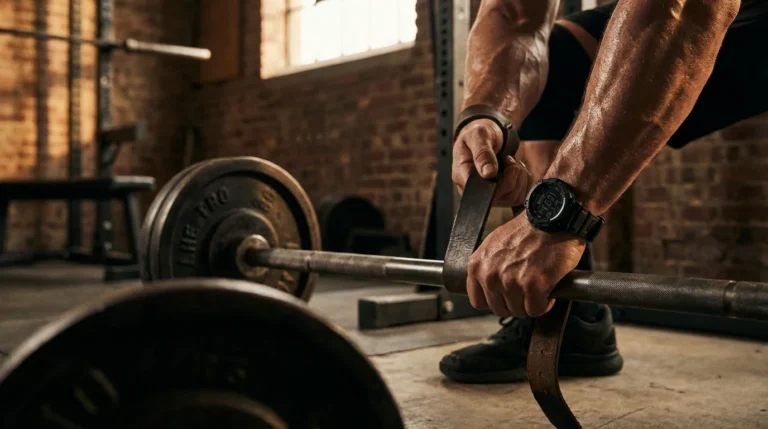
Five years ago, I bought my first top-tier wearable. I strapped it on, walked into the gym, and loaded 405 pounds on the bar for deadlifts. I ground out an ugly but effective set of five. My lungs were burning, my forearms were pumped, and my central nervous system felt like it had been hit by a freight train.
I looked down at my wrist, expecting the tiny screen to congratulate me for moving half a ton of iron. Instead, the “Best Fitness Tracker” of the year told me my heart rate was 85 BPM and I was participating in “light aerobic activity.”
📌 TL;DR: The Bottom Line on 2026 Fitness Trackers
- Optical Sensors Hate Barbells: Wrist-based trackers fail during heavy lifts because gripping weight restricts blood flow to your wrist, tricking the sensor into reading a low heart rate.
- HRV is Your Holy Grail: Heart Rate Variability (HRV) is the single most important metric for lifters. It tells you if your nervous system is recovered enough to push heavy weight or if you need a rest day.
- Sleep Quality Over Step Counts: Steps don’t build muscle. Deep, restorative sleep and low cortisol do. Trackers should be judged by how well they measure sleep architecture.
- You Need a Hybrid Approach: For perfect accuracy, the best setup in 2026 is pairing a premium wrist or finger wearable (for 24/7 recovery tracking) with a chest strap monitor (for the actual lifting session).
I wanted to throw it through the drywall.
The truth is, if you’re a guy who trains with heavy iron, chalks up for deadlifts, or swings kettlebells until your calluses tear, most of the wearables on the market are flat-out lying to you.
They are built for marathon runners, cyclists, and people trying to hit 10,000 steps at the mall. They are not built for men who push heavy weight, battle central nervous system (CNS) fatigue, and need to know exactly when their bodies are primed for hypertrophy.
In this guide, we are going to cut through the marketing BS. We’ll break down exactly why wrist-based optical sensors fail during heavy grip work, what metrics actually matter for muscle growth, and the definitive list of the best fitness trackers in 2026 that actually cater to guys who lift.
The Problem: Why Most Tech Doesn’t “Get” Iron
If you’ve ever felt like your wearable is gaslighting you during a heavy leg day, you aren’t crazy. It’s a matter of basic physiology and mechanical limitations.
🏃♂️ The Prime Perspective
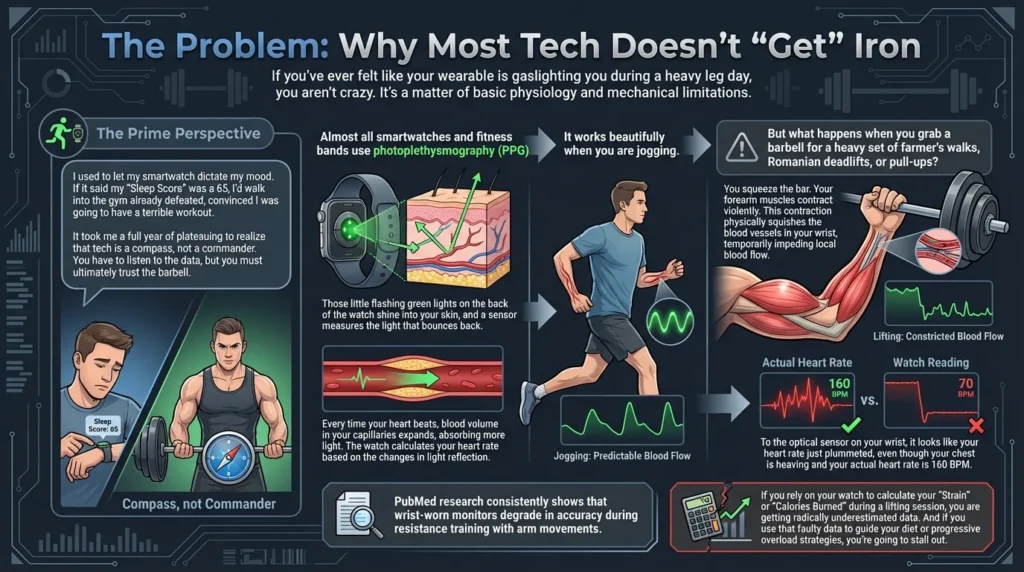
I used to let my smartwatch dictate my mood. If it said my “Sleep Score” was a 65, I’d walk into the gym already defeated, convinced I was going to have a terrible workout. It took me a full year of plateauing to realize that tech is a compass, not a commander. You have to listen to the data, but you must ultimately trust the barbell.
Almost all smartwatches and fitness bands use photoplethysmography (PPG). Those little flashing green lights on the back of the watch shine into your skin, and a sensor measures the light that bounces back.
Every time your heart beats, blood volume in your capillaries expands, absorbing more light. The watch calculates your heart rate based on the changes in light reflection.
It works beautifully when you are jogging. Your arms are loose, blood is flowing freely, and the rhythmic motion is easy for the algorithm to predict.
But what happens when you grab a barbell for a heavy set of farmer’s walks, Romanian deadlifts, or pull-ups?
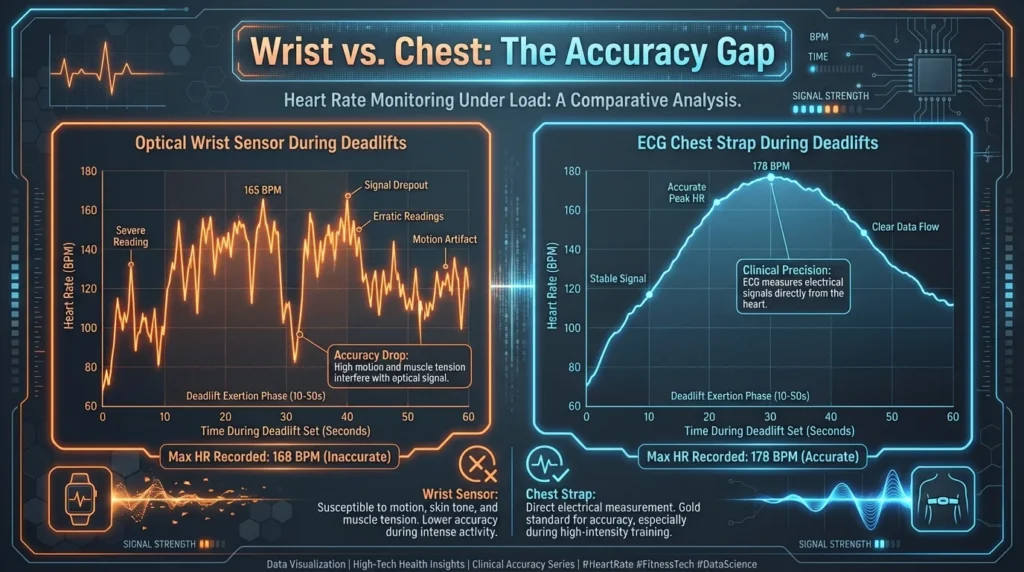
You squeeze the bar. Your forearm muscles contract violently. This contraction physically squishes the blood vessels in your wrist, temporarily impeding local blood flow.
To the optical sensor on your wrist, it looks like your heart rate just plummeted, even though your chest is heaving and your actual heart rate is 160 BPM.
PubMed research consistently shows that wrist-worn monitors degrade in accuracy during resistance training with arm movements.
If you rely on your watch to calculate your “Strain” or “Calories Burned” during a lifting session, you are getting radically underestimated data. And if you use that faulty data to guide your diet or progressive overload strategies, you’re going to stall out.
Table 1: Optical Sensors vs. Reality
| What the Tracker Thinks You Are Doing | What You Are Actually Doing | The Resulting Data Output |
| Steady, rhythmic arm swinging (Running) | Squeezing a barbell for a 1RM Deadlift | Massive underreporting of heart rate and exertion. |
| Sitting still on the couch | Resting 3 minutes between heavy squat sets | Assumes the workout is over; drops your active calorie burn. |
| Low heart rate = Easy workout | High CNS taxation with brief cardiac spikes | Fails to measure neuromuscular fatigue. |
Heart Rate Variability (HRV): The Ultimate Predictor of Readiness
If we can’t trust wrist sensors during the actual lift, why bother wearing a tracker at all?
Because the real magic of a fitness tracker isn’t measuring what happens during the workout. The magic is measuring what happens during the other 23 hours of the day. And in 2026, the gold standard metric for this is Heart Rate Variability (HRV).
Your heart does not beat like a metronome. If your heart rate is 60 beats per minute, it doesn’t beat exactly once every single second. Sometimes there are 0.9 seconds between beats, and sometimes there are 1.1 seconds. This tiny variance in time between beats is your HRV.
💡 What Most Guys Miss
Most men assume a “highly regular” heartbeat is a sign of supreme fitness. It’s the exact opposite. A high HRV (more variance between beats) means your nervous system is relaxed, adaptable, and ready to perform. A low HRV (a rigid, metronome-like heartbeat) means your sympathetic nervous system is trapped in “fight or flight” mode. Think of it like a car engine. A low HRV is an engine constantly revving at 4,000 RPM—burning out and waiting to snap. A high HRV is a smooth, quiet idle, ready to accelerate the second you hit the gas. If you lift heavy on a low HRV day, you are begging for an injury.
Your nervous system is a tug-of-war between the sympathetic (“fight or flight”) and parasympathetic (“rest and digest”) branches. Heavy lifting, poor sleep, alcohol, and work stress all pull on the sympathetic side. When you are overstressed, your heart beats rigidly.
By tracking your HRV every night while you sleep, a high-end fitness tracker gives you an exact look under the hood of your central nervous system. It tells you, definitively, if you have recovered from your last workout.
If your HRV is trending up, it’s a green light. Load the bar, push the intensity, and chase PRs.
If your HRV is in the gutter, your CNS is fried. You are bordering on overtraining syndrome. This is the day to do active recovery, mobility work, or take a complete rest day. Ignoring a plummeting HRV is how you end up with nagging joint pain and stagnant muscle growth.
The Best Fitness Trackers in 2026: The Heavy Hitters
With all of that physiology out of the way, let’s talk hardware.
We’ve tested everything from smart rings to chest straps to heavy-duty GPS watches. We threw out the cheap pedometers and the fashion watches. If you are serious about the iron, these are the only devices worth your hard-earned cash in 2026.
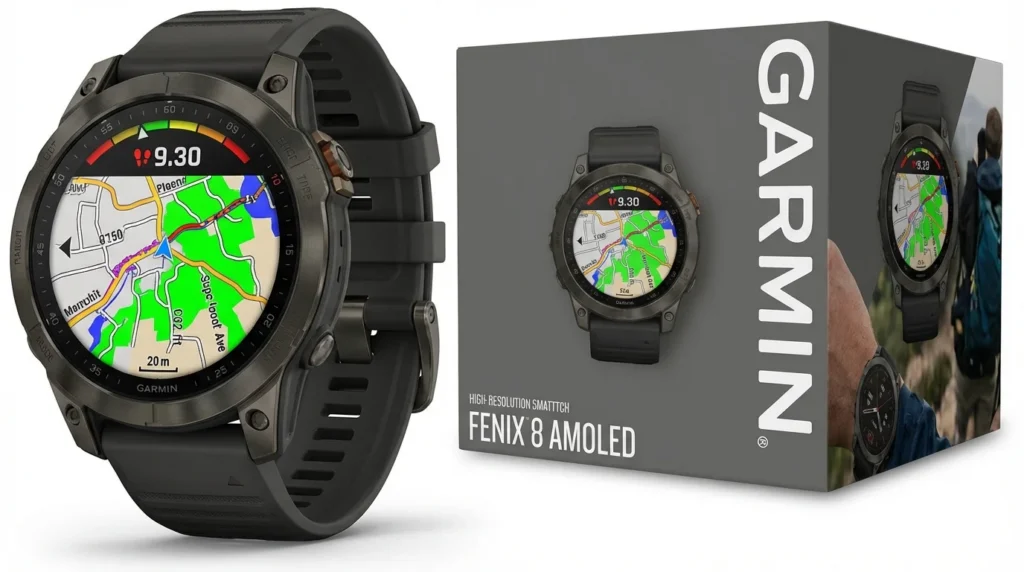
1. Garmin Fenix 8 AMOLED (The Ultimate Data Powerhouse)
* Example image
Garmin has long been the king of endurance sports, but with the Fenix 8 series, they’ve perfected the algorithm for strength athletes.
The beauty of the Garmin ecosystem is the “Training Readiness” score. This algorithm pulls together your sleep data, HRV status, acute training load, and stress history to give you a score from 1 to 100 on how prepared your body is to take on physical strain.
Furthermore, Garmin is one of the few platforms that allows you to easily pair a chest strap monitor (like the Garmin HRM-Pro) via ANT+ or Bluetooth directly to the watch. This solves the wrist-sensor problem instantly.
You wear the watch 24/7 for recovery data, strap on the chest monitor for your lifting session, and get flawless, laboratory-grade data synced into one app. The rugged titanium bezel also ensures you aren’t going to shatter the screen when you accidentally clip a kettlebell during a clean and press.
Why it rocks for lifters:
- Chest Strap Integration: Bypasses wrist-sensor errors by seamlessly syncing flawless cardiac data from a chest strap directly to your watch interface.
- Training Readiness Score: The algorithm tells you exactly how primed your CNS is to handle heavy barbell volume.
- Indestructible Build: The titanium bezel and scratch-resistant sapphire glass ensure it survives kettlebell impacts and raw knurling.
2. Whoop 5.0 (The Screenless Recovery Coach)
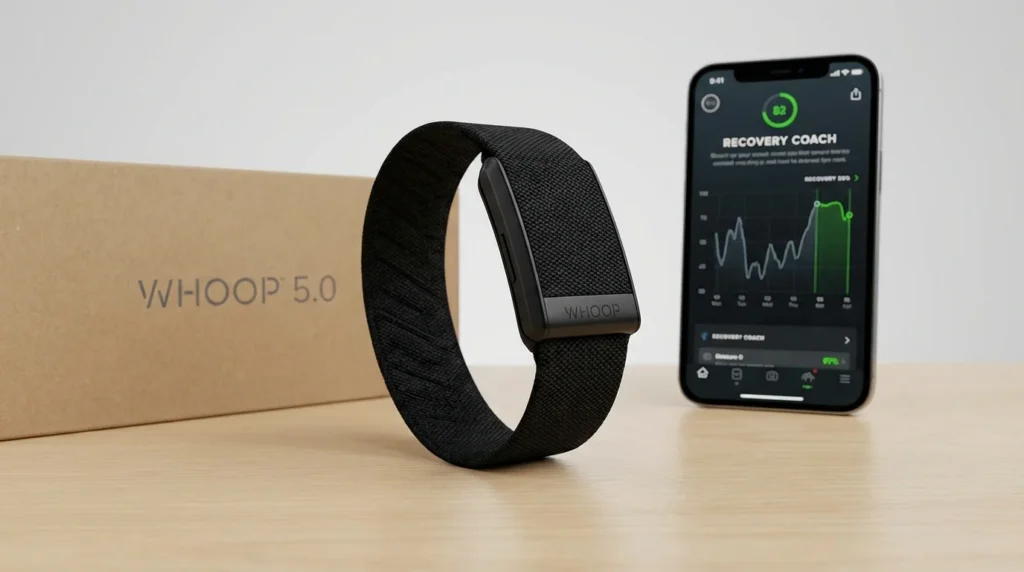
If you already wear a traditional mechanical watch, or if you simply hate the distraction of smart notifications pinging your wrist while you work out, the Whoop 5.0 is the definitive choice.
Whoop operates on a subscription model, providing you with a sleek, screenless fabric band that is packed with high-end sensors. Because there is no screen, the battery lasts for days, and you can wear it in a bicep sleeve (the Whoop Any-Wear apparel line) instead of on your wrist.
Moving the optical sensor to your bicep completely bypasses the grip-interference problem. You can deadlift, row, and do pull-ups, and the bicep sensor will read your heart rate with near chest-strap accuracy.
Whoop’s entire algorithm is based on “Strain” versus “Recovery.” It tracks your sleep debt, respiratory rate, and blood oxygen to tell you exactly how hard you can push. It’s the closest thing to having a sports scientist sitting on your nightstand.
Why it rocks for lifters:
- Bicep Placement: Moving the optical sensor to your bicep completely bypasses the grip-interference problem. You can deadlift, row, and do pull-ups without losing signal.
- Zero Distractions: No screen means no emails or text messages ruining your focus mid-set. Just raw data collection.
- Unmatched Strain vs. Recovery: Its entire algorithm tracks your sleep debt and respiratory rate to tell you exactly how hard you can push. It’s the closest thing to having a sports scientist sitting on your nightstand.
3. Oura Ring Gen 4 (The Unobtrusive Sleep Master)
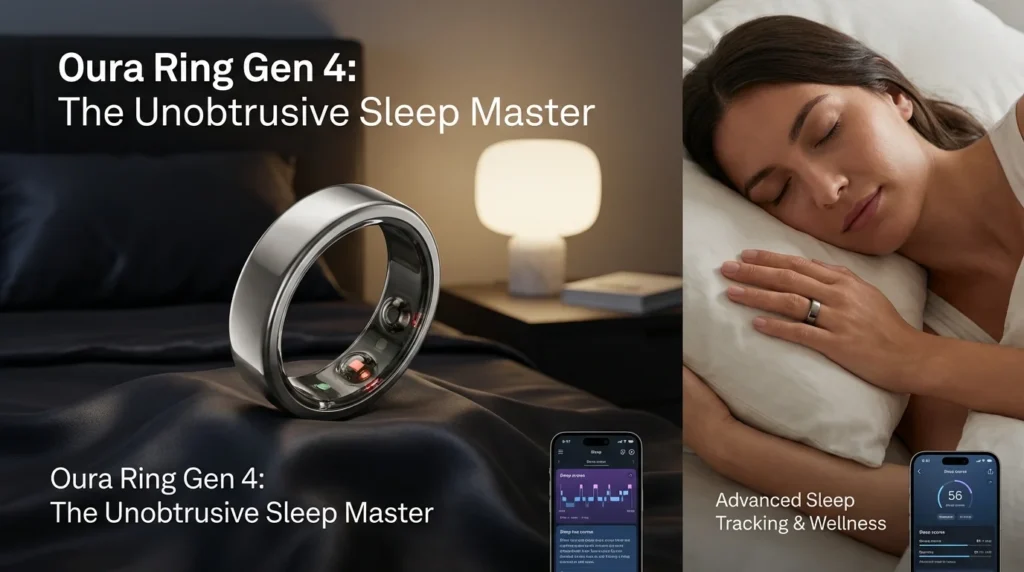
For a lot of guys, wearing a watch to bed is uncomfortable. If you can’t sleep with a watch, you won’t wear it. If you don’t wear it, you get no HRV data.
The Oura Ring Gen 4 solves this. It’s a sleek titanium ring that packs medical-grade sensors to track your pulse rate, HRV, body temperature, and blood oxygen saturation.
Because the blood vessels in your finger are closer to the surface than the vessels in your wrist, Oura actually gathers higher-fidelity nighttime data than most smartwatches.
The caveat? Do not lift weights wearing an Oura ring. Metal knurling on barbells will destroy the ring, and wearing rings during heavy lifts risks a “degloving” injury (don’t Google it, just trust me).
With Oura, you leave it in your gym bag, rely entirely on its world-class sleep data for recovery, and pair a standard chest strap to your phone if you want intra-workout cardiovascular data.
Why it rocks for lifters:
- Elite Sleep Architecture: Finger sensors provide higher fidelity nighttime sleep data than bulkier wrist wearables.
- Unobtrusive Design: No heavy watch face to mess with your sleep position. Put it on and forget it’s there.
- HRV Master: Tracks your nightly HRV baseline flawlessly so you know your CNS status before you even drink your pre-workout
Table 2: The 2026 Heavy Hitters Comparison
| Device | Best Feature for Lifters | The Main Drawback | Ideal Wear Setup |
| Garmin Fenix 8 | Training Readiness Score & Chest Strap Pairing | Bulky, expensive | 24/7 Wear + Chest strap during lifts |
| Whoop 5.0 | Bicep-band compatibility (bypasses wrist errors) | Subscription fee required | Bicep band during day/gym, wrist at night |
| Oura Ring Gen 4 | Elite sleep & temperature tracking | Must remove during weightlifting | Worn 24/7 (Except during the workout) |
Tracking Your Sleep vs. Stress vs. Hormones
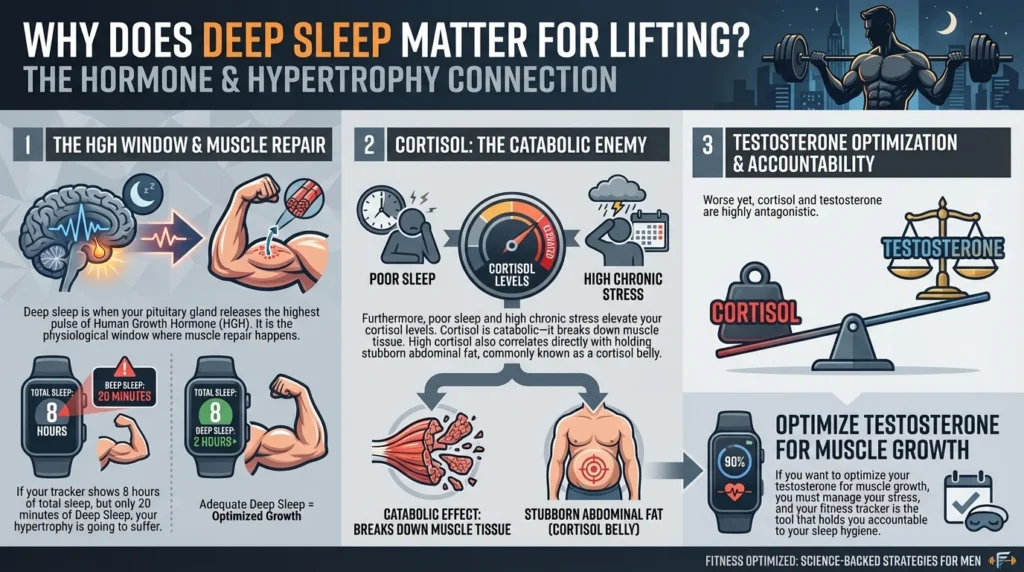
You don’t grow muscle in the gym. The gym is just the stimulus; it is the place where you tear muscle fibers down.
You only grow muscle in your bed, while you are sleeping. Understanding the importance of rest and recovery is the line in the sand between guys who make progress and guys who spin their wheels for years.
When evaluating the best fitness trackers in 2026, sleep tracking accuracy is paramount. A good tracker will map your cycles through Light Sleep, Deep Sleep (Slow Wave Sleep), and REM sleep.
Why does this matter for lifting?
Deep sleep is when your pituitary gland releases the highest pulse of Human Growth Hormone (HGH). It is the physiological window where muscle repair happens. If your fitness tracker shows that you are getting 8 hours of total sleep, but only 20 minutes of Deep Sleep, your hypertrophy is going to suffer.
Furthermore, poor sleep and high chronic stress elevate your cortisol levels. Cortisol is catabolic—it breaks down muscle tissue. High cortisol also correlates directly with holding stubborn abdominal fat, commonly known as a cortisol belly.
Worse yet, cortisol and testosterone are highly antagonistic. If you want to optimize your testosterone for muscle growth, you must manage your stress, and your fitness tracker is the tool that holds you accountable to your sleep hygiene.
✅ Your 24-Hour Action Plan
- Step 1: Ditch the obsession with wrist-based calorie counts. If you are lifting, assume the calorie burn is wrong. Stop eating back your calories based on watch data.
- Step 2: Check your HRV every morning before your feet hit the floor. Use this number to determine your training intensity for the day.
- Step 3: Invest in a chest strap monitor (like the Polar H10 or Garmin HRM), pair it with your phone or watch, and then ignore the screen while you lift. Let it record the data in the background so you can review your cardiac strain and rest intervals after the session.
How to Bulletproof Your Wearable Data
If you want to get the absolute most out of the best fitness trackers in 2026, you need to understand how to calibrate your life around the data. Tech is only as good as the human interpreting it.
First, establish a baseline. When you buy a new device like a Garmin or a Whoop, it doesn’t know you. It takes about 14 to 21 days for the algorithm to establish your personal baseline for resting heart rate, HRV, and sleep architecture.
During this three-week window, train normally, but do not make radical changes to your program based on the watch’s early warnings. It is still learning what “normal” looks like for your specific physiology.
Second, respect the chest strap. I’ve mentioned it several times, but it bears repeating. If you want flawless data on your rest periods, your maximum heart rate during a heavy set of squats, and accurate cardiovascular strain, buy a $90 Bluetooth chest strap.
The chest strap relies on electrocardiography (ECG)—it measures the actual electrical signals of your heart, completely unaffected by forearm flexing or grip strength. Pair the strap to your smartwatch via Bluetooth before your workout, and let the strap do the heavy lifting while the watch acts as the display.
Finally, remember that you are an organism, not an algorithm. If your fitness tracker says you are 100% recovered, but your joints ache, you feel lethargic, and the barbell feels twice as heavy as it should—listen to your body.
Conversely, if you wake up with a poor recovery score because you had a restless night, but you get to the gym and the weights feel light, do not hold yourself back. Tech informs the plan; the warmup dictates the reality.
In 2026, the era of step-counting pedometers is dead. We are in the era of physiological optimization. Choose your tech wisely, track what matters, and get back under the bar.
Frequently Asked Questions About Best Fitness Trackers in 2026
What are the best fitness trackers in 2026 for heavy weightlifting?
The best trackers for weightlifting focus on recovery metrics rather than just heart rate during the lift. Top choices include the Garmin Fenix 8 series (for its Training Readiness score and chest strap compatibility), the Whoop 5.0 (worn on the bicep to avoid wrist interference), and the Oura Ring Gen 4 (for elite nighttime recovery data).
Why does my fitness tracker lose my heart rate when I lift weights?
Most fitness trackers use optical sensors on the wrist. When you grip a dumbbell or barbell heavily, the muscles in your forearm contract, temporarily restricting blood flow to the wrist area. This prevents the optical sensor from accurately reading your pulse, often resulting in artificially low heart rate readings.
What is Heart Rate Variability (HRV) on a fitness tracker?
Heart Rate Variability (HRV) is the variance in time between your heartbeats. A higher HRV indicates that your nervous system is relaxed and recovered, meaning you are primed for a hard workout. A low HRV indicates stress, fatigue, or impending illness, signaling that you should take a rest day or focus on active recovery.
Can a fitness tracker tell me if I am overtraining?
Yes, high-end fitness trackers in 2026 use a combination of resting heart rate (RHR), HRV, and sleep architecture to warn you of overtraining. If your RHR is consistently elevated and your HRV is plummeting over a multi-day trend, it is a strong physiological indicator that your central nervous system is overtaxed and you are nearing overtraining syndrome.
Should I wear a smartwatch or use a chest strap for the gym?
For the best results, you should use both in a hybrid system. Wear a high-quality smartwatch or fitness band 24/7 to track your sleep, daily steps, and recovery metrics. During your actual weightlifting session, pair a Bluetooth/ANT+ chest strap monitor to your watch to get flawless heart rate data that isn’t disrupted by your grip on the barbell.
Disclaimer: The information provided in this article is for educational purposes only and is not intended as a substitute for advice from your physician or other health care professional.