


Let’s be honest: most cutting workout plans are a mess. You find a template online, it tells you to lift light weights for high reps to “tone up,” and then it leaves you starving and weak after three weeks.
You might lose some weight, but you look in the mirror and realize you just look like a smaller, softer version of yourself. That isn’t a “cut”—that’s just a slow-motion car crash for your metabolism.
If you want to actually look like you lift, you need a Cutting Workout Plan that respects the science of muscle preservation. You don’t just want to lose weight; you want to peel back the layers of fat while holding onto every ounce of muscle you’ve worked so hard to build.
In this guide, we aren’t just giving you a workout list. We are giving you a system. You’ll learn how to customize your split, how to eat so you don’t lose your mind (or your gains), and—most importantly—how to transition back to normal life without blowing up like a balloon.
Key Takeaways for a Successful Cut
- Deficit is King: You cannot lose fat without a calorie deficit. Period.
- Lift Heavy: Your workout’s primary job during a cut is to signal your body to keep muscle, not burn it.
- Protein is Your Shield: High protein intake is the most important nutritional variable for muscle retention and satiety.
- Cardio is a Tool: Use it to increase your deficit, but don’t let it interfere with your recovery from lifting.
- The Exit Strategy Matters: Most cuts fail because there is no plan for what happens after the diet ends. We’ll fix that with reverse dieting.
🔥 The “Keep Your Gains” Checklist
Before you start your first session, make sure these four pillars are in place:
- ✅ Calorie Deficit: Aim for 300-500 calories below maintenance.
- ✅ Protein Target: Aim for 0.8g – 1.2g of protein per pound of body weight.
- ✅ Strength Focus: Try to maintain or increase your strength on compound lifts.
- ✅ Sleep: Get at least 7-9 hours. Recovery is much harder in a deficit.
Part 1: The Science of a Smart Cut (The Unbreakable Rules)
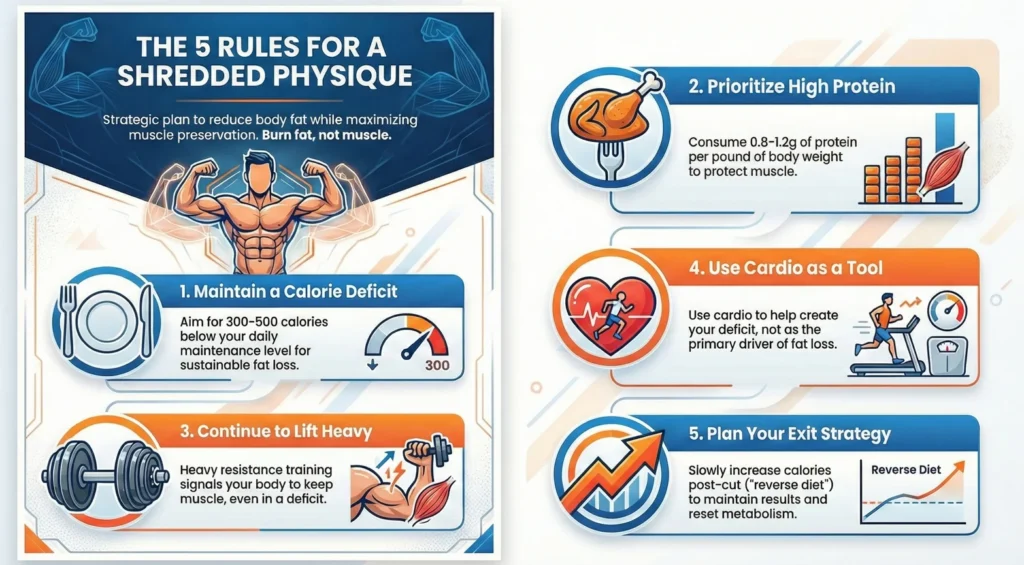
A Cutting Workout Plan is different from a general weight loss plan. When most people say they want to lose weight, they usually mean they want to lose fat. But if you aren’t careful, a large chunk of that weight loss can come from your muscle tissue.
Your body is a survival machine; in a calorie deficit, it sees muscle as “expensive” tissue that requires a lot of energy to maintain. If you don’t give it a reason to keep that muscle, it will burn it for fuel.
What is a Cutting Phase, Really? (It’s Not Just “Weight Loss”)
To “cut” means to strategically reduce body fat while maximizing muscle preservation. This requires a fine balance. You need enough of a calorie deficit to trigger fat loss, but enough stimulus (lifting) and fuel (protein) to prevent muscle breakdown.
Most people fail because they treat their body like a math equation and forget that it’s a biological system. If you drop your calories too low, your body doesn’t just “burn fat faster.” It panics. It lowers your heart rate, slows your digestion, and makes you so tired that you stop moving spontaneously. This is why “starvation diets” always backfire.
According to the American College of Sports Medicine (ACSM), a sustainable rate of fat loss is roughly 0.5% to 1% of your body weight per week. If you weigh 200 pounds, that’s 1-2 pounds a week. Any faster than that, and you’re likely losing muscle or just setting yourself up for a massive metabolic rebound.
The 4 Non-Negotiable Principles for Muscle Retention
If you want to succeed, you have to follow these four rules. They aren’t suggestions; they are the laws of physics for your physique.
- The Calorie Deficit: This is the engine. You can have the best workout in the world, but if you eat more than you burn, you won’t lose fat. A moderate deficit of 300-500 calories is usually the “sweet spot” where you lose fat but keep your energy levels high enough to train hard.
- Prioritize High Protein: Protein does three things during a cut. It builds and repairs muscle, it keeps you full (satiety), and it has a high “thermic effect,” meaning your body burns more calories just digesting it compared to fats or carbs. You should be checking out our best protein powders to help hit your targets safely.
- Resistance Training is Your Signal: Stop believing the myth that you need “high reps for definition.” Definition comes from having low body fat and underlying muscle. To keep that muscle, you must lift heavy. If you find your recovery is lagging despite high protein, you might look into what peptides increase testosterone or the best peptide for muscle growth to see how modern science can support muscle retention during a deficit.
- Strategic Cardio is a Tool: Cardio is great for your heart, but during a cut, its main job is to help you reach your calorie deficit without having to starve yourself. However, too much cardio can interfere with your recovery from lifting. Think of it as a support player, not the star of the show.
Part 2: Build YOUR Perfect Cutting Workout Plan
One of the biggest common fitness mistakes men make is picking a plan that doesn’t fit their life. If you have a high-stress job and three kids, a 6-day “pro” bodybuilder split is going to crush you. You need a plan that is flexible and scales with your schedule.
Step 1: Choose Your Weekly Workout Split
Your “split” is just how you organize your training throughout the week. The best split is the one you can stick to consistently, even when work gets busy or your kids get sick.
Option A: The 3-Day Full Body Split
Best for: Beginners, busy professionals, or anyone who can only commit to 3 gym days.
In this split, you hit every major muscle group every time you walk into the gym. Because you have a full day of rest between sessions, you can keep the intensity very high. This is incredibly effective for maintaining muscle because the frequency of “protein synthesis” is kept high throughout the week.
Option B: The 4-Day Upper/Lower Split
Best for: Intermediate lifters who want a balance of volume and recovery.
This is the “Gold Standard” for many. You do two upper body days and two lower body days. This allows you to include more “accessory” work for specific areas (like arms or calves) without making your workouts three hours long. It also ensures that your legs have 48-72 hours to recover before you blast them again.
Option C: The 5-Day Push/Pull/Legs (PPL) Split
Best for: Experienced lifters with high recovery capacity and a flexible schedule.
This split allows for the highest amount of volume. You have a “Push” day (chest, shoulders, triceps), a “Pull” day (back, biceps), and a “Legs” day. This is great for guys who want to really focus on muscle “sculpting” during their cut, but it requires you to be very on top of your sleep and nutrition.
Step 2: Select Your Key Exercises & Program Reps/Sets
You want to build your plan around compound movements. These are exercises that use multiple joints and muscle groups at once. They give you the biggest “bang for your buck.”
The Hierarchy of Movements:
- Knee Dominant: Squats, Lunges, Step-ups.
- Hip Dominant: Deadlifts, RDLs, Kettlebell Swings.
- Horizontal Push: Bench Press, Push-ups.
- Horizontal Pull: Rows (Barbell, Dumbbell, Cable).
- Vertical Push: Overhead Press.
- Vertical Pull: Pull-ups, Chin-ups, Lat Pulldowns.
For your compound lifts, stick to 3-4 sets of 6-10 reps. For accessory movements (like curls or lateral raises), you can go a bit higher, around 2-3 sets of 10-15 reps.
Exercise Substitution Table
If you can’t do a specific lift because of an injury or lack of equipment, use this table to find a high-quality alternative.
| Primary Lift | Tier 1 Alternative | Tier 2 Alternative |
| Barbell Squat | Goblet Squat | Leg Press |
| Deadlift | Trap Bar Deadlift | Romanian Deadlift |
| Bench Press | Dumbbell Press | Weighted Push-ups |
| Overhead Press | Dumbbell Shoulder Press | Landmine Press |
| Barbell Row | One-Arm Dumbbell Row | Seated Cable Row |
The Complete 4-Day Upper/Lower Cutting Template
This is our recommended starting point for most men. It provides enough frequency to maintain muscle but enough rest to keep your cortisol levels in check. Check out our strength training basics if you need a refresher on form.
Upper Day A (Monday)
| Exercise | Sets | Reps | Rest |
| Barbell Bench Press | 3 | 6-8 | 120s |
| Weighted Pull-ups | 3 | 8-10 | 90s |
| Dumbbell Overhead Press | 3 | 10-12 | 90s |
| Seated Cable Row | 3 | 10-12 | 60s |
| Face Pulls | 2 | 15-20 | 60s |
Lower Day A (Tuesday)
| Exercise | Sets | Reps | Rest |
| Barbell Squat | 3 | 6-8 | 120s |
| Romanian Deadlift | 3 | 8-10 | 90s |
| Leg Press | 3 | 12-15 | 60s |
| Leg Curls | 2 | 12-15 | 60s |
| Standing Calf Raises | 3 | 15-20 | 60s |
Repeat the logic for Upper B and Lower B on Thursday and Friday, swapping your primary movements (e.g., swapping Barbell Squat for Trap Bar Deadlift).
🛠️ The Progressive Overload Rule
Even on a cut, you must try to progress. If you lifted 200 lbs for 8 reps last week, try for 9 reps this week. Or try 205 lbs. If you just “go through the motions” because you’re in a deficit, your body will realize it doesn’t need that muscle to survive. Fight for every rep.
Learn More About OverloadStep 3: Add Cardio Strategically
Don’t just jump on a treadmill for an hour every day. That’s a great way to burn out and drive your hunger through the roof. Instead, use a mix of LISS (Low-Intensity Steady State) and HIIT (High-Intensity Interval Training).
- LISS: Think incline walking or a brisk stroll. It’s easy to recover from and burns calories without spiking your appetite or making you feel “trashed.” Aim for 2-3 sessions of 30-45 minutes. Walking 10,000 steps a day is the most underrated “cardio” there is.
- HIIT: Think sprints or kettlebell swings. It’s intense and time-efficient, but it takes a toll on your central nervous system. Limit this to 1 session of 15-20 minutes initially.
If you’re feeling extra tired or your main lifts (Squat/Bench) are stalling, drop the HIIT first. You can always check our guide on home cardio exercises for more low-impact ideas.
Part 3: Fueling Your Cut: Essential Nutrition & Supplement Guide
You can’t out-train a bad diet. During a cut, your nutrition is what determines whether that scale moves. But more importantly, it determines what is moving—fat or muscle.
Setting Your Cutting Calories & Macros
Most men will find success by taking their body weight (in lbs) and multiplying it by 11-13. This is your “Starting Deficit.”
- Protein: 1g – 1.2g per lb of body weight. This is higher than what most “health” sites suggest, but you’re an athlete in a deficit. You need more protein to protect your muscle tissue.
- Fat: 0.3g – 0.4g per lb of body weight. You need this for hormone production, including testosterone.
- Carbs: The rest of your calories. Carbs are your fuel for the gym; they spare muscle protein and give you the energy to actually lift heavy.
If you’re worried about hormonal decline during a long cut, some guys look into testosterone boosters or specific ingredients that boost testosterone like Vitamin D and Zinc to help maintain their hormonal baseline.
Managing Hunger and Cravings: The Psychological Game
Cutting is 20% mechanics and 80% psychology. Your brain is going to try to convince you to eat. You have to outsmart it.
- High-Volume Eating: Swap calorie-dense foods for high-volume ones. Instead of a handful of nuts (200 calories), eat two entire cucumbers and a bowl of spinach (50 calories). Your stomach feels full, which signals your brain to turn off the hunger alarm.
- The Caffeine Window: Use caffeine strategically. A cup of black coffee at 2 PM can kill a mid-afternoon craving and power you through a late-day workout. Just don’t overdo it, or you’ll ruin your sleep.
- Sleep is a Fat Burner: When you are sleep-deprived, your body spikes a hormone called Ghrelin (the hunger hormone) and lowers Leptin (the “I’m full” hormone). If you want to stay on your diet, you must sleep.
Part 4: Female-Specific Guidance for Cutting
While the physics of fat loss are the same, women have different hormonal considerations. A prolonged, aggressive calorie deficit can disrupt the menstrual cycle and bone density.
- Don’t Go Too Low: Women should rarely drop below 1,200 calories without medical supervision.
- Cycle Syncing: Many women find that they are stronger and can handle more intensity during the first two weeks of their cycle (follicular phase) and need more recovery and higher calories during the last week (luteal phase) when hunger naturally spikes.
- Focus on Iron and Calcium: Nutrient density is even more critical when calories are restricted.
Part 5: Life After the Cut: How to Keep The Fat Off For Good
This is the most important part of this article. This is the “Knowledge Gap” that most sites ignore. You finish your 12-week cut, you’ve got abs, and you’re thrilled. So you go out for a massive celebratory meal. Then you keep eating like that for a week. Suddenly, you’re up 12 pounds.
This is the “rebound,” and it happens because your metabolism has “down-regulated” (slowed down) during the cut. To fix this, you need a Reverse Dieting Protocol.
The Ultimate Guide to Reverse Dieting
Reverse dieting is the process of slowly and strategically increasing your calories back to maintenance levels. This allows your metabolism to “catch up” without storing a massive amount of fat.
- Week 1-2: Add 100-150 calories back into your daily total, mostly from carbohydrates. Keep your protein target exactly where it was.
- Assess: Did your weight stay stable? A 1-2 pound increase is usually just water weight and glycogen returning to the muscles. This is good.
- Week 3-4: Add another 100-150 calories.
- The Goal: Continue this until you reach a calorie level where you are feeling energetic and strong in the gym, but your body fat remains stable.
By doing this, you “teach” your body to handle more food again. It’s the difference between a temporary transformation and a permanent lifestyle change.
🛑 The Plateau-Busting Checklist
If the scale hasn’t moved for 14 days, don’t panic. Go through this list in order:
- Check Your Tracking: Are you “eyeballing” portions or forgetting about the cream in your coffee? Use a food scale for three days to be 100% sure.
- Increase Your NEAT: Are you sitting more because you’re tired? NEAT (Non-Exercise Activity Thermogenesis) can drop by 500 calories a day when you’re dieting. Get moving.
- Add 10 Mins of LISS: Small, incremental changes are better than massive calorie cuts.
- The “Diet Break”: If you’ve been cutting for 12+ weeks, eat at maintenance for one full week. This lowers stress, resets leptin, and often triggers a “whoosh” of weight loss.
Cutting Workout Plan: Frequently Asked Questions (FAQ)
Should I lift lighter with more reps when cutting?
No. This is one of the oldest myths in the book. High reps don’t “burn” fat off a specific muscle. Lifting heavy is what tells your body to keep the muscle you have. Stick to the 6-12 rep range for your main lifts.
How long should my cutting phase last?
Most successful cuts last between 8 to 16 weeks. If you go longer than that, “diet fatigue” sets in, your hormones take a hit, and your adherence usually falls off a cliff.
Can I build muscle while cutting?
If you are a beginner, have a high body fat percentage, or are returning from a long break, yes (this is called body recomposition). For experienced lifters, the goal is usually muscle maintenance.
What should I do if I have a “cheat meal” and blow it?
Do nothing except get back on the plan. Don’t try to “starve” yourself the next day or do two hours of cardio to “make up for it.” That starts a cycle of disordered eating. Just go back to your scheduled deficit.
I’m a home-gym user. Can I do this with just dumbbells?
Absolutely. Use the “Exercise Substitution Table” above. Many of the best compound movements (Goblet Squats, DB Presses, Lunges) can be done with minimal equipment. Check our guide on effective home workout routines for more.
Conclusion: Your Blueprint for a Shredded Physique
Building a Cutting Workout Plan isn’t about doing more; it’s about doing better. It’s about being precise with your training, disciplined with your plate, and smart with your recovery.
You now have the tools. You have the workout split, the exercise substitutions, the nutrition framework, and the secret weapon: the reverse diet. Most guys will stop at the “losing weight” part. They’ll get lean, then they’ll get fat again, and they’ll spend their lives in a cycle of frustration.
Don’t be that guy. Use this system to peel back the fat, show off the muscle you’ve built, and stay that way. It’s time to get to work.
Infographic Prompt:
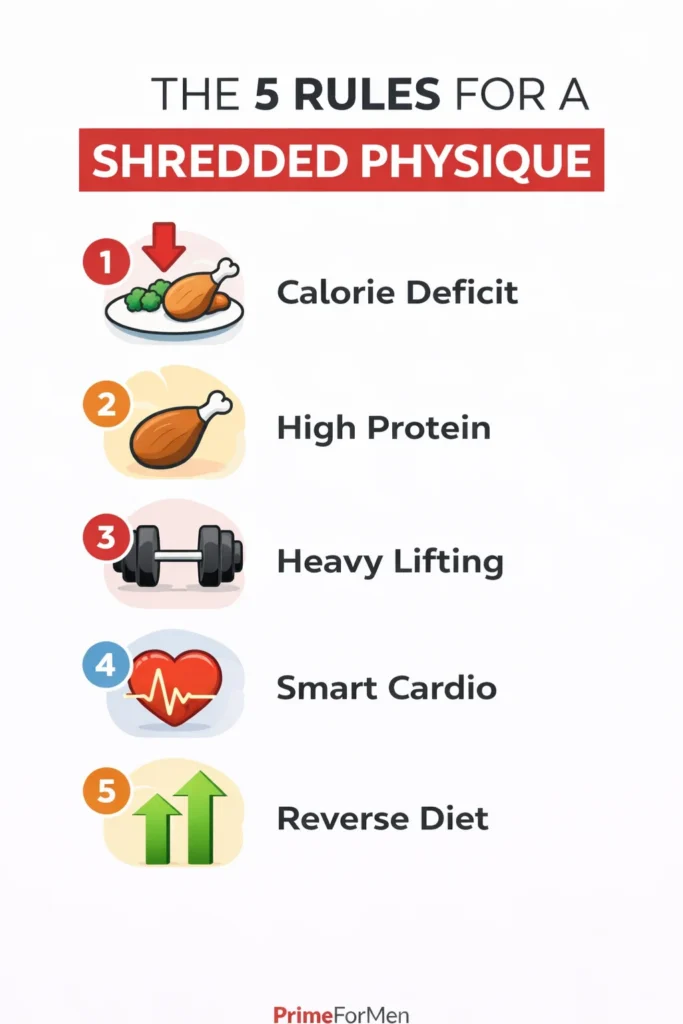
A 9:16 vertical infographic titled ‘THE 5 RULES FOR A SHREDDED PHYSIQUE’. Modern vector illustration style. 1. Calorie Deficit (plate icon), 2. High Protein (chicken leg icon), 3. Heavy Lifting (dumbbell icon), 4. Smart Cardio (heart icon), 5. Reverse Diet (upward arrow icon). Clear, vibrant colors and minimal text.