
I remember the exact moment I realized my digital workout routine was a complete joke. It was late 2020. The gyms were locked down, the iron was gathering dust, and like millions of other guys, I panicked and bought into the hype of home workout apps.
I found myself in my living room, paying $39 a month to watch an incredibly energetic instructor yell at me while I did mountain climbers and burpees to a curated EDM playlist.
TL;DR: The Quick Hits
- Entertainment vs. Programming: Most popular fitness apps are designed to make you sweat, not to make you strong. You need a platform built around algorithmic progression, not just a smiling instructor.
- The Golden Rule: If an app doesn’t force you to track your weights, sets, and reps from week to week, cancel it immediately.
- AI is the New Coach: Algorithmic coaching platforms (like JuggernautAI) have completely changed the game, auto-regulating your volume based on daily readiness and biometric data.
- Integration is Key: The best platforms don’t exist in a vacuum; they pull data from your wearables to adjust your training loads dynamically.
I was sweating. I was tired. But after eight weeks, I looked in the mirror and realized my shoulders were shrinking, my bench press strength was evaporating, and I was basically doing glorified aerobics.
Here is the hard truth that the fitness tech industry doesn’t want you to know: sweating does not equal muscle growth. Fatigue is not the same thing as getting stronger. Most of the highly marketed fitness streaming platforms are designed for generalized weight loss and “wellness.”
They are built to entertain you, to make you feel like you did something hard, and to keep your subscription active. They are entirely devoid of the one non-negotiable law of physical adaptation: progressive overload.
If you are a man trying to build serious muscle, optimize your testosterone levels, and push heavy weight, 90% of the apps on the market are a waste of your time and money.
In this guide, we are cutting through the fluff. We are going to break down the digital platforms that actually understand hypertrophy, periodization, and raw strength. If you want to stop doing jumping jacks in your living room and start building a physique that commands respect, keep reading.
🏃♂️ The Prime Perspective
I’ve tested dozens of these digital programs over the last five years. The biggest mistake I see guys make is confusing “feeling wrecked” with “having a productive workout.” Any idiot can design a workout that makes you puke—just do 100 burpees for time. But a program that adds 20 pounds to your squat while keeping your joints healthy? That requires real periodization. Don’t pay a monthly fee just to be tired; pay for a roadmap to get strong.
Why Most Fitness Streaming Platforms Fail Men
If you look at the top-rated apps on the iOS or Android stores, you’ll see a common theme. They rely heavily on Video on Demand (VOD) vs. Linear Streaming classes. You log in, pick a 30-minute high-intensity class, and follow along.
Here is the fundamental problem: these platforms treat every workout as an isolated event.
The Illusion of High-Intensity
Most commercial platforms lean heavily into High-Intensity Interval Training (HIIT). HIIT is fantastic for cardiovascular conditioning and burning a few extra calories, but it is a terrible primary modality for building muscle mass. When you jump from a generic full-body routine on Monday to a “core blast” on Tuesday and a “plyo burner” on Thursday, you are missing the essential component of hypertrophy programming.
Muscle grows when it is subjected to a stimulus it hasn’t experienced before, forcing adaptation. This means adding weight to the bar, adding reps to the set, or increasing time under tension. If your app doesn’t track what you lifted last week and mathematically compel you to lift more this week, you are running on a hamster wheel.
The Problem with “Follow-Along” Workouts
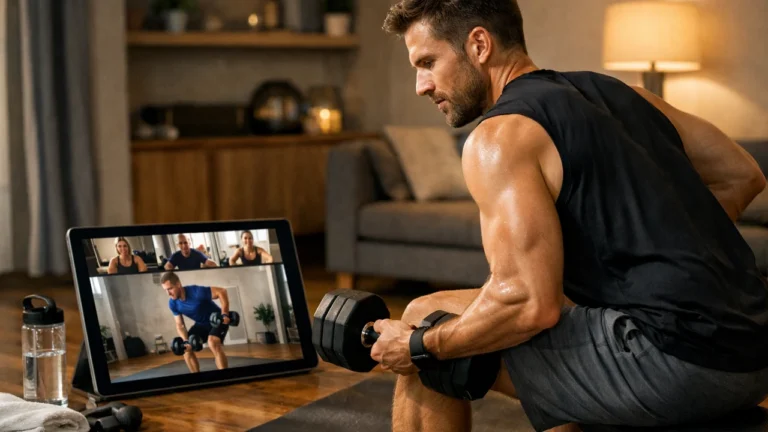
When you follow a live instructor, you are tied to their pacing. This is known as synchronous training. For cardiovascular work (like spinning or rowing), this is highly effective for motivation. But for heavy resistance training, it’s a disaster.
If you are doing heavy Romanian deadlifts, you might need a full three minutes of rest between sets to allow your central nervous system to recover. An instructor on a screen bounding into the next set after 30 seconds is going to force you to drop the weight, turning a strength movement into a sloppy cardio exercise.
This is why asynchronous training—where the app gives you the program and lets you dictate the rest periods—is vastly superior for male strength goals.
💡 What Most Guys Miss
A recent cross-sectional analysis of fitness app users published in the National Institutes of Health found a fascinating data point regarding user retention. Men utilizing apps with specific “muscle gain” goals demonstrated significantly higher long-term adherence (an average of 132 days) compared to users simply aiming for “weight loss.”
Why? Because strength metrics provide tangible, mathematical progression. When you see your numbers go up, you stay hooked. If an app doesn’t show you hard data proving you are stronger than last month, you will eventually abandon it.
Study Reference: Analysis of Training Behavior in Users of a Fitness App
The Core Elements of an Effective Digital Strength Program
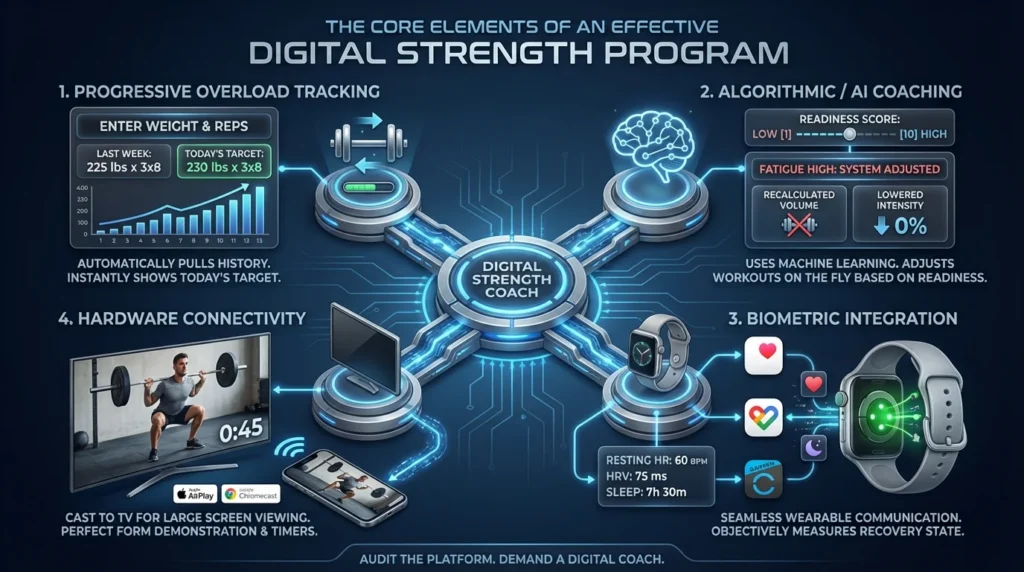
Before you hand over your credit card, you need to audit the platform. A serious fitness platform must act as a digital strength coach, not a cheerleader. Here are the four pillars it must possess.
1. Progressive Overload Tracking
This is non-negotiable. The app interface must prompt you to enter the weight and reps for every single working set. More importantly, it should pull your historical data. When you step up to the bench press, the app should immediately show you: “Last week you did 225 lbs for 3 sets of 8. Today, the target is 230 lbs.” ### 2. Algorithmic / AI Coaching
We are moving past static PDF templates. The best AI-powered fitness apps use machine learning to adjust your workout on the fly. Let’s say you had a terrible night of sleep, or your lower back is tight. An algorithmic platform will ask you for a “readiness score” before the workout begins.
If you report high fatigue, the system instantly recalculates your daily volume, stripping away a few sets or lowering the intensity percentage to prevent overtraining. This is the digital equivalent of a smart coach reading the room.
3. Biometric Integration
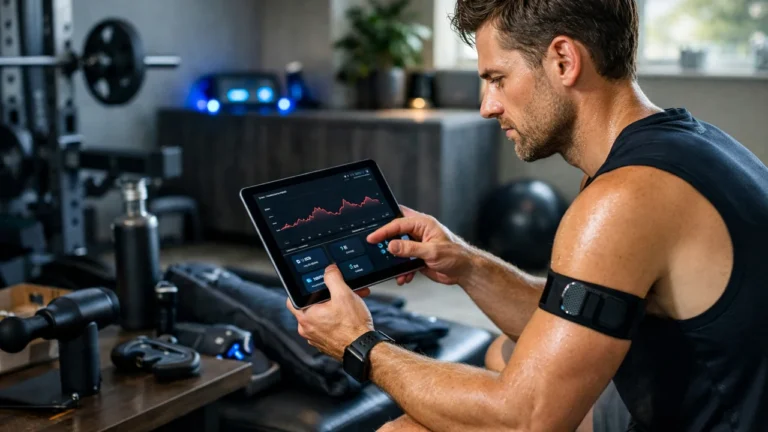
Your app shouldn’t exist in a vacuum. It should seamlessly communicate with your wearable fitness tech. Through Apple HealthKit, Google Fit, or Garmin Connect, your streaming platform should ingest your resting heart rate, heart rate variability (HRV), and sleep data. This biometric integration allows the program to objectively measure your recovery state rather than just relying on how you “feel.”
4. Hardware Connectivity
Nobody wants to squint at a 6-inch phone screen while trying to perfect their barbell squat mechanics. A premium platform must feature a robust cast-to-TV / screen mirroring protocol (like Apple AirPlay or Google Chromecast) so you can project the visual demonstrations and timers onto a large screen in your garage or living room.
Data Breakdown: Evaluating the Platforms
Let’s look at the hard data. We’ve categorized the industry leaders not by how pretty their marketing is, but by how effectively they stimulate male muscle growth and strength adaptation.
Table 1: The Prime Platform Matrix
| Platform Name | Primary Modality | Progressive Overload Capability | Biometric Integration | PrimeForMen Verdict |
| JuggernautAI | Powerlifting / Powerbuilding | Masterclass. Auto-regulates every single set based on fatigue. | Moderate (Relies more on subjective RPE inputs) | Top Pick for Raw Strength. If you want to move heavy iron, this is it. |
| Fitbod | Algorithmic Bodybuilding | High. Learns your strength curve and adjusts daily. | High (Great Apple Health/Watch integration) | Best for General Hypertrophy. Excellent for adapting to whatever gym equipment is available. |
| Centr | Functional / Hybrid | Low to Moderate (More focused on VOD circuits) | Moderate | Best for Beginners. Good holistic approach, but lacks deep strength periodization. |
| Peloton App | Cardio / Muscular Endurance | Zero. No set/rep tracking within the app for strength. | High (Heart rate focus) | Avoid for Hypertrophy. Great for conditioning, terrible for building muscle mass. |
| Athlean-X | Sports Performance | Moderate (Provides the numbers, you track them) | Low | Best for Athleticism. Heavy on biomechanical education, but the tech UI is dated. |
Table 2: The Myth vs. Reality Matrix of Streaming Workouts
| The Claim | The Origin of the Myth | What the Data Actually Says | Practical Adjustment | Relevant Entity |
| “Muscle Confusion builds more mass.” | P90x and early 2000s VOD marketing. | Changing exercises too frequently prevents neurological adaptation and limits load progression. | Stick to the same compound lifts for 6-8 weeks before swapping movements. | Periodization |
| “You need 45 minutes of non-stop movement.” | Group fitness class structures maximizing calorie burn. | Hypertrophy requires adequate rest (2-3 mins) between heavy sets to replenish ATP stores. | Ignore the instructor’s pace. Pause the stream. Rest properly. | Asynchronous Training |
| “Wearables tell you exactly how many calories you burned.” | Tech companies over-promising hardware capabilities. | Wrist-based optical sensors can overestimate caloric expenditure in resistance training by up to 40%. | Use wearables for HRV and resting heart rate, not macro-math. | Biometric Integration |
Deep Dive: The Top Fitness Streaming Platforms for Men
Let’s look at the specific platforms that actually belong in a man’s digital toolkit.
1. JuggernautAI: The Powerlifter’s Brain in Your Pocket
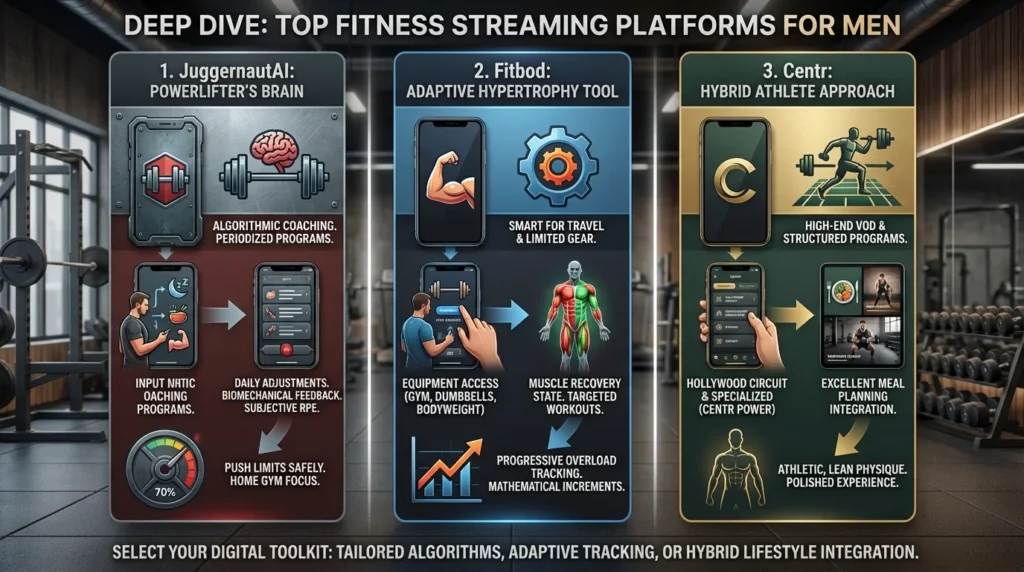
Created by renowned strength coach Chad Wesley Smith, JuggernautAI is less of a “streaming” platform and more of a highly advanced algorithmic coach. You won’t find peppy instructors here. You tell the app your current maxes, your weak points, and how many days a week you want to train. The system builds a deeply periodized program tailored to you.
Before every workout, it asks you a series of questions about your sleep, nutrition, and soreness. It then uses biomechanical feedback and subjective RPE (Rate of Perceived Exertion) to adjust your working weights for the day. If you have a fully equipped home gym, this is the ultimate tool for pushing your limits safely.
2. Fitbod: The Ultimate Adaptive Hypertrophy Tool
Fitbod is arguably the smartest app for guys who travel or have limited equipment. You simply tell the app what gear you have access to—whether it’s a full commercial gym, a pair of adjustable dumbbells, or just your body weight.
The algorithm generates a workout targeting the muscles that are most recovered, based on your previous logged sessions. It visually shows your muscle recovery state on a 3D anatomical model. It excels at progressive overload tracking, constantly nudging your required weights up by small, mathematically sound increments.
3. Centr: The Hybrid Athlete Approach
Created by Chris Hemsworth’s team, Centr bridges the gap between high-end VOD streaming and structured programming. While it leans a bit heavily into the “Hollywood circuit training” vibe, their specialized programs (like Centr Power) actually utilize decent periodization.
It is a highly polished app with excellent meal planning integration, making it a solid choice for a guy who wants to build an athletic, lean physique rather than pure powerlifting bulk.
Escaping Subscription Fatigue: How to Choose Just One
The fitness industry thrives on subscription fatigue. They know that if you sign up for a $14.99/month yoga app, a $19.99/month strength app, and a $12.99/month mobility app, you will likely forget to cancel at least two of them.
You do not need five apps. You need one primary driver for your fitness goals.
If your primary goal is to pack on dense muscle, ditch the VOD cardio platforms. If you are already a strong guy looking to drop body fat and improve cardiovascular capacity, a platform like Peloton or iFit might actually serve you well—but use it strictly for conditioning, not for your primary resistance training.
Look for platforms that offer a comprehensive ecosystem. Fitbod, for example, allows you to dictate recovery sessions alongside heavy lifts. The key is data centralization. When your workouts, your biometrics, and your progression are all housed in one algorithmic brain, the results compound exponentially.
✅ Your 24-Hour Action Plan
- Step 1: Audit your current phone. Delete any fitness app you haven’t opened in 14 days and cancel the recurring subscription immediately. Stop bleeding cash.
- Step 2: Define your primary 90-day goal right now. Is it pure strength (JuggernautAI), aesthetic muscle building (Fitbod), or athletic conditioning (Centr)? Pick one.
- Step 3: Download your chosen platform, take the initial assessment honestly (do not fake your 1-rep maxes), and commit to following the algorithm’s prescribed volume for 4 straight weeks without altering it.
Frequently Asked Questions About Fitness Streaming Platforms
Are fitness streaming platforms effective for building muscle?
They are only effective if the platform utilizes a progressive overload model. If the app just provides randomized daily workouts without tracking your historical weight and rep data, it will not efficiently build muscle mass. You need a platform that acts as an algorithmic coach, not just a video player.
How do algorithmic fitness apps differ from standard streaming apps?
Standard streaming apps provide linear, one-size-fits-all video classes. Algorithmic fitness apps use machine learning to adapt to your specific strength levels, equipment availability, and daily fatigue. They calculate your exact sets, reps, and weights to optimize hypertrophy and prevent overtraining.
Can I use fitness streaming platforms if I only have a home gym?
Absolutely. In fact, many of the best platforms are designed specifically for this. Apps like Fitbod allow you to input your exact home gym inventory (e.g., dumbbells, pull-up bar, kettlebells) and will instantly generate a mathematically optimized workout using only that equipment.
Why is asynchronous training better than live classes for strength?
Live classes force you to adhere to the instructor’s pacing, which is usually fast-paced to keep heart rates elevated. True strength training requires adequate rest periods (often 2-4 minutes) between heavy sets to replenish cellular energy. Asynchronous platforms give you the workout data but allow you to control the clock.
Do I need a wearable device to use these apps effectively?
While not strictly mandatory, biometric integration is a massive advantage. Using a chest strap heart rate monitor or a smartwatch allows the app to pull objective data regarding your resting heart rate and cardiovascular exertion, allowing the AI to adjust your recovery parameters more accurately.
Disclaimer: The information provided in this article is for educational purposes only and is not intended as a substitute for advice from your physician or other health care professional. Always consult with a healthcare provider before beginning any new exercise or fitness program.