
An Off-Season Baseball Strength Program in 2026 isn’t about doing “more.” It’s about doing the right things in the right order so you show up in spring stronger, faster, and harder to break.
Most off-season plans fail for one simple reason: they’re built like generic gym programs… not like a baseball performance system.
This guide fixes that.
You’re getting a 5-phase blueprint, position tweaks (pitcher vs catcher vs infield/outfield), a weekly schedule that doesn’t fry your arm, plus the 2026 upgrades athletes actually use now: simple tracking, smarter recovery, and “auto-regulation” so you push on good days and protect yourself on bad days.
Quick note (safety): This is educational, not medical advice. If you have sharp pain, a recent injury, or you’re a youth athlete with a heavy throwing calendar, get clearance from a qualified sports medicine professional and work with a certified strength coach.
What makes this 2026 blueprint different
Here’s the Unique Value Proposition:
- A phased plan that builds the “engine” first (tissue tolerance + strength) before you chase power.
- Position-specific modifications so you’re not training like someone who plays a different sport.
- A realistic weekly schedule that fits school, work, and skill sessions.
- Tracking that matters: you’ll know if you’re improving before tryouts.
If you want extra supporting reads while you go through this plan, keep these pages open (internal resources from your project source):
- Baseball workouts
- Progressive overload
- Plyometric training
- Unilateral training
- Overtraining syndrome
- Creatine guide
- Electrolytes for athletes
- Strength training at home
The 2026 season is won in the off-season
Baseball is a power sport with a skill problem.
Your skills matter. But if you don’t build the physical base to express those skills—rotation, sprinting, deceleration, and durability—your ceiling stays low.
The off-season is where you:
- add lean mass without being crushed by games
- build max strength without constant travel
- turn that strength into on-field power
- clean up weak links (hips, T-spine, scap control)
- build arm-friendly strength (yes, that’s a thing)
And since it’s 2026, the edge is not “a secret exercise.”
The edge is the system:
- fewer random workouts
- better timing between throwing/hitting and heavy lifting
- smarter recovery
- basic tech + tracking so you stop guessing
Before you lift a single weight: the CEO mindset & the baseline assessment
If you don’t measure, you’re guessing.
You’re not “working hard.” You’re just doing activity.
Step 1: Become the CEO of your baseball career
Think of your development like a business. You have departments:
- Strength & Power (weight room + jumps + med ball)
- Skill (throwing, hitting, fielding)
- Recovery (sleep, nutrition, mobility)
- Durability (arm care, tissue tolerance, load management)
Your job is to run all of them.
Step 2: The non-negotiable assessment protocol
You don’t need a lab. You need consistency.
Track:
- Throwing velocity (radar gun if possible)
- Exit velocity (or best proxy you can access)
- Broad jump (lower body power)
- 10-yard split (first-step speed)
- Estimated 1RM trend on 1–2 main lifts (trap bar deadlift and a press are enough)
- Mobility quick checks: hip internal rotation, thoracic rotation, shoulder flexion
Why this matters: your body adapts to what you can recover from. The tests keep you honest.
Off-season assessment scorecard
Module 1: Your 2026 high-tech toolkit (without blowing your budget)
Tech is useful only if it changes decisions.
In 2026, the best athletes use tracking to answer 3 questions:
- Am I recovered enough to push today?
- Is my power going up or down?
- Is my throwing/hitting workload matching my lifting plan?
Velocity-based training (VBT) — the simple version
VBT is just measuring bar speed.
- If the bar is moving fast, you’re ready.
- If the bar speed tanks, you don’t force it. You adjust.
That’s how you build power while protecting your nervous system.
You don’t need a VBT device, but if you want more modern tools:
Budget tiers (so you don’t overthink this)
- $0 tier: notebook + phone camera + stopwatch + readiness rating (1–5)
- $100 tier: occasional radar access + jump app + basic heart rate monitor
- $500+ tier: recovery wearable + VBT device + swing/pitch sensors
If you consistently track anything, you beat the athlete who tracks nothing.
Module 2: Winning the Off-Season Between the Ears (Mental Game)
Here’s the truth most athletes hate hearing:
If you can’t follow a plan for 16 weeks, you don’t have a “program problem.”
You have a discipline problem.
And that’s why the mental game is a massive knowledge gap online. Everyone sells exercises. Almost nobody teaches you how to execute when motivation drops.
Step 1: Set process goals (not fantasy goals)
Outcome goals are fine. But they don’t control your day.
Use this simple setup:
- 1–2 outcomes (what you want): “+3 mph,” “+5 mph exit velo,” “add 10 lb lean mass.”
- 3 processes (what you do): “Never miss 3 lifts in a row,” “hit protein 6 days/week,” “sleep 8 hours 5 nights/week.”
If you want a simple habit framework, these internal guides help:
Step 2: Build a daily routine you can actually keep
A routine that fits your life beats a “perfect plan” you quit.
Use this template and adjust the times:
| Time block | What you do | Why it matters |
|---|---|---|
| Morning | Protein + hydration + 5 min mobility | You start the day like an athlete |
| After school/work | Skill session (throw/hit/field) | High-quality reps while fresh |
| Later | Lift session (strength or power) | You build the engine |
| Night | 10 min reset (stretch + breathing) | Recovery = progress |
If you’re mentally cooked, don’t force a hero workout. Do a reset session:
- 10–20 min walk
- 5–10 min mobility
- 5 min breathing
That still counts. It keeps the chain unbroken.
Step 3: “If-Then” planning (the cheat code)
Most athletes fail because life happens.
So decide in advance:
- If I get stuck late at work, then I do a 25-minute minimalist workout.
- If I sleep under 6 hours, then I cut volume 20% and keep technique clean.
- If my shoulder feels sharp pain, then I stop and get assessed.
This is how pros stay consistent.
Step 4: 5-minute visualization script (use it before bed)
This sounds “soft” until you do it and it works.
- Close your eyes. Breathe slow for 30 seconds.
- Visualize your best throw or swing for 60 seconds.
- Visualize the process for 2 minutes: warm-up, focus, execution.
- Visualize pressure: tryout, crowd, fatigue — you stay calm.
- End with one sentence: “Tomorrow I execute the plan.”
If you want more nervous-system tools, this internal read is useful:
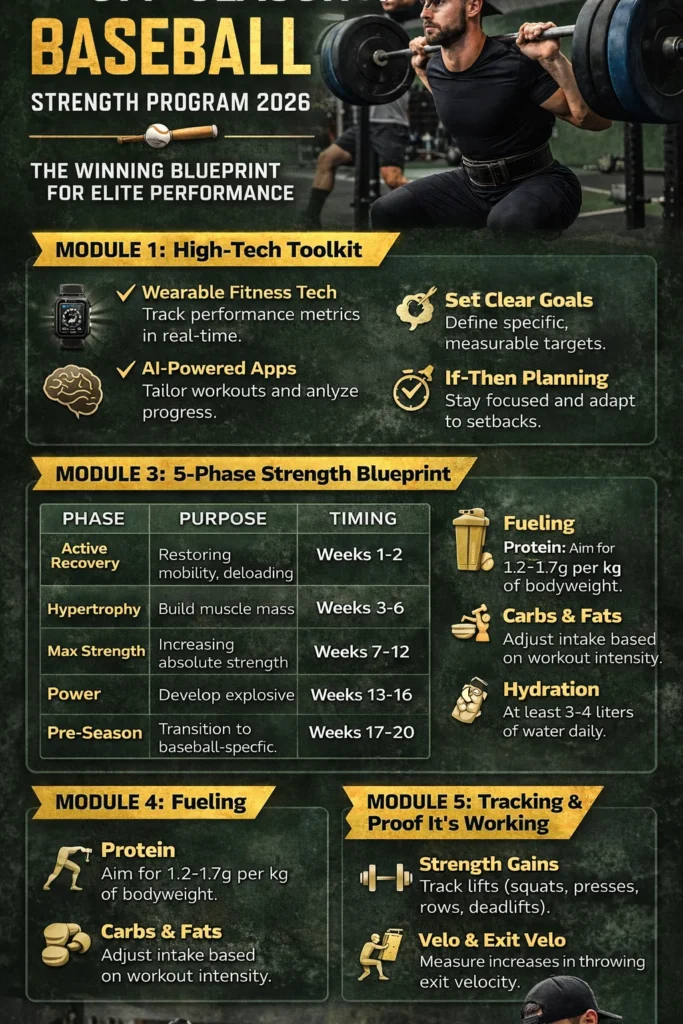
Module 3: The Off-Season Baseball Strength Program in 2026: The 5-phase blueprint
Most athletes train “hard” all off-season. Same intensity. Same style.
That’s not a plan. That’s a coin flip.
A real off-season has phases. Each phase has a job.
The 5 phases at a glance
| Phase | Length | Primary goal | What you should feel | Biggest mistake |
|---|---|---|---|---|
| 1. Regenerate | 2–4 weeks | Heal + restore range | Better each week | Jumping back into max effort |
| 2. Foundation | 4–6 weeks | Build muscle + work capacity | Pumps, mild soreness | Turning every workout into cardio |
| 3. Max Strength | 4–6 weeks | Build force (the engine) | Heavy, crisp reps | Grinding reps / rushing sets |
| 4. Power Conversion | 4–6 weeks | Turn strength into speed | Fast, explosive | Too much volume, slow intent |
| 5. Preseason Bridge | 2–3 weeks | Maintain + arrive fresh | Springy, not tired | PRs right before tryouts |
Position-specific modifications (quick cheat sheet)
Most online programs treat every athlete the same. That’s lazy.
Use this layer on top of the phases:
| Position | Your #1 Priority | Your #2 Priority | What to Limit |
| Pitcher | Scap + cuff endurance, upper-back strength | Rotational power + decel control | Excessive pressing volume and junk throws |
| Catcher | Hip mobility + adductor strength | Single-leg strength + trunk stiffness | Too much knee-banging jump volume |
| Infield | First-step speed + lateral power | Single-leg strength + rotation | Slow, grindy conditioning |
| Outfield | Sprint speed + elasticity | Deceleration + change-of-direction | Heavy lower volume near speed days |
Now let’s run the phases.
Phase 1: Regenerate (2–4 weeks)
This phase is where strong seasons are built.
If you’re coming off a long year of throwing, sliding, and travel… your tissues need a reset.
Goals:
- reduce accumulated fatigue
- restore shoulder + hip motion
- fix nagging tightness
- build “movement quality” before load
Do this 3–4 days/week:
- zone 2 cardio: 20–30 minutes
- mobility flow: hips, T-spine, ankles
- light full-body circuit (bodyweight + bands)
- easy med ball patterns (low skill, low intensity)
Pitcher rule: if your arm feels “hot” after you rest, that’s a sign you needed this phase.
Phase 2: Foundation (4–6 weeks)
This is where you build the base that lets you handle real strength work.
Goal: Put on quality tissue and build work capacity.
Rep zone: mostly 6–12 reps.
Key categories:
- squat pattern
- hinge pattern
- horizontal push/pull
- vertical pull
- unilateral leg strength
- trunk: anti-rotation + carries
Sample Foundation Day (full body):
- Goblet squat: 4×10
- DB bench press: 4×10
- 1-arm row: 4×10/side
- Bulgarian split squat: 3×8/side (Bulgarian split squats)
- Farmer carry: 6×30–40m
- Pallof press: 3×12/side
Common mistake: trying to “out-condition” everyone. Baseball needs pop, not just sweat.
Phase 3: Max Strength (4–6 weeks)
Strength is the multiplier.
More strength means:
- more force into the ground
- more stable rotation (better transfer)
- better deceleration (less stress on joints)
Rep zone: mostly 3–5 reps.
Main lifts to prioritize:
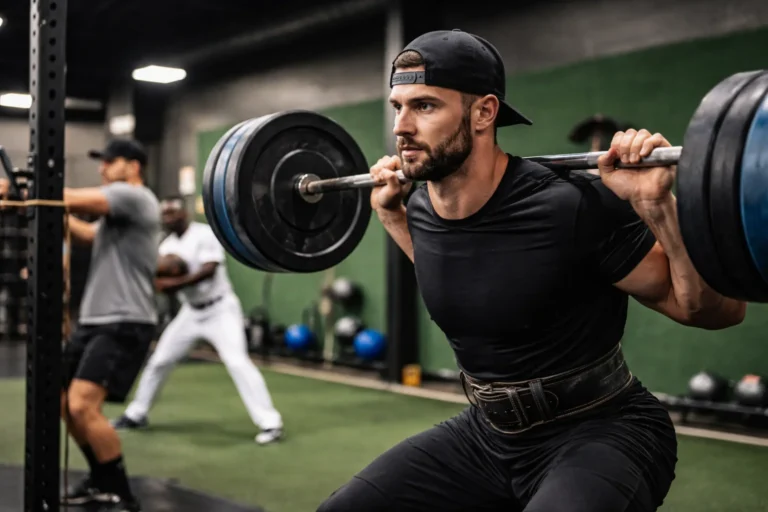
- trap bar deadlift or front squat
- bench press or incline press
- heavy row or weighted pull-up
If you want the basics of getting strong without ego lifting, read: Powerlifting basics.
Sample Max Strength Day:
- Trap bar deadlift: 5×3 (rest 2–3 min)
- Bench press: 5×3
- Chest-supported row: 4×6
- Rear-foot elevated split squat: 3×6/side
- Copenhagen plank: 3×20–30 sec/side
Pitcher focus: keep pressing volume in check; prioritize upper-back + scap strength.
Phase 4: Power Conversion (4–6 weeks)
Now you cash out.
You’re turning strength into speed.
That means:
- jumps
- sprints
- medicine ball throws
- Olympic-lift variations (only if you’ve earned them)
Start here if you’re new: Plyometric training.
Power rules (non-negotiable):
- stop sets when speed drops
- quality over fatigue
- short, crisp sessions
Sample Power Day:
- Box jump: 5×3
- Med ball rotational scoop toss: 6×3/side
- Hang clean (or KB swing): 5×3
- Trap bar jump (light): 6×2
- Sprints: 6×20–30m
If you love kettlebells, use them smart: Kettlebell complexes.
Phase 5: Preseason Bridge (2–3 weeks)
Your goal is to arrive ready.
Not tired.
This is where most athletes self-sabotage. They panic and chase PRs.
Don’t.
Goal: maintain strength and power, reduce volume, increase baseball-specific work.
What changes:
- 2 full-body lifts/week
- keep intensity moderate-high
- cut accessory volume in half
- keep jumps/throws crisp
5-phase planner (print + fill)
How to schedule lifting with throwing and hitting (without wrecking your arm)
This is a massive knowledge gap online.
Everyone tells you what to do.
Almost nobody shows you how to place it in a week.
The rule of high-quality reps
Put your highest skill work when you’re freshest.
That usually means:
- primary throwing work earlier in the day
- lifting later
- heavy lower days away from your hardest bullpen
A simple weekly template (Phase 2–4)
| Day | Skill focus | Lift focus | Why it works |
|---|---|---|---|
| Mon | Throw + light hit | Lower strength | Legs work, arm stays controlled |
| Tue | Hit + fielding | Upper strength | Pulling + scap strength dominates |
| Wed | Recovery | Optional speed/jumps | Low fatigue, keep elasticity |
| Thu | Bullpen / hard throw | Full body (lighter) | Maintain without frying you |
| Fri | Hit + sprint | Power session | Explosive work on fresh legs |
| Sat | Optional skill | Recovery | Tissue work + mobility |
| Sun | Off | Off | Real rest = progress |
If you’re squeezing training into a small space, use: Resistance bands and Strength training at home.
The 2 biggest mistakes
- Hard throwing + heavy upper + heavy lower back-to-back.
- No off switch.
If your arm never feels “fresh,” you’re not “tough.” You’re just under-recovered.
Arm care, durability, and the pain vs soreness line
You don’t need to baby your arm.
You need to train it correctly.
What arm care actually is
Arm care isn’t 40 minutes of band work.
It’s a system:
- scap control and strength
- rotator cuff endurance
- thoracic mobility
- posterior shoulder strength
- smart throwing progression
For official safety guidance (especially for youth players), use USA Baseball’s resources: https://www.usabdevelops.com/page/show/5260570-health-and-safety-resources
Pain vs soreness (simple decision rule)
- Soreness: dull, diffuse, improves during warm-up.
- Pain: sharp, specific, worsens with reps, changes mechanics.
If it’s pain, stop. Get it assessed.
Recovery readiness dashboard
Module 4: Fueling for off-season gains (simple, not fancy)
You can’t out-train under-eating.
You also can’t build power while living on energy drinks and skipped breakfasts.
The performance plate (easy rule)
- Protein: every meal
- Carbs: around training
- Fats: consistent, not excessive
- Hydration: daily, not just game days
Macro targets that actually work
| Athlete type | Protein | Carbs | Fats | Notes |
|---|---|---|---|---|
| High school (hard gainer) | 1.6–2.2 g/kg | 3–6 g/kg | 0.8–1.0 g/kg | Eat more on lift + sprint days |
| College / intense load | 1.8–2.4 g/kg | 4–7 g/kg | 0.8–1.2 g/kg | Carbs = performance fuel |
| Cutting phase (rare off-season) | 1.8–2.4 g/kg | 2–4 g/kg | 0.8–1.2 g/kg | Don’t cut hard if you need power |
Hydration matters more than most athletes think: Electrolytes for athletes.
Supplements: what’s worth it
Keep it evidence-based:
- Creatine monohydrate: Creatine guide
- protein powder if food intake is inconsistent
- electrolytes when training hard or sweating a lot
Avoid sketchy products. If you compete, use certified supplements.
👉 Recommended list of Creatine Products
👉 Recommended list of Proteine Powder
Affiliate Disclaimer: This post may contain affiliate links, which means I may receive a small commission if you make a purchase through my links, at no extra cost to you. I only recommend products I genuinely believe in and would use myself. Your support helps keep this blog running and allows me to continue creating free content to help you achieve your best skin. Thank you for support!
Module 5: How to know the program is working
Track the outcomes that show up at tryouts and showcases:
- throwing velocity (best 3 throws)
- exit velocity (best 3 swings)
- broad jump
- 10-yard split
- estimated 1RM trend on main lift
- arm feel trend (0–10)
If power is going up and the arm stays healthy, you’re winning.
And yes, progressive overload still matters: Progressive overload.
FAQ: Off-season baseball strength
1) How many days per week should I lift in the off-season?
Most players do best with 3–4 lifts per week in Phases 2–4.
- Pitchers: usually 3 lifts/week to protect arm recovery.
- Catchers / position players: often 4 lifts/week if recovery is good.
- Phase 5 (preseason bridge): drop to 2 lifts/week and keep sessions sharp.
2) Should I lift before or after throwing/hitting?
If it’s a high-intent throwing day (bullpen, velocity work), throw first and lift later.
If it’s a heavy lower day, keep throwing light and technical so your mechanics stay clean.
3) What if I don’t have a full gym?
You can still get strong and explosive with:
- dumbbells
- a pull-up bar
- resistance bands
- sprint + jump progressions
Run more unilateral work and controlled eccentrics, and keep your sprint/jump quality high.
4) How do I know if it’s pain or just soreness?
Use the rule:
- Soreness is dull and improves during warm-up.
- Pain is sharp/specific, gets worse with reps, or changes mechanics.
When in doubt: stop, and get assessed by a qualified professional.
5) What supplements are actually worth it?
Start with the basics:
- creatine monohydrate
- adequate protein
- hydration + electrolytes if needed
Food first. Supplements are the assist, not the plan.
Your next step
If you do this right, you don’t just “get in shape.”
You build a body that can:
- create more force
- express it faster
- handle more skill work without breaking
Now pick your start date, run Phase 1 with discipline, and re-test every 4–6 weeks.
Because the athletes who win in spring are the ones who built it in winter.
The Ultimate Guide to Sport-Specific Training
Stop guessing your workouts. Discover the specific protocols elite athletes use to dominate their field, court, or track.
Get the Free Guide