
Does Ashwagandha Really Boost Testosterone? If you’ve heard that claim on gym TikTok, in a group chat, or on a supplement label, you’re not alone.
And here’s the honest answer you’re looking for:
- Yes, it can help—human studies suggest ashwagandha may raise testosterone, especially in men under stress or doing strength training.
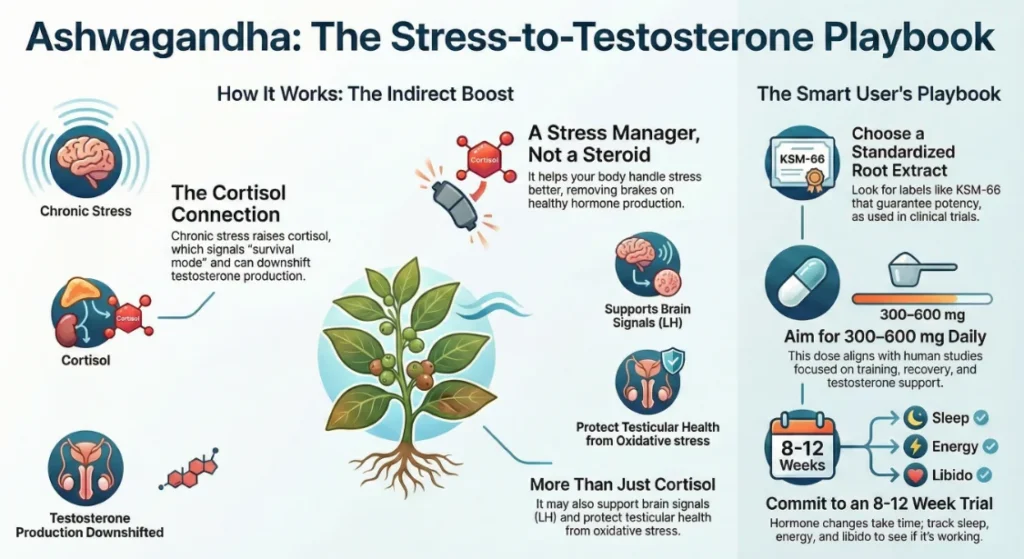
- No, it’s not a “testosterone steroid in a capsule.” The best explanation is that it helps your body handle stress better, which can remove some of the brakes on healthy hormone production.
- The details matter—extract type, dose, timeline, and your starting testosterone level change the outcome.
Quick note : This article is educational and not medical advice. If you have symptoms of low testosterone (fatigue, low libido, mood changes, infertility) or take prescription meds, talk with a qualified clinician.
What you’ll get from this guide
Most articles stop at “ashwagandha lowers stress → testosterone goes up.” That’s only half the story.
In this post, you’ll learn:
- How ashwagandha may influence testosterone beyond just cortisol
- What the best human studies actually found (and what they didn’t)
- The practical details most people miss: extract type, withanolides, dosing, timing, and cycling
- A clear 8-week plan that pairs supplements with training, sleep, and stress control
- Safety notes, who should avoid it, and when it’s smarter to get labs
Does Ashwagandha Really Boost Testosterone? Here’s the short answer
Ashwagandha (Withania somnifera) is an herb used in traditional Ayurvedic medicine. In modern research it’s often described as an adaptogen—something that may help your body handle stress.
When you look at human trials, the “testosterone boost” is real for some men, but it’s not universal.
The most accurate way to frame it
Think of ashwagandha as a hormone environment optimizer:
- If stress is high, sleep is poor, and training recovery is lagging, your testosterone output can dip.
- If you lower the chronic stress load and recover better, testosterone may rise—sometimes enough to notice.
That means ashwagandha’s best role is not “magic T booster.” It’s more like:
- Stress support
- Recovery support
- Sleep support
- And then—for some men—testosterone support
For more context on the stress side of the equation, these deep dives help:
First, what exactly is ashwagandha?
Ashwagandha is a small shrub. Most supplements use root (sometimes root + leaf). The main compounds people talk about are withanolides.
Here’s the key detail that gets missed online:
- “Ashwagandha” is not one thing.
- The effects you get depend heavily on whether you’re taking:
- plain root powder, or
- a standardized extract (the kind used in many trials)
One reliable overview of uses and safety is the NCCIH’s ashwagandha fact sheet.
The stress-testosterone connection (and why it matters)
Testosterone is not produced in a vacuum. Your body makes it inside a bigger system that responds to:
- sleep
- training load
- calories and protein
- alcohol intake
- relationship stress
- work stress
- illness
- and chronic inflammation
A simplified version:
- Chronic stress → higher cortisol
- High cortisol signals “survival mode”
- Survival mode can downshift “reproductive mode”
This is why the best foundational approach to testosterone is still boring—but powerful:
- strength training
- sleep
- food quality
- stress management
- smart recovery
If you need a refresher on the training and recovery pillars, start here:
Does Ashwagandha Really Boost Testosterone? The mechanism men miss
Most people stop at “it lowers cortisol.” That’s part of it—but not the whole story.
1) The cortisol pathway (the big one)
Ashwagandha may help some people feel less stressed and sleep better. If your cortisol output stays high for months, that can suppress testosterone.
So when cortisol comes down (or your stress response becomes smoother), testosterone can rebound.
2) Possible effects on LH (a key upstream signal)
LH (luteinizing hormone) is a signal from your brain that tells your testes to produce testosterone.
Some studies and reviews suggest ashwagandha may influence LH in certain groups, which could help explain why some men see measurable changes.
3) Oxidative stress and testicular health
Sperm and hormone production are sensitive to oxidative stress. Ashwagandha has antioxidant properties in some settings, which might support reproductive function—especially in men dealing with infertility or high stress.
The takeaway: the “boost” is usually indirect—it’s about changing the environment where testosterone is made.
What the human studies actually show (without the hype)
A lot of claims come from animal studies or marketing.
The stronger evidence comes from human randomized controlled trials—especially:
- men doing resistance training
- men dealing with stress, fatigue, or low energy
- men with fertility issues
One well-cited trial looked at ashwagandha plus resistance training—here’s the PubMed record for the study by Wankhede and colleagues:
Examining the effect of Withania somnifera supplementation on muscle strength and recovery.
Table 1: Key evidence at a glance (3 columns)
| What was studied | What they did | What changed (in plain English) |
|---|---|---|
| Strength training + ashwagandha | 8 weeks of lifting + a standardized extract | Strength and lean mass improved; testosterone rose more in the supplement group in some studies |
| Overweight/older men with fatigue | Standardized extract for ~8 weeks | Testosterone and DHEA-S increased vs placebo in one commonly cited trial |
| Male fertility / sperm parameters | Root extract in oligospermic or infertile men | Improvements in semen measures and hormone markers in some trials |
Important: “Some trials show a measurable rise” does not mean “every man will feel like a superhero.”
What changed in the studies (and what didn’t)
Here’s the part that’s usually missing from the internet summary: testosterone changes show up in specific contexts, and the improvements often come with other changes that matter more day-to-day.
In many trials, ashwagandha is linked with some combination of:
- improved training adaptation (strength/lean mass)
- improved recovery markers
- reduced perceived stress or anxiety (in some groups)
- improved sleep quality (in some studies)
That matters because a lot of men don’t actually want “a number.” They want:
- better energy
- better drive
- better workouts
- better libido
- better mood stability
So when you evaluate whether ashwagandha is “working,” don’t only stare at testosterone. Track what you can feel and what you can measure.
A simple 4-metric tracking sheet (no lab required)
For 14 days before you start, and then weekly:
- Morning energy (1–10)
- Libido (1–10)
- Training drive (1–10)
- Sleep quality (1–10)
If those improve—and your training is consistent—that’s a win even if testosterone barely moves.
Why results vary so much
Ashwagandha research has a few built-in limitations you should know:
- Small sample sizes. Many trials include dozens of participants, not thousands.
- Different extracts. Root vs root+leaf, different withanolide concentrations, different manufacturing.
- Different starting points. A stressed, sleep-deprived lifter is not the same as a relaxed guy with high-normal testosterone.
- Different endpoints. Some studies focus on fertility, some on stress, some on performance.
This explains why you’ll see headlines like “Ashwagandha boosts testosterone!” and other headlines like “No effect!” Both can be true depending on who took what and why.
Total vs free testosterone (quick clarity)
A lot of supplement conversations get sloppy here.
- Total testosterone is your overall amount in the blood.
- Free testosterone is what’s not bound tightly and is more biologically available.
- SHBG is a binding protein that can change how much testosterone is free.
Two men can have the same total testosterone but very different free testosterone.
That’s why symptoms matter—and why labs (when needed) should include more than one marker.
A reality check on “boost” size
Most responsible research summaries describe changes as modest, not dramatic.
So if you’re hoping to jump from low to elite levels with an herb alone, this won’t be your thing.
But if you’re trying to:
- recover better
- reduce stress load
- sleep deeper
- and nudge hormones in a healthier direction
…ashwagandha can be a useful tool.
Spotting marketing red flags (don’t get played)
If a label or ad says any of the following, take a breath:
- “Explodes testosterone in 7 days”
- “Works like TRT”
- “Guaranteed results”
- “Clinically proven” with no extract details, no dosage, and no study references
Real supplements show their work:
- extract type
- standardization
- study-like dosage
- quality testing
Who benefits most (baseline testosterone matters)
This is one of the biggest knowledge gaps online.
If your testosterone is low because life is crushing you
If your sleep, stress, and recovery are off, you’re the classic “ashwagandha sweet spot.”
In that situation, you’re not trying to go from normal → insane.
You’re trying to go from suppressed → normal.
If your testosterone is already healthy
You may still like ashwagandha for stress or sleep, but you might not see much movement on testosterone.
That’s not failure. That’s biology.
If you want a full food + lifestyle stack, these are worth bookmarking:
The big dosing mistake: root powder vs standardized extract
Two bottles can both say “600 mg ashwagandha.”
And one can be way stronger than the other.
Why?
Standardized extracts list the withanolide percentage (the active compounds).
Plain root powder often doesn’t.
Table 2: Choosing the right form (3 columns)
| Form on the label | What it usually means | Best for |
|---|---|---|
| Root powder | Ground root; potency varies | Budget stress support (effects may be mild) |
| Standardized root extract (e.g., KSM-66) | Consistent potency; used in many trials | Training support + stress + potential T support |
| Higher-withanolide extract (e.g., Sensoril/Shoden types) | More concentrated; often used for stress/sleep studies | Stress/sleep focus (start low if sensitive) |
A simple rule
If your main goal is testosterone support, prioritize:
- a standardized extract
- a dose that matches human trials
- consistency for 8+ weeks
How much should you take (and when)?
Most testosterone-related trials cluster around 300–600 mg/day of a standardized extract.
A practical approach (simple, not perfect)
- Week 1–2: Start lower to test tolerance.
- Week 3–8+: Move into a study-like range if you’re doing well.
Timing: morning vs evening
- Morning: may help smooth the stress response during the day.
- Evening: may support sleep quality for some men.
If sleep is your weak link, “evening” is a logical choice. If daily stress is your weak link, “morning” can make sense.
Should you take it with food?
Many people do best taking ashwagandha with a meal (less stomach upset). If it makes you drowsy, keep it for evening and pair it with dinner.
Start low, then earn your dose (a smart progression)
A lot of men jump straight into the deep end and quit after a week because they feel off.
Try this instead:
- Days 1–4: lowest label dose
- Days 5–14: move toward the middle of the label range if you feel fine
- Weeks 3–8: use a study-like daily range if your goal is performance/recovery/testosterone support
If you feel overly sedated, get vivid dreams you hate, or your stomach is upset, don’t “push through.” Adjust the timing or reduce the dose.
What matters more than the brand name
You’ll see a lot of arguments online about which trademarked extract is “best.”
The practical checklist is simpler:
- Standardized extract (not mystery powder)
- Clear daily dose you can consistently hit
- Single-ingredient option if you want a clean test (avoid massive proprietary blends)
- Third-party testing if available
If you pass those checks, you’re already ahead of most buyers.

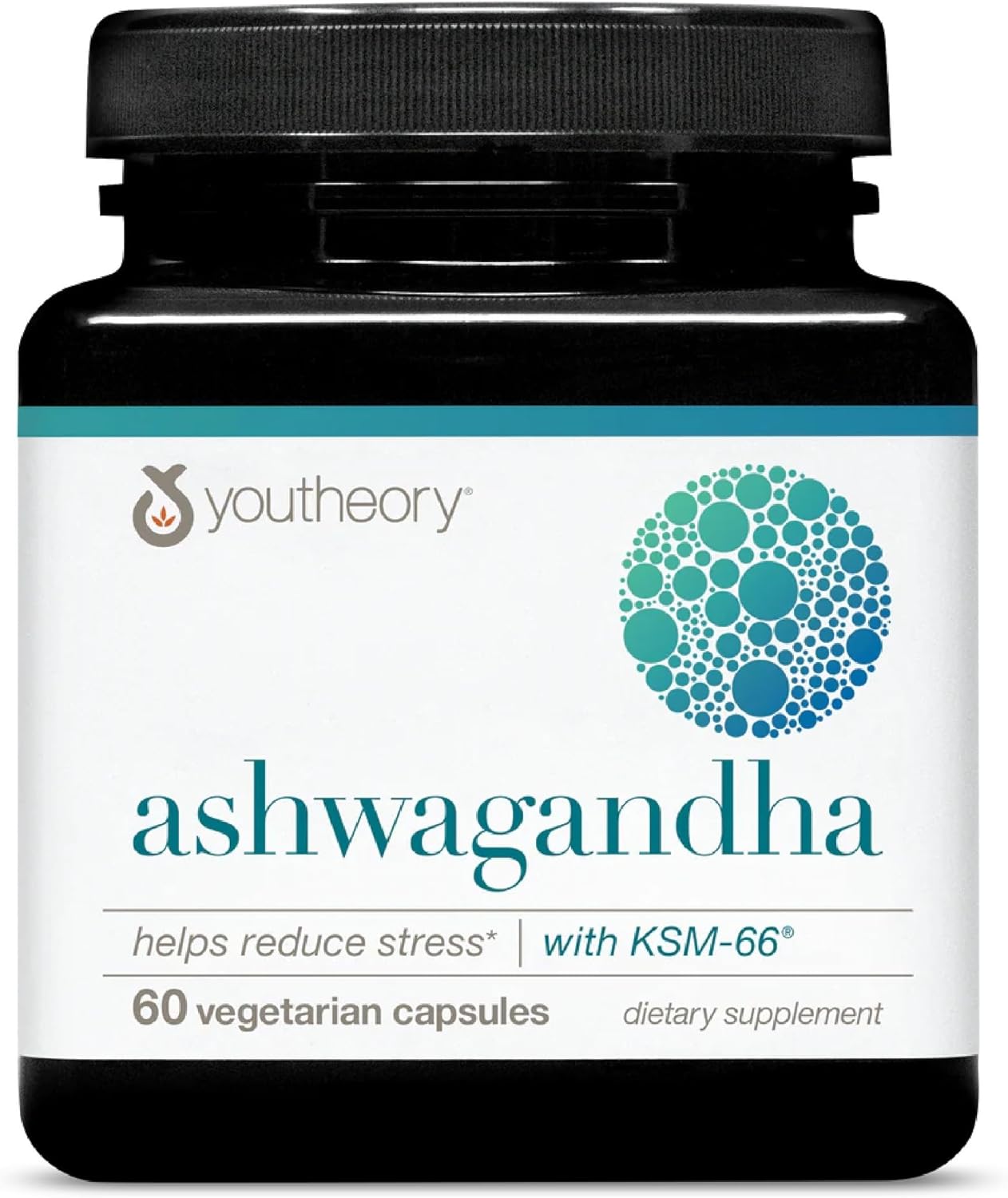
Youtheory Ashwagandha
Optimized with KSM-66® to help maintain healthy cortisol levels and support physical performance.
- KSM-66® Extract: The most studied root extract
- Full Spectrum: Designed for maximum bioavailability
- Stress Support: Targets the body’s response to fatigue
- Vegan Friendly: Plant-based 1,000mg daily dose
How to run a clean 8-week experiment (and actually know if it worked)
If you do this casually, you’ll never know what changed.
Here’s a clean approach that still fits real life.
Step 1: Pick one main outcome
Choose one:
- better sleep
- less stress / better mood stability
- improved training recovery
- improved libido/energy
You can track more than one, but don’t chase ten goals at once.
Step 2: Keep the rest stable
For 8 weeks, keep these steady:
- training schedule
- alcohol intake (or remove it entirely)
- sleep/wake time (as consistent as possible)
- caffeine cutoff (e.g., none after lunch)
Step 3: Track the simple stuff weekly
Use the 1–10 ratings from earlier (energy, libido, training drive, sleep). Add one measurable training marker:
- your 5-rep set on a key lift, or
- your total weekly training volume, or
- your resting heart rate trend
Step 4: Decide what “success” looks like
A realistic win is:
- sleep quality up by 1–2 points
- training drive up by 1–2 points
- libido up by 1–2 points
If you get that, you don’t need a dramatic lab swing to call it worthwhile.
If symptoms stay strong or get worse, it’s time to look deeper.
Should you cycle it?
You’ll hear “8 weeks on / 2 weeks off” in supplement circles.
There’s no universal rule.
If you want a conservative plan:
- Run it for 8–12 weeks
- Then take 1–2 weeks off
- Reassess how you feel and (ideally) what your labs show
How long does it take to see results?
This is another gap most articles gloss over.
A realistic timeline looks like this:
- Days 3–14: some men notice a calmer baseline or improved sleep
- Weeks 3–6: improved training recovery, mood stability, less “burnout”
- Weeks 8–12: this is when many studies measure meaningful shifts in testosterone (when shifts happen)
If you want a general guide for expectations, this helps: How long does it take testosterone boosters to work.
Ashwagandha vs other “natural testosterone” supports
Most men aren’t choosing ashwagandha in a vacuum.
They’re comparing it to:
- vitamin D
- zinc
- magnesium
- tongkat ali
- sleep aids
- sauna
- training programs
Here’s a clear way to think about it.
Table 3: Simple comparison
| Option | Best use case | What to remember |
|---|---|---|
| Ashwagandha | Stress + sleep + recovery; possible T support | Works best when stress is a bottleneck |
| Vitamin D | Low vitamin D levels; general health support | Best if you’re deficient; test if unsure |
| Lifestyle stack (training + sleep + recovery) | Everyone | The “boring basics” still win long-term |
If you want to explore other natural levers, these are great reads:
- Does sauna increase testosterone
- Exercises to boost testosterone
- Are testosterone boosters safe for men
The Testosterone System: the 4 pillars that make ashwagandha work better
If you take ashwagandha but ignore the foundations, results often disappoint.
Here’s the system that makes it “worth it.”
Pillar 1: Lift like an adult (not like a hero)
If you train hard but recover poorly, cortisol rises and motivation drops.
Use a program that builds strength without wrecking you.
- 3–4 lifts per week
- focus on big basics
- keep 1–2 reps in the tank most sets
Helpful training guides:
Pillar 2: Sleep like it’s your job
Testosterone is tied to sleep quality.
Even a great supplement can’t outwork a 5-hour sleep habit.
If you’re struggling with sleep strategies, start here:
Pillar 3: Eat for hormones (not just calories)
High-protein, nutrient-dense eating supports training, recovery, and hormones.
If you need a broader food list, use:
Pillar 4: Stress management that doesn’t feel like a cult
You don’t need incense.
You need a repeatable plan.
Two practical options:
Safety, side effects, and who should avoid it
Most men tolerate ashwagandha well, but “natural” doesn’t mean “risk-free.”
Common side effects (usually mild)
- stomach upset
- nausea
- diarrhea
- drowsiness (especially if taken at night)
Who should be extra cautious
Talk to a clinician before using ashwagandha if you:
- are on thyroid medication or have thyroid disease
- have autoimmune conditions
- have hormone-sensitive cancers or complex hormone treatment
- are planning fertility treatment
- take sedatives, anti-anxiety meds, or other meds that affect sleep/stress
Again, the NCCIH ashwagandha safety overview is a solid starting point.
Why ashwagandha might not “work” for you (4 common reasons)
This is where you build real trust—because yes, sometimes it doesn’t do much.
1) Your product is weak or inconsistent
A non-standardized powder may not hit the same effects as a studied extract.
2) Your dose is too low (or you’re inconsistent)
If you take it “sometimes,” you’ll get “sometimes” results.
3) Your baseline testosterone is already solid
If you’re already high-normal, there may be less room to move.
4) The real problem isn’t testosterone
Low libido, fatigue, and low motivation can come from:
- sleep apnea
- depression
- overtraining
- low calories
- alcohol
- thyroid issues
- relationship stress
Ashwagandha won’t solve those alone.
When it’s smarter to stop guessing and get labs
If you have persistent symptoms, the best next step is data.
A basic starting set (discuss with a clinician) might include:
- total testosterone
- free testosterone (or calculated)
- SHBG
- LH/FSH
- prolactin
- thyroid markers
- vitamin D
Once you know your baseline, you can use supplements strategically.
If you want to keep your approach safe and realistic, also review:
Frequently Asked Questions
1) How long does it take ashwagandha to increase testosterone?
Most trials that measure hormones run 8–12 weeks. Some men feel stress/sleep benefits sooner, but hormone changes take time.
2) What’s the best ashwagandha type for testosterone support?
A standardized root extract is the most consistent option when testosterone support is the goal.
3) Can I take ashwagandha with vitamin D or magnesium?
Many people stack them. But if you take prescriptions or have thyroid/autoimmune issues, ask a clinician first.
4) What are the first signs it’s working?
Often the first noticeable signals are better sleep, a calmer baseline, and improved training recovery—before you see lab changes.
5) Should I take ashwagandha every day?
If you’re testing whether it works for you, daily consistency for 8+ weeks is the cleanest experiment. Some people take short breaks after.
The bottom line
Ashwagandha isn’t a shortcut to elite testosterone.
But for the right guy, at the right dose, with the right product, it can be a meaningful lever—mostly by improving the stress and recovery environment that testosterone depends on.
If you want to do this the smart way:
- Fix sleep and stress first.
- Train consistently (not brutally).
- Use a standardized extract at a study-like range.
- Reassess at 8–12 weeks.
- If symptoms persist, get labs.